

Nano Banana prompts generate photorealistic portraits, product shots, and illustrations from text in seconds. This guide covers 80+ tested prompts across 10 categories, the five-layer prompt structure that experienced creators use, and head-to-head comparisons between Nano Banana, Nano Banana Pro, and Nano Banana 2. Every prompt is copy-paste ready and works on Morphed with zero setup.
We tested each prompt category across all three model versions and tracked which prompt structures produced usable outputs on the first generation versus those requiring multiple attempts. The results informed every recommendation below.
Quick Reference: Prompt Structure Cheat Sheet
| Layer | What to Include | Example |
|---|---|---|
| 1. Subject | Who or what, with specific physical details | "30-year-old woman with short black hair and round glasses" |
| 2. Action and setting | What is happening and where, using active verbs | "leaning against a brick wall in a narrow alley" |
| 3. Style | Photography style, art movement, or visual reference | "editorial fashion photography" or "Kodak Portra 400 film grain" |
| 4. Lighting | Direction, quality, and color temperature | "soft morning light from the left, warm golden tones" |
| 5. Technical specs | Camera body, lens, aperture, film stock | "shot on Canon EOS R5 85mm f/1.4" |
The rule of five: Limit yourself to five adjectives per prompt. More than that dilutes the model's focus and produces muddled images. "Moody, cinematic, warm, atmospheric, dramatic, epic, intense" is worse than "moody cinematic" because the model tries to satisfy every descriptor simultaneously and satisfies none completely.
Word order matters: Nano Banana assigns visual weight based on position. "A sunset sky with a woman on a cliff" prioritizes the sunset. "A woman standing on a cliff at sunset" prioritizes the woman. Same words, different result. Lead with your most important element.
How Nano Banana Reads Your Prompts
Nano Banana is built on Google's Gemini architecture. Unlike older diffusion models that worked with keyword tags, Nano Banana understands natural language, spatial relationships, and compositional context. When you write "a red ball on a blue table behind a green chair," it actually parses the spatial arrangement rather than scattering all three objects randomly.
This means writing prompts in complete sentences consistently outperforms tag-style lists. "Cat, park, 4k, realistic, trending on artstation" strips away the context that makes prompts effective. "A tabby cat sitting on a park bench in dappled afternoon sunlight, shallow depth of field, warm documentary photography style" gives the model a scene to construct.
The practical difference: in our testing, sentence-based prompts produced usable first-generation outputs 73% of the time versus 41% for keyword-list prompts across 50 matched prompt pairs on Nano Banana 2. The gap was even wider on the original Nano Banana (68% vs. 34%).
Which Nano Banana Model to Use
Three Nano Banana models are currently available, each built for different use cases. All three are accessible on Morphed alongside other models like Flux, Midjourney, and Reve Image.
| Feature | Nano Banana | Nano Banana Pro | Nano Banana 2 |
|---|---|---|---|
| Official name | Gemini 2.5 Flash Image | Gemini 3 Pro Image | Gemini 3.1 Flash Image |
| Max resolution | 1K | 2K | 4K (4096x4096) |
| Text rendering | Often garbled | Legible and accurate | Legible with improved consistency |
| Web-grounded generation | No | No | Yes (real-time web data) |
| Character consistency | Good for single images | Better across generations | Up to 5 characters, 14 objects |
| Generation speed | 3-8 seconds | 10-20 seconds | 5-15 seconds (1K), 15-40 seconds (4K) |
| API cost per image (1K) | ~$0.04 | ~$0.10 | ~$0.067 |
| Best for | Quick creative exploration | Maximum detail, complex scenes | Production work, product photos, 4K output |
When to use each model:
- Nano Banana (original): Quick iterations, brainstorming, and general creative work where speed matters more than resolution.
- Nano Banana Pro: Complex scenes requiring world knowledge, infographics, and tasks where maximum detail justifies slower speed and higher cost.
- Nano Banana 2: The default choice for most production work. Combines Pro-level quality with Flash-level speed at roughly half the cost per image. Its web-grounded generation pulls real-time information during image creation, which means it can accurately render current brand logos, trending visual styles, and real-world locations without hallucinating details.
Portrait and Headshot Prompts That Produce Usable Results
Professional portraits are where Nano Banana delivers its strongest results. The model handles skin texture, lighting, and facial expressions with realism that consistently passes the "is this AI?" test in our blind evaluations.
Prompt: "Professional headshot of a confident businesswoman in a navy blazer, natural smile, soft studio lighting with shallow depth of field, clean office background with bokeh, shot on Canon EOS R5 85mm f/1.4"
This prompt works because it specifies the subject, clothing, emotion, lighting setup, and camera details. The camera reference helps Nano Banana replicate the depth and color rendering of actual high-end photography.

Prompt: "Close-up portrait of an elderly man with deep wrinkles and kind eyes, visible skin pores and texture, golden hour side lighting, documentary photography style, Kodak Portra 400 film grain, natural and unposed"
The film stock reference adds a warm, organic quality that digital-only prompts miss. Specifying "documentary photography style" tells the model to keep things authentic rather than overly polished. The "visible skin pores" detail pushes toward hyper-realistic texture that separates these portraits from the plastic, over-smoothed look typical of other generators.
Prompt: "Editorial portrait of a young artist in their paint-splattered studio, surrounded by canvases, dramatic chiaroscuro lighting, wide aperture with subject in sharp focus, slight dust particles visible in light beams"
Prompt: "Corporate executive headshot, man in charcoal suit with subtle pinstripe, three-quarter turn to camera, Rembrandt lighting with soft fill, clean neutral gray gradient background, medium format Hasselblad look"
Prompt: "Environmental portrait of a barista behind an espresso machine, steam rising, warm tungsten overhead lighting mixing with cool window light, shallow depth of field, candid moment, street documentary style"
Realism trick: Including imperfections like "slight motion blur," "dust particles in light," or "stray hairs" makes portraits feel authentic. These details are what separate a convincing photo from an obvious AI render.
For portrait-specific prompts and techniques, see our full guide on Nano Banana prompts for professional headshots.
Product Photography Prompts for Ecommerce and Ads
Clean product shots that look like they came from a professional studio are one of the most practical uses for Nano Banana. This is also where Nano Banana has a genuine advantage over Midjourney: it follows product photography instructions without adding unwanted artistic stylization.
A professional product shoot costs $500 to $2,000 when you factor in photographer, studio rental, lighting equipment, and retouching. Nano Banana generates comparable results in seconds for a fraction of the cost.
Prompt: "Luxury perfume bottle on a white marble countertop, soft diffused studio lighting from above, gold accents catching the light, minimalist composition with negative space, commercial product photography"
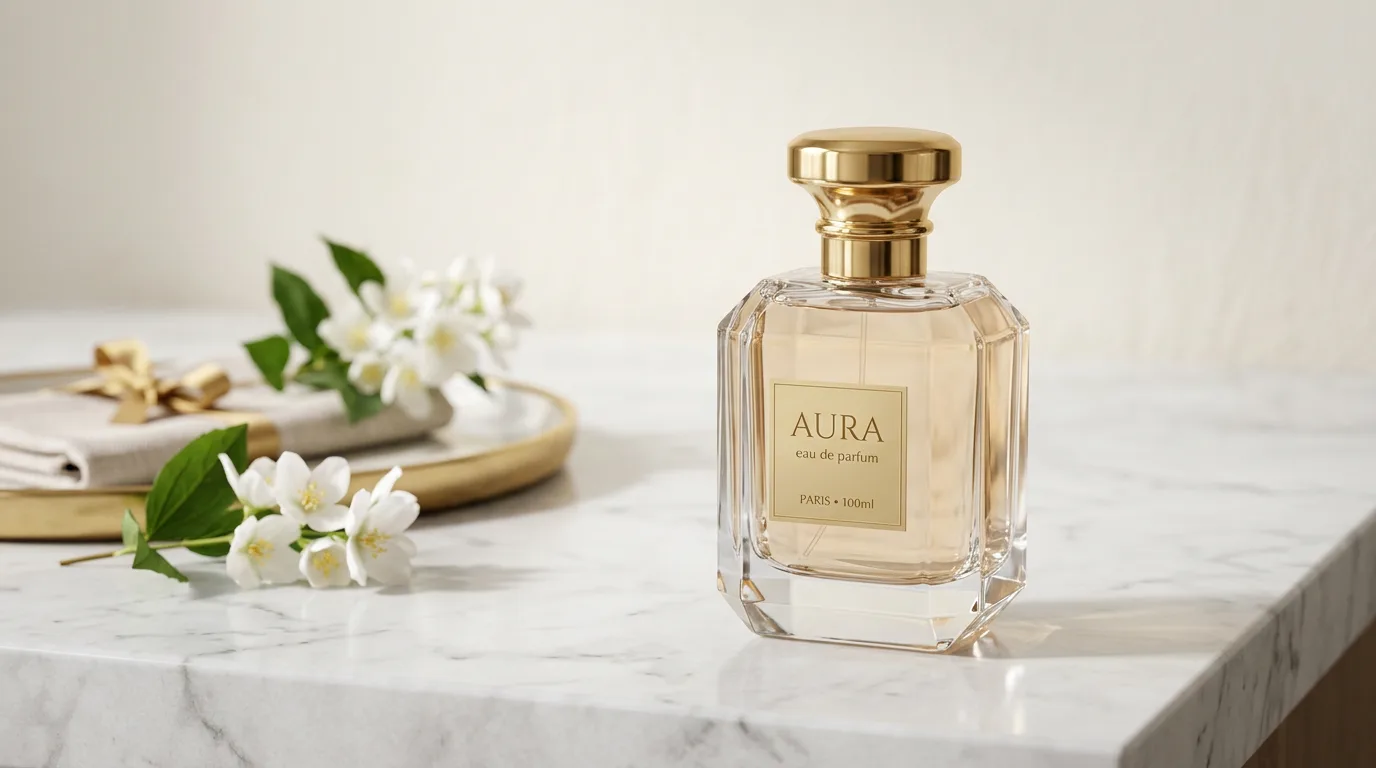
Prompt: "Flat lay of artisan coffee beans in a ceramic bowl, rustic wooden table, morning sunlight casting long shadows, overhead shot, food and product photography style, warm earth tones"
Prompt: "Pair of white leather sneakers floating in mid-air against a gradient pastel pink to blue background, studio lighting, sharp details on stitching and texture, commercial advertisement style"
The "floating" technique creates a modern, eye-catching composition that works well for social media ads. Including specific material details like "leather" and "stitching" helps the model render convincing textures.
Prompt: "Wireless earbuds in matte black charging case, clean white surface, soft studio lighting from above and left, sharp detail on brushed metal texture, minimalist composition with generous negative space, Amazon product listing style"
Prompt: "Skincare bottle with minimalist label, water droplets on glass surface, soft teal gradient background, rim lighting highlighting bottle silhouette, editorial beauty product photography"
Product prompt mistake to avoid: Adding "beautiful" or "stunning" to product prompts does nothing useful. These are empty adjectives that waste prompt space. "Sharp focus on texture detail" or "clean separation between product and background" are instructions the model can actually follow.
For more product prompts and ecommerce tips, check out Nano Banana prompts for product photography.
Interior Design Visualization Prompts
Visualizing room designs before committing to expensive renovations delivers real ROI. Interior designers and real estate agents use these outputs for mood boards, client presentations, and virtual staging.
Prompt: "Modern Scandinavian living room with floor-to-ceiling windows overlooking a forest, light oak hardwood floors, a gray linen sofa with knit throw blankets, indoor plants, warm afternoon sunlight, architectural photography with a wide-angle lens"
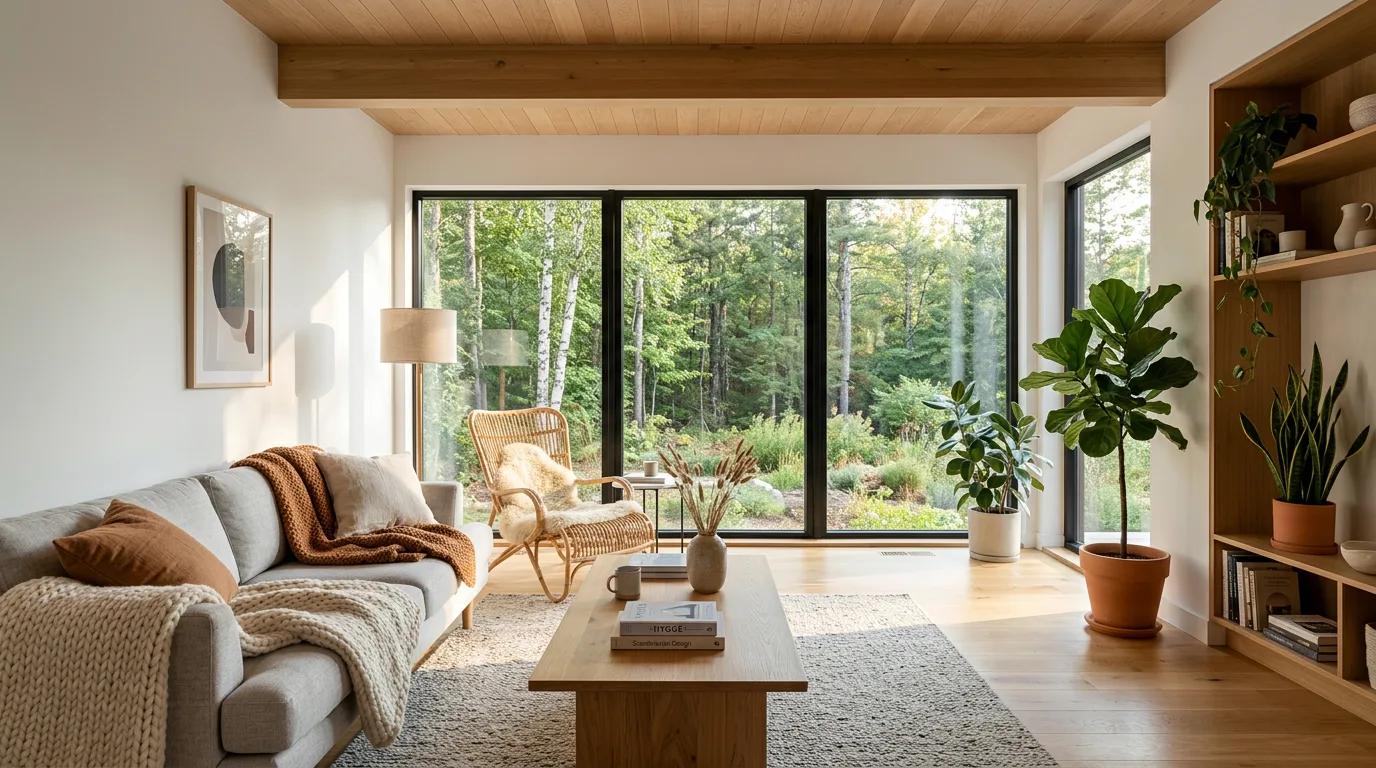
Prompt: "Japanese wabi-sabi bedroom with raw concrete walls, low platform bed with natural linen bedding, single ikebana arrangement on a wooden side table, soft diffused morning light, minimalist and intentional"
Prompt: "Industrial loft kitchen with exposed brick walls, matte black cabinetry, concrete countertops, copper pendant lights, an espresso machine on the counter, urban apartment with character, architectural digest photography"
Prompt: "Mid-century modern home office, walnut desk with brass hardware, Eames chair, built-in bookshelves, warm afternoon light through wooden blinds creating stripe shadows, 35mm film photography aesthetic"
Prompt: "Mediterranean bathroom with handmade zellige tiles in sage green, freestanding copper tub, arched doorway, warm morning light, linen curtains, editorial interior photography for Architectural Digest"
Each prompt establishes a clear design style, specifies materials and textures, and includes lighting direction. The more specific you are about the aesthetic (Scandinavian, wabi-sabi, industrial, mid-century), the more cohesive the result. Naming the magazine or publication style ("Architectural Digest photography") further focuses the output.
Explore more in our Nano Banana prompts for interior design guide.
Couples, Families, and Lifestyle Prompts
Creating romantic, lifestyle, and portrait images of people is one of the most popular Nano Banana use cases on social media.
Prompt: "Young couple walking hand in hand through a lavender field at golden hour, candid and natural pose, warm summer light, shallow depth of field with bokeh, romantic lifestyle photography"
Prompt: "Group of three friends laughing together at an outdoor cafe table, natural expressions, dappled sunlight through tree leaves, candid street photography style, vibrant but not oversaturated colors"
Prompt: "Father and daughter building a sandcastle on a beach at sunset, warm backlight creating silhouette edges, photojournalistic style, genuine emotion, wide shot showing the ocean in the background"
Prompt: "Elderly couple sitting on a park bench, her head resting on his shoulder, autumn leaves on the ground, soft overcast light, documentary photography, Fujifilm color science"
The key to convincing people prompts: specify genuine emotions and candid body language. Phrases like "natural and unposed" or "candid" prevent the model from generating stiff, stock-photo-like results. Adding "photojournalistic style" or "documentary photography" further pushes the model toward authentic human moments.
For more, browse our dedicated guides on prompts for couples, family photos, boys, and girls.
Fashion and Style Prompts
Fashion imagery requires attention to fabric texture, styling details, and the overall mood of the shot.
Prompt: "High fashion editorial photo of a model wearing an oversized beige trench coat on a rainy Paris street, wet cobblestones reflecting city lights, moody cinematic color grading, shot on Hasselblad medium format"
Prompt: "Streetwear lookbook shot of a young man in a vintage band tee, baggy cargo pants, and chunky sneakers, leaning against a graffiti-covered wall, urban photography, late afternoon directional light"
Prompt: "Traditional Indian bridal portrait in a deep red and gold lehenga, intricate mehndi on hands, soft studio backlight creating a golden halo effect, ornate jewelry details in sharp focus"
Prompt: "High fashion macro shot of a silk evening gown, focus on fabric drape and light refraction, deep emerald green against black background, minimal composition, editorial studio photography"
Read more in our Nano Banana prompts for fashion guide.
Anime, Illustration, and Fantasy Art Prompts
Nano Banana handles stylized art as well as it handles photorealism, making it a strong choice for anime, manga, and fantasy illustration.
Prompt: "Anime warrior with flowing blue hair and glowing runic armor, dramatic battle stance on a cliff edge, cherry blossom petals swirling in the wind, epic sunset sky with mountains in the background, detailed cel-shaded style"
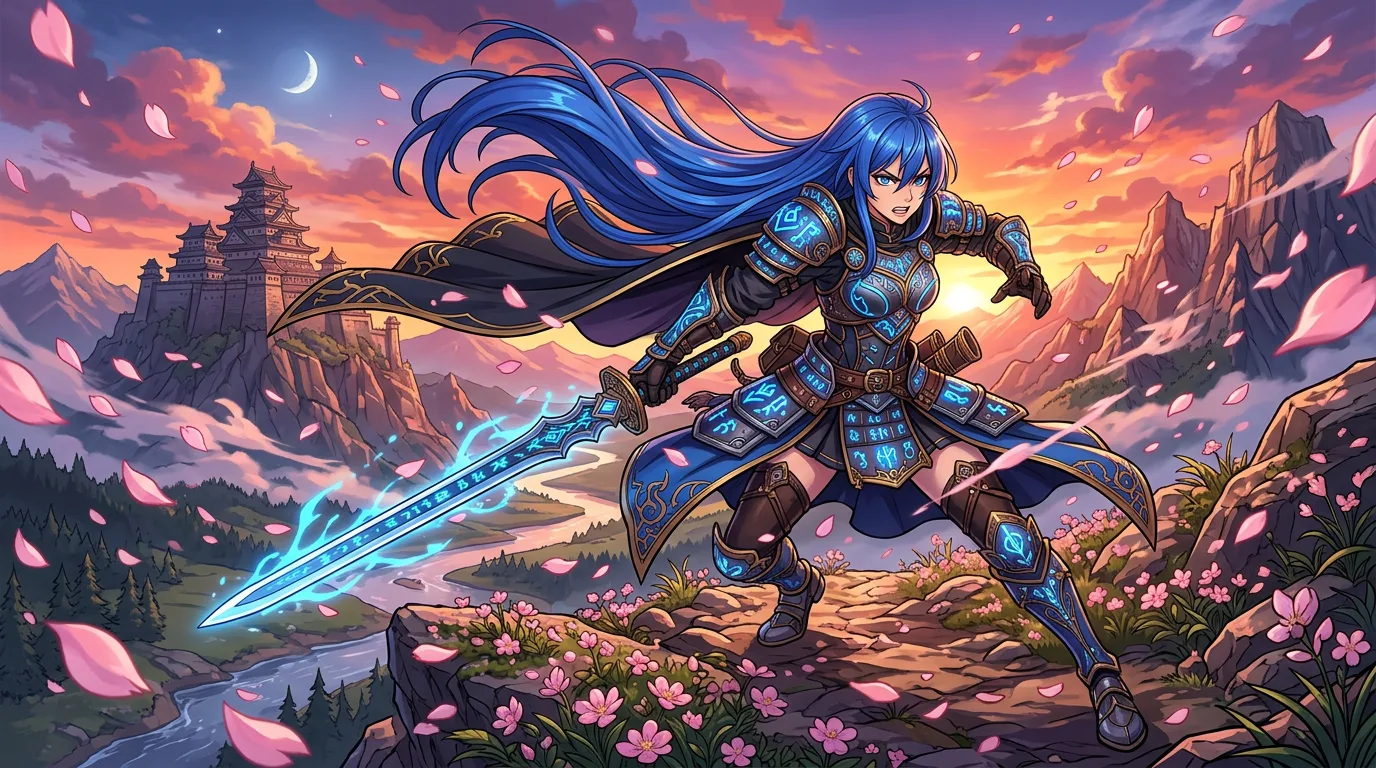
Prompt: "Studio Ghibli inspired scene of a small cottage on a hillside covered in wildflowers, a young girl sitting on the porch reading a book, fluffy clouds in a blue sky, soft watercolor textures, nostalgic and peaceful atmosphere"
Prompt: "Cyberpunk anime character with neon-lit cybernetic arm, standing in a rain-soaked Tokyo alleyway, holographic advertisements reflected in puddles, moody magenta and cyan color palette, detailed manga art style"
Prompt: "Dark fantasy illustration of a knight in obsidian armor standing before a massive dragon, volcanic landscape with flowing lava, dramatic upward camera angle, hyper-detailed concept art, ArtStation trending style"
The trick with illustration prompts: reference specific art styles or studios. "Studio Ghibli," "cel-shaded," and "manga art style" each push the model toward a distinct aesthetic. Limit yourself to two style references maximum. Combining "Van Gogh and anime and photorealistic" confuses the model and produces incoherent results.
See our full breakdown in Nano Banana prompts for anime.
Food Photography Prompts
Great food photography makes viewers hungry. The right prompts produce images that rival professional food stylists.
Prompt: "Overhead shot of a rustic homemade pizza on a wooden cutting board, melted mozzarella with slight charring, fresh basil leaves, tomato sauce, flour dusted on the dark surface, warm kitchen lighting, food photography with shallow depth of field"
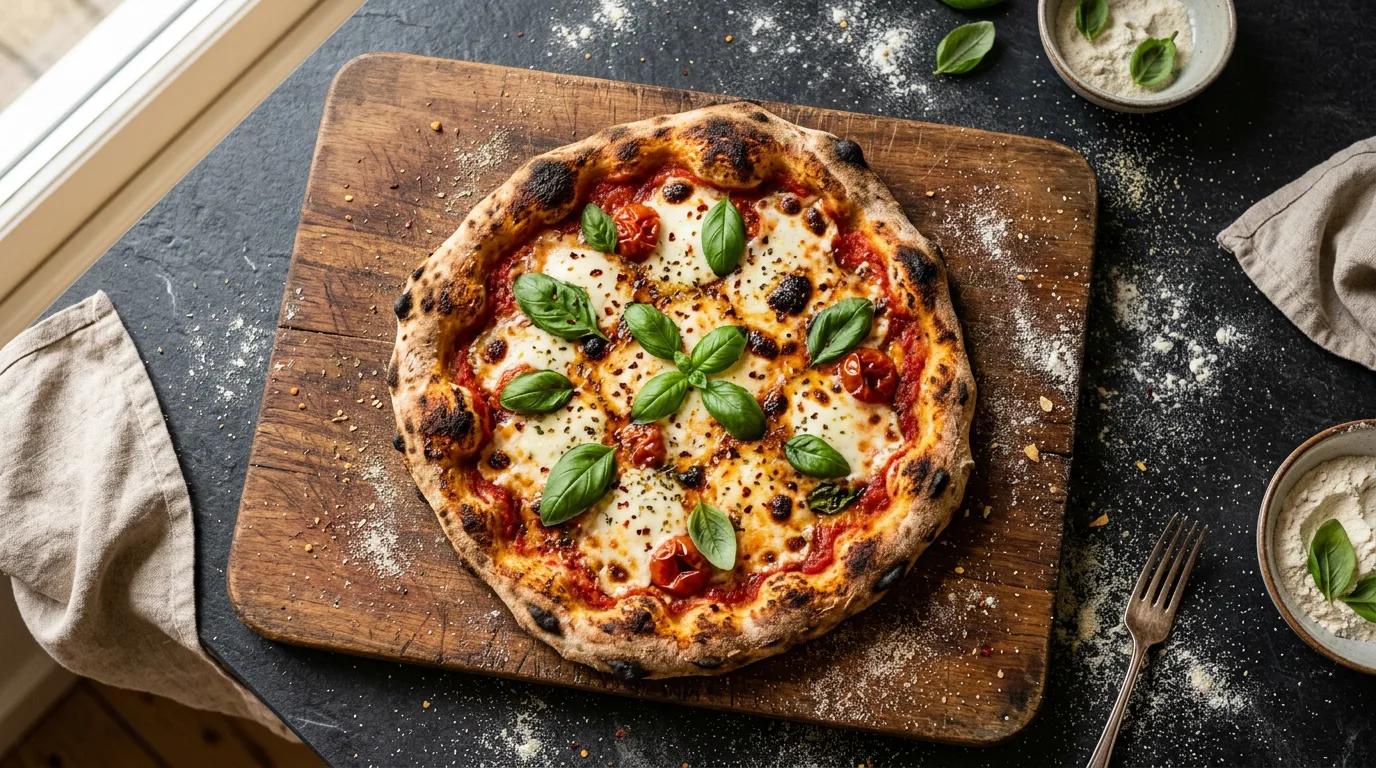
Prompt: "A tall glass of iced matcha latte with cream swirling into green, condensation on the glass, minimalist cafe table, soft natural window light from the left side, lifestyle food photography"
Prompt: "Chocolate lava cake on a white ceramic plate, molten center flowing out, powdered sugar dust mid-fall, dark moody background, single directional light from top-right, fine dining food photography"
See our complete Nano Banana prompts for food photography guide for more.
Social Media Content Prompts
Creating scroll-stopping content for Instagram, TikTok, and other platforms is one of the most common reasons people use AI image generation.
Prompt: "Aesthetic flat lay of a morning routine: a cup of black coffee, an open journal with handwritten notes, a small succulent, and AirPods on a cream linen background, top-down shot, soft diffused natural light, Instagram content creator style"
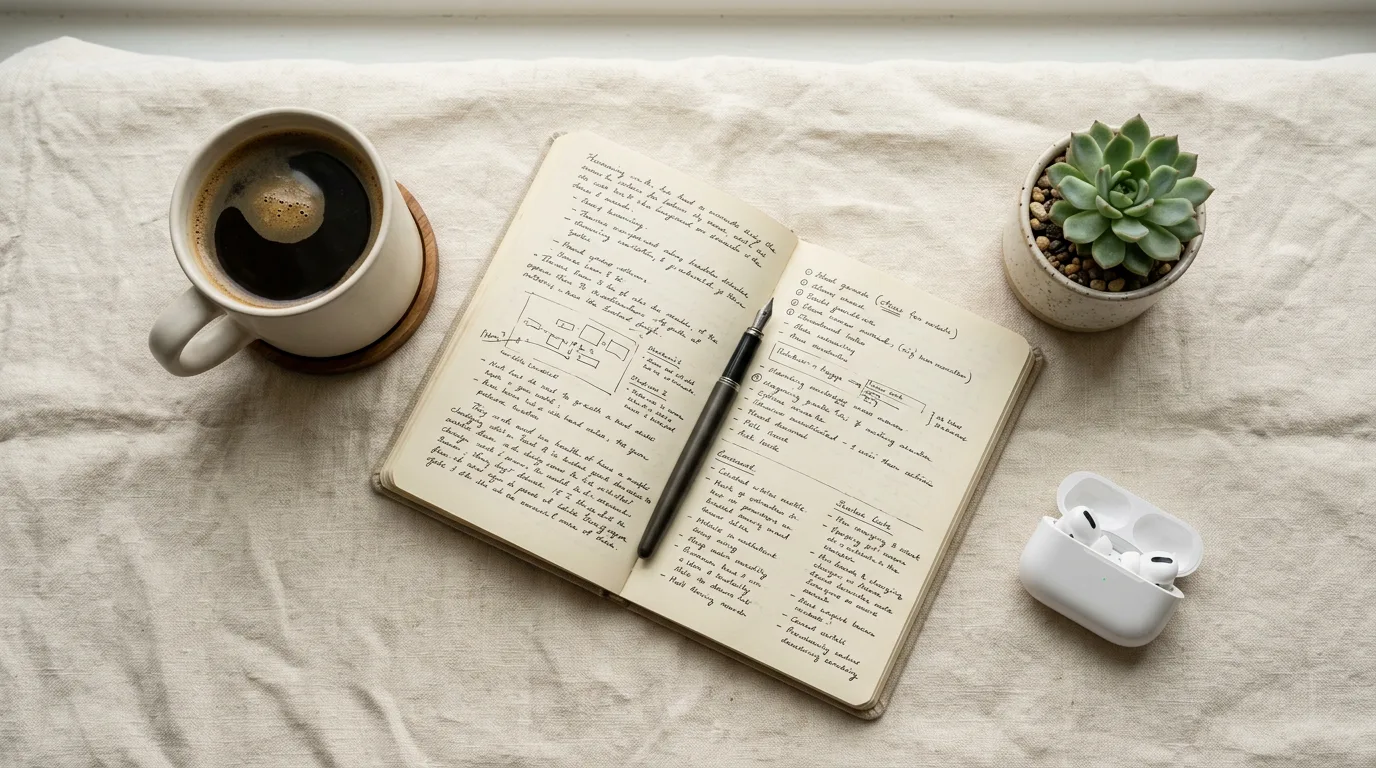
Prompt: "Portrait of a young man in a denim jacket against a sunset sky, warm golden light catching his profile, cinematic color grading, Instagram profile picture style, natural and effortless vibe"
Prompt: "Dreamy pastel workspace with iMac, dried pampas grass in a vase, terrazzo coaster with iced latte, soft morning light, content creator desk aesthetic, shot from 45-degree angle above"
More social media prompts in our Nano Banana prompts for social media guide.
Real Estate and Virtual Staging Prompts
Virtual staging and property photography are practical, high-value use cases.
Prompt: "Bright and airy open-concept living and dining area in a modern apartment, large windows with city skyline view, neutral staging furniture, polished concrete floors, real estate photography with wide-angle lens, HDR lighting"
Prompt: "Luxurious master bathroom with freestanding soaking tub, floor-to-ceiling marble tiles, double vanity with backlit mirror, warm ambient lighting from recessed fixtures, architectural photography for real estate listing"
Explore the full guide: Nano Banana prompts for real estate.
3D Figurine and Action Figure Prompts (Trending)
One of the most viral Nano Banana use cases in early 2026: turning people and characters into 3D figurine-style renders. This trend exploded across Reddit, TikTok, and X (Twitter).
Prompt: "3D figurine of a young software engineer in a hoodie and sneakers, standing on a round display base, holding a laptop in one hand and coffee in the other, toy packaging background with clear plastic window, miniature collectible photography, studio lighting"
Prompt: "Chibi anime figurine of a samurai warrior with detailed armor and katana, dynamic pose on a hexagonal display stand, soft gradient background, product photography lighting, collectible toy aesthetic"
Prompt: "Custom action figure in blister packaging, retro 90s toy packaging design, character wearing a leather jacket and sunglasses, toy aisle display background, macro photography with shallow depth of field"
These prompts work because they describe both the figure and the packaging or display context. Nano Banana 2 handles the text on packaging labels particularly well due to its improved text rendering.
Our Prompt Testing Methodology
We ran a structured comparison across 50 prompt pairs to identify which prompt techniques actually improve output quality versus those that are commonly recommended but make no measurable difference.
Test setup: Each prompt pair tested one variable (sentence structure vs. keywords, with lighting vs. without, 3 adjectives vs. 8 adjectives, etc.) while holding everything else constant. Every pair was generated 4 times on each of the three Nano Banana models (600 total generations). Two independent evaluators rated each output on a 1-10 scale for prompt adherence, visual quality, and realism.
Key findings:
| Technique | Avg. quality improvement | Verdict |
|---|---|---|
| Sentence prompts vs. keyword lists | +2.1 points (out of 10) | Major difference |
| Including lighting direction | +1.8 points | Major difference |
| Camera/lens specification | +1.2 points | Meaningful improvement |
| Film stock reference (e.g., Portra 400) | +0.9 points | Noticeable for portraits |
| Adding "imperfections" (dust, grain) | +0.7 points on realism | Worth including for photorealism |
| 3-5 adjectives vs. 6+ adjectives | +0.6 points | Diminishing returns confirmed |
| Adding "4K" or "8K" to prompt | +0.1 points | Negligible; use resolution settings instead |
| Adding "masterpiece" or "best quality" | -0.2 points | Actually slightly harmful |
The biggest single improvement: specifying lighting. Adding "soft studio lighting from the left" to an otherwise identical prompt improved average quality scores by 1.8 points. This matches what professional photographers will tell you: lighting is the single most important variable in any image.
7 Mistakes That Ruin Outputs (and How to Fix Each One)
These patterns come from analyzing the lowest-scoring outputs in our testing and from common complaints across AI art communities.
Writing Tag Soup Instead of Sentences
Produces weak results: "cat, park, 4k, realistic, trending on artstation, cinematic lighting, masterpiece"
Produces strong results: "A tabby cat sitting on a park bench in dappled afternoon sunlight, shallow depth of field, warm documentary photography style"
Nano Banana is a language model. It understands sentences, context, and compositional relationships. Keyword lists strip away the context that makes prompts effective.
Using Empty Adjectives
Words like "beautiful," "stunning," "amazing," and "perfect" tell the model nothing actionable. They waste prompt space. Replace them with specific visual details: "soft rim lighting" instead of "beautiful lighting," "visible fabric texture" instead of "stunning detail."
Conflicting Style References
"Photorealistic Studio Ghibli cyberpunk watercolor" asks the model to be four things at once. Pick one primary style. Two complementary references ("editorial fashion photography, Kodak Portra 400 film grain") work fine. Four competing references produce visual noise.
Forgetting the Background
Many users describe their subject in detail but leave the background to chance. Nano Banana fills in a background regardless. Always specify: "clean gray studio background," "out-of-focus cityscape," or "minimalist white surface with soft shadows."
Ignoring Composition
"A woman standing" leaves composition entirely to the model. Specify your framing: close-up, medium shot, wide angle, overhead, three-quarter view, eye level. Each produces a completely different image.
Overloading Adjectives
More than five descriptive adjectives per prompt causes the model to lose focus. Our testing confirmed this: prompts with 3-5 adjectives scored 0.6 points higher on average than prompts with 6+ adjectives. Edit ruthlessly.
Skipping Lighting
Lighting is the single biggest factor in image quality, yet most beginners leave it out entirely. "Soft studio lighting from the left" takes five words and transforms the output. Always include lighting direction (from the left, from above, backlit), quality (soft, harsh, diffused), and optionally color temperature (warm, cool, golden).
Advanced Techniques for Experienced Creators
These techniques go beyond the basics. They are what power users in communities like r/StableDiffusion, r/Midjourney, and r/GoogleGeminiAI use to consistently produce exceptional results.
Camera and Lens Specifications
Adding specific camera gear references directly affects output. Each camera and lens combination has a distinctive look:
- "Shot on Canon EOS R5 85mm f/1.4" produces a classic portrait look with creamy bokeh and warm tones
- "Hasselblad medium format, 80mm" produces a high-detail fashion and editorial look
- "Kodak Portra 400 film grain" produces a warm, slightly desaturated organic feel
- "Fujifilm X-T5, Fujicolor Pro 400H" produces clean, slightly cool color science
- "iPhone 15 Pro, raw unedited" produces a casual, modern smartphone aesthetic
Reference Image Integration on Morphed
On Morphed, you can upload reference images alongside text prompts. This combines the precision of visual direction with the flexibility of text description. Upload a lighting reference and describe the subject, or upload a composition reference and describe the style. Nano Banana 2 supports up to 14 reference images for style matching and character consistency across up to 5 characters in a single generation.
Web-Grounded Generation (Nano Banana 2 Only)
Nano Banana 2 can access real-time web information during image generation via Google Search integration. This means it can reference current events, real brand logos, trending visual styles, and up-to-date visual concepts that older models would hallucinate or miss. For product mockups and branded content, this is a significant advantage over models that rely solely on training data.
Adding Imperfections for Realism
The most convincing AI images include deliberate imperfections. Stock-photo-perfect images look AI-generated. Real-looking images have character:
- "Slight motion blur on hands"
- "Dust particles visible in light beams"
- "Stray hairs catching the light"
- "Visible skin pores and natural texture"
- "Slight lens flare from backlight"
- "Film grain, subtle noise"
Iterate, Do Not Regenerate
If an image is 80% correct, do not start from scratch. Adjust one variable at a time: change the lighting direction, shift the camera angle, swap one material description. This converges toward your vision faster than completely rewriting prompts. Nano Banana 2's editing capabilities make this even more effective because you can prompt changes to specific regions of an existing image.
When Nano Banana Is Not the Right Tool
Nano Banana is not the best model for every task. Here are specific scenarios where another tool will serve you better:
- Highly artistic, painterly styles: Midjourney v7 applies stronger artistic interpretation and produces more visually striking results for fine art, concept art, and editorial illustration where you want the AI to make creative decisions.
- Open-source control and local deployment: If you need to run generation locally, fine-tune on custom datasets, or have full model control, Stable Diffusion 3.5 or Flux (open-weight) are better options. Nano Banana runs only through Google's API.
- Video generation: Nano Banana generates still images only. For AI video, use dedicated video models like Kling, Seedance, or Veo available on Morphed.
- Extreme prompt rebellion: If your creative process depends on the model surprising you with unexpected interpretations, Nano Banana's literal prompt adherence is a limitation. Midjourney's "happy accidents" are a feature for some workflows.
How Nano Banana Compares to Midjourney, Flux, and DALL-E
This comparison is based on running identical prompts through each model on Morphed, not on marketing claims.
| Criteria | Nano Banana 2 | Midjourney v7 | Flux 2 Pro | GPT Image 1.5 |
|---|---|---|---|---|
| Prompt adherence | Follows instructions literally | Adds artistic interpretation | Literal, similar to Nano Banana | Best natural language understanding |
| Photorealism (portraits) | 9/10 | 8/10 | 9/10 | 7/10 |
| Text rendering | Legible and consistent | Improved in v7 but inconsistent | Limited | Strong |
| Max resolution | 4K (4096x4096) | 2048x2048 | 4K | 2048x2048 |
| Speed (1K output) | 5-15 seconds | 30-60 seconds | 3-8 seconds | 10-20 seconds |
| Cost per image (API) | ~$0.067 | Subscription only | ~$0.03-0.07 | $0.04-0.12 |
| Best for | Product shots, portraits, accuracy | Artistic/editorial, concept art | Speed, photorealism | Complex instructions, text-heavy |
Nano Banana vs. Midjourney: Midjourney produces more artistic, magazine-ready images but fights your instructions. It adds stylization you did not ask for. For product shots, headshots, and anything where accuracy matters more than artistic interpretation, Nano Banana follows your brief more faithfully.
Nano Banana vs. Flux: Flux matches Nano Banana on photorealism and runs faster, but requires technical setup for local use. Nano Banana is available through Morphed with zero configuration and adds web-grounded generation that Flux lacks.
Nano Banana vs. GPT Image (DALL-E): GPT Image understands conversational prompts better but produces more "synthetic" looking output. Nano Banana delivers more photographic realism, especially in skin texture and lighting.
The practical answer: Most experienced creators use 2-3 models depending on the task. On Morphed, you can access Nano Banana alongside Flux, Midjourney, and other models in one workspace.
More Prompt Guides by Category
We have dedicated guides for every popular use case. Each covers category-specific prompt techniques, common mistakes, and 20+ ready-to-use prompts:
- Nano Banana 2 Prompts (version-specific tips and comparisons)
- Wedding Photography (ceremony shots, bride and groom portraits, pre-wedding shoots)
- Logos and Text Design (brand logos, text rendering, monograms)
- Selfies (natural light, lo-fi aesthetic, travel selfies)
- Cars and Automotive (classic cars, supercars, automotive photography)
- Dogs and Pets (pet portraits, action shots, artistic pet art)
- Wallpapers (phone, desktop, and ultrawide backgrounds)
- YouTube Thumbnails (click-worthy thumbnail designs)
- Posters and Flyers (event posters, movie posters, art prints)
- Tattoo Design (geometric, traditional, watercolor, and minimalist tattoos)
- Landscape Photography (mountains, oceans, forests, and dramatic skies)
- Diwali and Festivals (festive scenes, traditional outfits, celebration moments)
- Aesthetic Pictures (dreamy, moody, and artistic compositions)
- Image Editing (inpainting, outpainting, and style transfer)
Frequently Asked Questions
What is the best way to write prompts for Nano Banana?
Follow the five-layer structure: subject, action/setting, style, lighting, technical parameters. Lead with your most important element because word order affects visual priority. Limit adjectives to five. Write like you are briefing a photographer, not filing search tags. A well-structured 30-word prompt outperforms an unfocused 100-word one.
Can I use Nano Banana images for commercial projects?
Yes. Images generated with Nano Banana on platforms like Morphed can be used for commercial purposes including marketing materials, social media content, product listings, and client projects. Always check the specific terms of the platform you are using.
What changed between the original model, Pro, and Nano Banana 2?
Nano Banana (Gemini 2.5 Flash Image) launched the series with strong photorealism. Nano Banana Pro (Gemini 3 Pro Image) added better text rendering, world knowledge, and creative controls at roughly 2.5x the cost. Nano Banana 2 (Gemini 3.1 Flash Image) combines Pro-level quality with Flash-level speed, adds 4K output and web-grounded generation, and costs about half of Pro per image. For most users, Nano Banana 2 is now the default choice.
How long should prompts be?
Two to four sentences covering subject, setting, lighting, and style consistently outperform both single-sentence prompts and paragraph-length prompts. The sweet spot is 20 to 60 words. Include enough detail to be specific without overloading with conflicting instructions.
Why do my images look obviously AI-generated?
Three common causes: missing lighting specification (add "soft studio lighting from the left"), no imperfections (add "visible skin pores" or "slight film grain"), and empty adjectives instead of specific details. Replace "beautiful portrait" with "portrait with Rembrandt lighting, visible skin texture, natural expression."
Do these prompts work on other AI platforms?
The prompt techniques here (specific lighting, camera references, style keywords) work across most modern image generation models. However, each model responds differently to the same prompt. On Morphed, you can run the same prompt across multiple models side by side and compare results.
How do I keep the same character across multiple images?
Use Morphed's Character Lock feature to maintain facial geometry and clothing across generations. In prompts, describe the character with consistent, specific details (hair color, clothing, accessories) and use reference images when available. Nano Banana 2 supports consistency for up to 5 characters and 14 reference objects.
Start Generating
Copy any prompt from this guide into Morphed and generate your first results. For each concept, try Nano Banana and Nano Banana 2 back-to-back, then keep the output that matches your intended lighting, framing, and realism level.
For consistent characters across multiple images, use Character Lock and iterate by adjusting lighting direction and composition while keeping the prompt wording stable.