

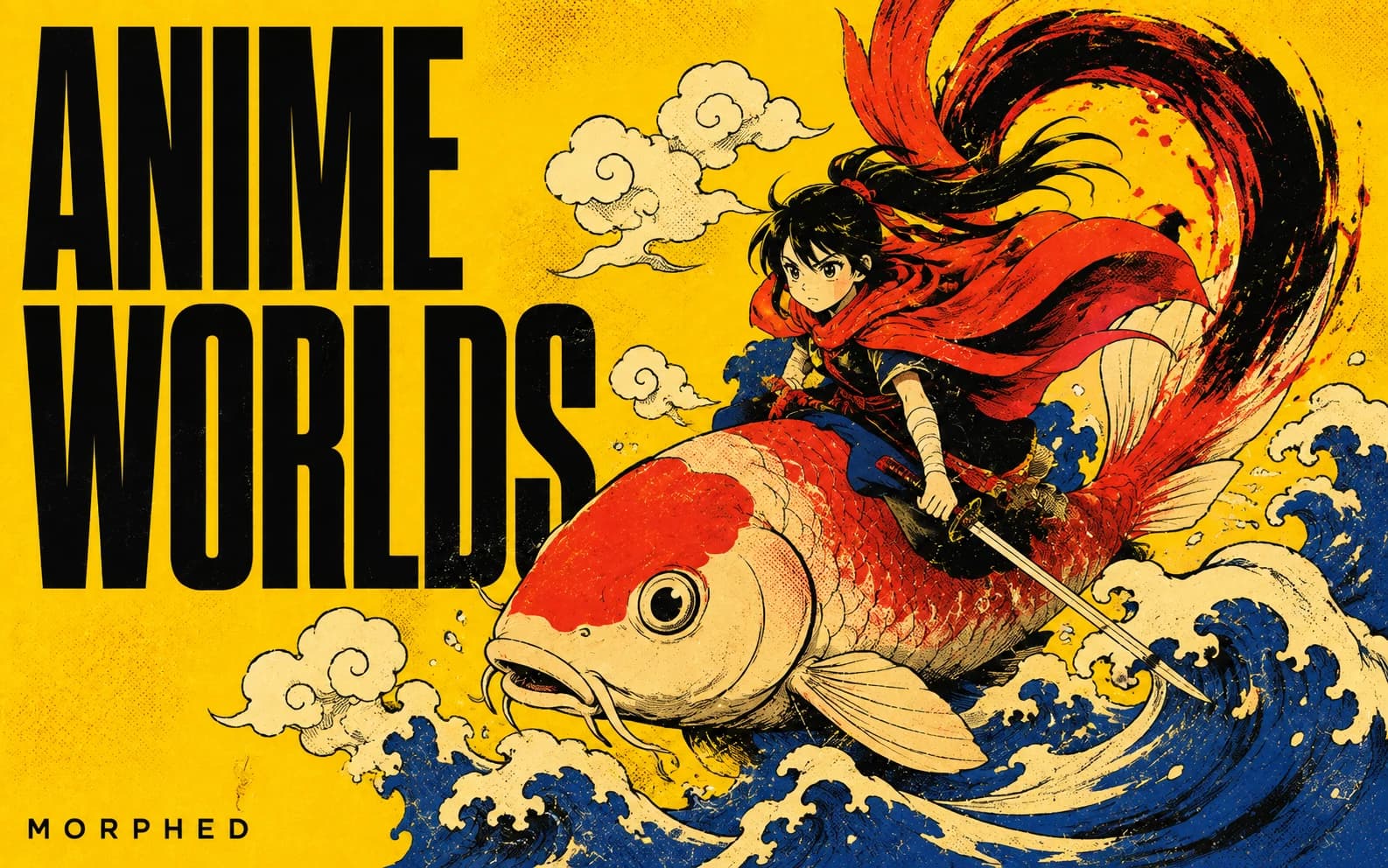
Nano Banana generates anime illustrations that compete with dedicated illustration models, but only when your prompt structure matches the sub-style you want. The single biggest mistake: combining conflicting style references like "photorealistic Studio Ghibli cyberpunk watercolor." That produces incoherent output every time. One style anchor per prompt is the rule.
This guide covers 25+ copy-paste Nano Banana prompts for anime across six sub-styles, the structural technique that separates clean results from visual noise, and a prompt-format comparison showing when plain text outperforms JSON formatting for anime generation on Morphed. These prompts are written for Morphed's Nano Banana 2 model.
| Style | Best For | Color Palette | Key Prompt Anchors |
|---|---|---|---|
| Shonen action | Battle scenes, power-ups, key visuals | Warm reds, golds, high contrast | "shonen manga style," "dynamic action pose," "sharp linework" |
| Slice-of-life / Ghibli | Everyday moments, emotional depth | Soft pastels, warm golden hour | "Studio Ghibli inspired," "soft watercolor textures" |
| Cyberpunk sci-fi | Neon cities, mecha, futuristic tech | Magenta, cyan, neon reflections | "cyberpunk anime style," "Blade Runner influence" |
| Chibi / kawaii | Cute characters, stickers, mascots | Pastel rainbow, pink, cream | "chibi," "kawaii style," "clean vector-like" |
| Dark fantasy / horror | Knights, witches, unsettling scenes | Deep purples, blacks, red accents | "dark fantasy manga style," "Junji Ito-inspired" |
| Toy photography | Action figures, collectibles, dioramas | Studio lighting, colored gels | "toy photography style," "miniature scale visible" |
For a broader overview of the model, see our complete Nano Banana prompts guide. For related creative directions, explore Nano Banana prompts for aesthetic pictures and Nano Banana 2 prompts.
Why Does Nano Banana Handle Anime Better Than Dedicated Illustration Models?
Dedicated anime AI models tend to produce one look: saturated colors, similar face shapes, generic backgrounds. Nano Banana gives you more control because it was built for photorealism first, which means its lighting engine, composition logic, and material rendering transfer into illustrated styles with unusual precision. You can prompt for specific anime sub-styles (90s cel-shading, watercolor manga, modern digital illustration) and get meaningfully different results each time.
Nano Banana Pro (Gemini 3 Pro Image) adds compositional reasoning, which matters for multi-panel manga layouts and complex scenes with multiple characters. Nano Banana 2 (Gemini 3.1 Flash Image) combines Pro-level detail with faster generation, making it the strongest choice for intricate character designs with layered costumes and accessories. All three versions are available on Morphed.
The Single Rule That Fixes Most Failed Anime Prompts
Most anime prompts fail because they combine conflicting style references. "Photorealistic Studio Ghibli cyberpunk watercolor anime" asks the model to satisfy four incompatible aesthetics simultaneously. The result is visual noise that looks like none of the referenced styles.
The rule: Pick one primary style anchor and stick with it. You can add one complementary modifier, but no more.
- "Shonen manga style, vibrant colors" works because shonen and vibrant colors are complementary
- "Studio Ghibli inspired, soft watercolor textures" works because Ghibli and watercolor align naturally
- "Cyberpunk anime, Blade Runner neon aesthetic" works because both reference the same visual language
- "Studio Ghibli photorealistic cyberpunk manga shonen" produces incoherent output
The style keyword is the single most important element in any anime prompt. Get it right and the lighting, color, and composition follow.
Plain Text vs. JSON Prompts: Which Format Works Better for Anime?
Google's official Nano Banana documentation recommends JSON-formatted prompts for structured illustration work. In practice on Morphed, each format tends to suit different kinds of anime scenes.
| Format | Best For | Weakness |
|---|---|---|
| Plain text | Single characters, atmospheric scenes, simple compositions | Multi-character layouts, precise positioning |
| JSON structured | Manga panels, character sheets, multi-element scenes | Overly rigid for mood-driven art |
Plain text example: "Anime warrior in flowing cape, dynamic action pose mid-leap, energy aura surrounding fists, dramatic backlighting, shonen manga style, sharp linework, vibrant red and gold color palette"
JSON example for the same concept: "Generate an image with these specs: { subject: anime warrior with flowing cape, pose: dynamic mid-leap action, effects: energy aura around fists, lighting: dramatic backlighting, style: shonen manga with sharp linework, colors: vibrant red and gold }"
For single-character anime scenes (the majority of this guide), plain text performs well. Switch to JSON when you need precise spatial control: manga page layouts, character sheets with multiple views, or scenes with three or more characters.
Shonen Action Anime Prompts
Shonen action anime emphasizes dynamic poses, dramatic lighting, and high-energy battle or power-up scenes. These prompts produce the kind of illustrations you would see as a key visual on a manga volume cover.
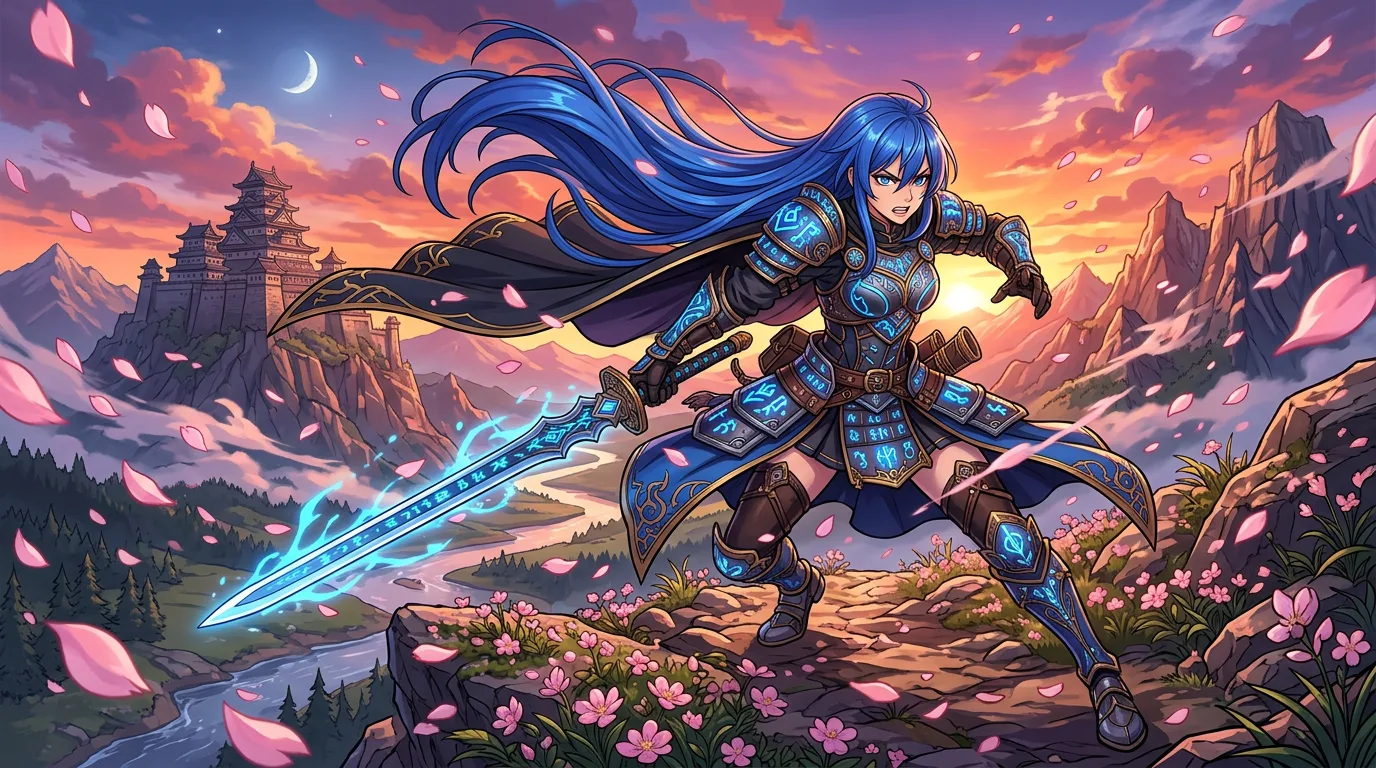
Prompt: "Anime warrior in flowing cape, dynamic action pose mid-leap, energy aura surrounding fists, dramatic backlighting, shonen manga style, sharp linework, vibrant red and gold color palette, epic battle scene"
The energy aura and dynamic pose are hallmarks of shonen. "Sharp linework" and "shonen manga style" give the model clear stylistic references. The color palette (red and gold) is deliberately chosen because shonen art uses warm, high-energy colors.
Prompt: "Young male anime protagonist with spiky hair, determined expression, power-up transformation moment, lightning crackling around body, dark stormy sky background, anime key visual style, high contrast"
"Key visual style" is the term for the promotional illustrations used on anime posters and Blu-ray covers. It signals a highly polished, high-impact composition that showcases a character at their most dramatic.
Prompt: "Anime swordsman in traditional samurai armor, katana drawn mid-slash with motion trail, cherry blossom petals falling, dramatic side lighting, detailed fabric and metal textures, anime film quality, cinematic 2.35:1 composition"
Cherry blossoms and samurai imagery create a classic anime aesthetic. Adding a specific aspect ratio (2.35:1 cinematic) produces a widescreen composition that reads like a movie still.
Prompt: "Two anime rivals facing each other in battle stance, split composition with different color lighting on each side, warm orange on the left and cool blue on the right, dramatic tension, shonen manga cover art style"
The split-color technique is used in actual manga covers to show conflict between characters. Specifying it gives Nano Banana a clear compositional instruction that single-subject prompts do not need.
Slice-of-Life and Studio Ghibli Style Prompts
Slice-of-life and Studio Ghibli-inspired prompts favor soft colors, gentle lighting, and everyday moments with emotional depth. These work best with Nano Banana because its photorealistic lighting engine renders atmospheric effects (rain on glass, steam, golden hour) with more subtlety than flat illustration models.
Prompt: "Anime girl sitting by a window with a cup of tea, soft rain on glass, cozy room with plants and books, Studio Ghibli inspired, warm pastel colors, gentle and contemplative mood"
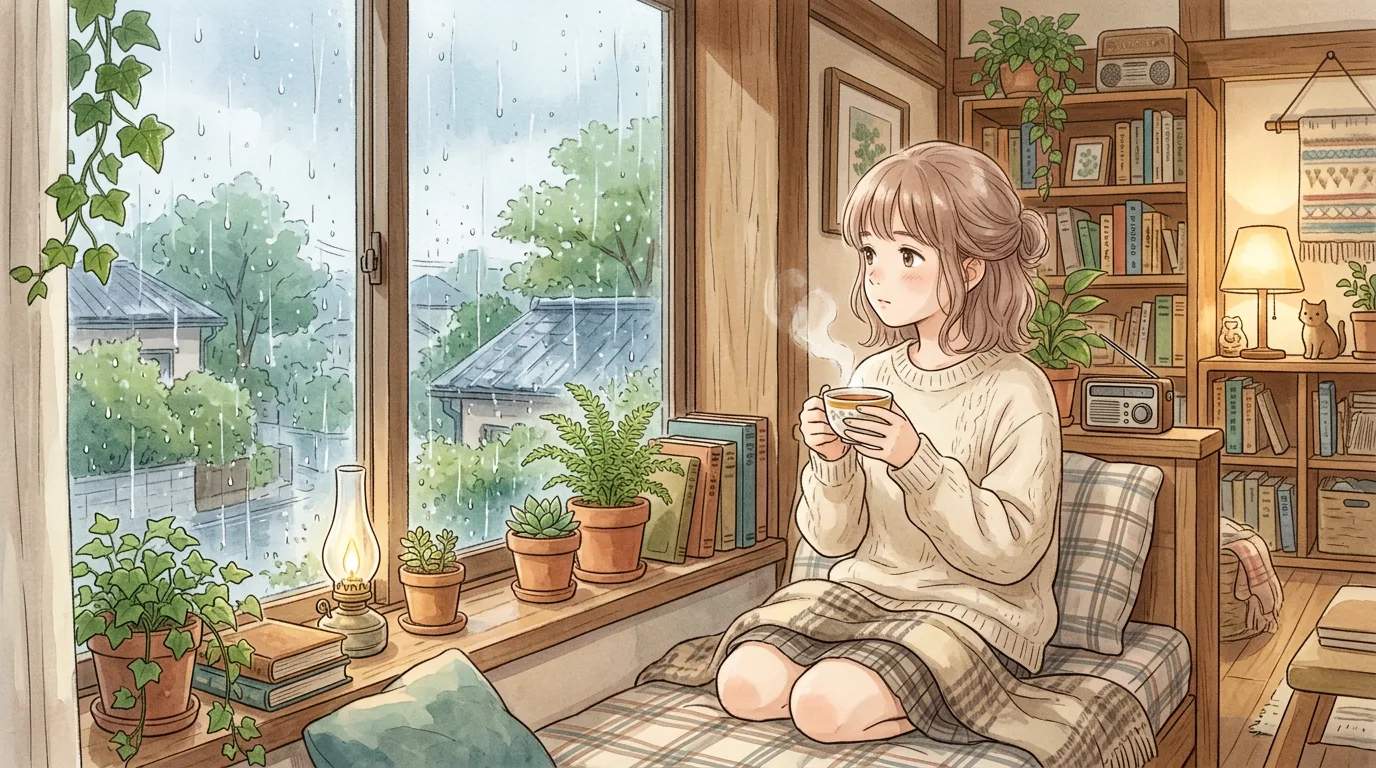
Window scenes and rain are quintessential slice-of-life imagery. "Studio Ghibli inspired" evokes the soft, hand-drawn feel of Hayao Miyazaki's films: natural textures, warm lighting, and backgrounds that feel alive with detail.
Prompt: "Anime boy walking through a sunlit meadow with wildflowers, wind in his hair, soft watercolor-like background, slice-of-life anime style, peaceful and nostalgic, Makoto Shinkai color palette"
Adding a specific director's name ("Makoto Shinkai color palette") gives the model a precise color reference. Shinkai is known for vivid, saturated skies and hyper-detailed backgrounds, and Nano Banana interprets this as higher color saturation in sky and environment areas.
Prompt: "Cozy anime cafe interior, steam rising from coffee cups, warm wooden furniture, cat sleeping on a window seat, soft golden hour light through windows, slice-of-life anime, detailed background, inviting atmosphere"
Detailed backgrounds are the hallmark of quality slice-of-life anime. Specifying concrete elements (cat, window seat, steam, wooden furniture) prevents the model from generating a generic interior.
Prompt: "Anime character on a bicycle riding down a tree-lined path in autumn, golden leaves falling, warm afternoon light, Studio Ghibli style, nostalgic and bittersweet, wide establishing shot"
"Wide establishing shot" is cinematography language that Nano Banana understands. It places the character small in the frame with the environment as the visual star, which is how Ghibli films frame contemplative moments.
Cyberpunk and Sci-Fi Anime Prompts
Cyberpunk and sci-fi anime combine neon lighting, futuristic settings, and high-tech aesthetics. The color palette does most of the heavy lifting here.
Prompt: "Anime cyborg girl with neon-lit cybernetic arm, rain-soaked neon city street at night, reflections in puddles, cyberpunk anime style, magenta and cyan color palette, Blade Runner influence"
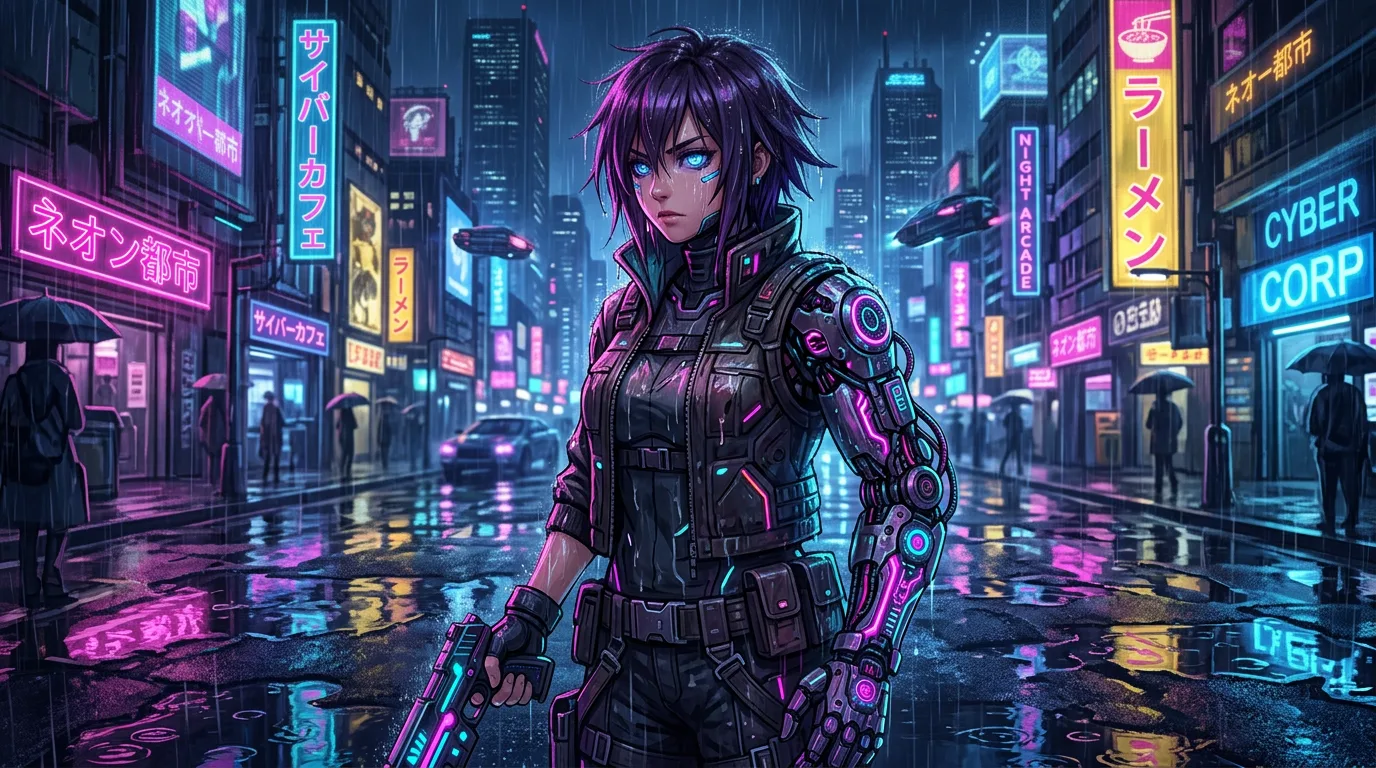
Neon and rain define cyberpunk. The color palette (magenta and cyan) keeps the output cohesive. "Blade Runner influence" is a strong visual anchor without copying it directly.
Prompt: "Anime mecha pilot in cockpit, holographic displays and controls glowing, dramatic cockpit lighting casting colored shadows on face, sci-fi anime style, detailed mechanical elements, tense atmosphere"
Colored shadows from holographic displays add visual interest and mood. "Detailed mechanical elements" pushes the model to render convincing cockpit technology rather than vague glowing shapes.
Prompt: "Anime character in futuristic city, flying vehicles in background, holographic advertisements in Japanese and English text, night scene with neon signs, Akira-inspired aesthetic, bold linework, fisheye lens perspective"
Specifying "fisheye lens perspective" creates the distorted, immersive viewpoint that cyberpunk art uses to convey overwhelming urban scale. The Akira reference is one of the strongest cyberpunk anchors available because the model has extensive training data for this aesthetic.
Character Sheets and Multi-View Consistency
Character consistency across multiple images is one of the most requested anime use cases, and it is where prompt structure matters most. A character sheet gives Nano Banana a visual blueprint to reference.
Prompt: "Anime character sheet, front view, side view, and three-quarter view of a female knight with silver armor and red cape, short white hair, detailed expression range showing neutral, determined, and happy, clean white background, professional character design reference sheet"
The key phrase is "character sheet" combined with explicit view angles. Adding "clean white background" and "reference sheet" signals the model to produce a design document rather than an illustrated scene.
Prompt: "Anime character turnaround sheet, male sorcerer in dark robes with glowing blue runes, four poses: standing, casting spell, walking, sitting, consistent proportions across all views, character design style"
For multi-pose sheets, list the exact poses you want. Nano Banana Pro handles multi-view consistency better than the base model because its compositional reasoning keeps proportions stable across views. Use it on Morphed when character sheets are the priority.
To maintain the same character across separate generations (not a sheet), use the same style keyword, color palette, and lighting in every prompt as a fixed base. On Morphed, Character Studio trains a reusable character from your photos to generate consistent realistic images of that character.
Manga Panel Layouts
Full manga page layouts require structured prompts. This is where JSON formatting outperforms plain text.
Prompt: "Full manga page layout, four panels arranged in a dynamic grid, action sequence of an anime swordsman: panel 1 close-up of eyes narrowing, panel 2 wide shot drawing sword, panel 3 diagonal slash with motion lines, panel 4 aftermath with opponent falling, black and white manga style with screentone shading, dramatic pacing"
Specify "manga page layout" (multiple panels) rather than "manga illustration" (single image). Describe each panel's content and shot type individually. Black and white with screentone shading produces the most authentic manga aesthetic.
Prompt: "Single manga page, romantic slice-of-life, three panels: top panel wide shot of cherry blossom-lined school path, middle panel medium shot of two characters walking together, bottom panel close-up of hands almost touching, shojo manga style, delicate linework, flower motif borders"
For shojo (romance) manga, "delicate linework" and "flower motif borders" are genre-specific cues. The panel sequence (wide to medium to close-up) creates natural visual pacing that reads authentically.
Action Figure and Toy Photography Prompts
These prompts produce images that look like professional toy photography, featuring collectible figures in dramatic poses with studio lighting and creative backgrounds.
Prompt: "Action figure of anime character on rocky terrain diorama, dramatic low-angle shot, soft studio lighting with rim light separating figure from background, toy photography style, sharp focus on figure, miniature scale visible"
Low angles make figures look heroic. "Miniature scale visible" ensures the image reads as a toy photo rather than a full-size character. This is the single detail that separates toy photography from regular character illustration.
Prompt: "Vinyl designer toy figure on gradient background, soft diffused key light from upper left, clean product-style shot, collectible toy photography, sharp details on sculpt, glossy surface reflections"
Product-style framing with a gradient background is the standard for collectible photography. The glossy surface reflections sell the material quality of a vinyl figure.
Prompt: "Action figures in battle pose on urban diorama base, dramatic lighting with colored gels, warm orange from left and cool blue from right, dust and debris effects, dynamic composition, toy photography for social media"
Colored lighting gels are a real toy photography technique. Specifying opposite warm and cool colors on different sides creates dramatic tension that makes the image shareable.
Chibi and Kawaii Style Prompts
Chibi and cute anime styles feature oversized heads, simplified features, and an adorable, approachable aesthetic. These translate well to stickers, profile pictures, and merchandise.
Prompt: "Chibi anime character with big eyes and small body, holding a giant cupcake, pastel pink and cream background, kawaii style, soft rounded shapes, cute and cheerful, clean vector-like illustration"
"Clean vector-like illustration" pushes toward the graphic, clean-edged chibi style rather than painterly rendering. This produces output suited for digital stickers and print merchandise.
Prompt: "Cute anime animal mascot character, fluffy texture, holding a heart, pastel rainbow color palette, sticker-style illustration, simple and charming, flat design with subtle shadows"
"Sticker-style" and "flat design" are the key modifiers for merchandise-ready output. The flat design with subtle shadows creates depth without the complexity that breaks at small print sizes.
Prompt: "Chibi anime couple holding hands, cherry blossom background, soft watercolor style, romantic and sweet, Valentine's day aesthetic, surrounded by floating heart shapes"
Dark Fantasy and Horror Anime Prompts
A category most prompt guides skip entirely. Dark fantasy anime has a large audience and a distinct visual language that Nano Banana handles well because its lighting engine renders atmospheric effects (fog, volumetric light, fire) convincingly.
Prompt: "Dark fantasy anime knight in obsidian armor, standing before a massive dragon, volcanic landscape with flowing lava, dramatic upward camera angle, hyper-detailed concept art style, dark and epic atmosphere"
Prompt: "Anime witch in a gothic forest, floating grimoire with glowing pages, moonlight through twisted branches, purple and green color palette, dark fantasy manga style, atmospheric fog"
The purple and green palette is deliberate. Dark fantasy uses cool secondary colors (purple, green, deep blue) rather than warm primaries. This palette signals the genre before the viewer consciously processes the content.
Prompt: "Horror anime scene, abandoned school hallway with flickering fluorescent lights, single figure standing at the end, unsettling atmosphere, muted desaturated colors with single red accent, Junji Ito-inspired aesthetic"
The Junji Ito reference is powerful for horror. His distinctive style of unsettling, hyper-detailed linework creates a specific visual language the model interprets well. The single red accent against desaturated tones is a horror composition technique that draws the eye to the source of dread.
When Nano Banana Is the Wrong Choice for Anime
Nano Banana handles stylized illustration well, but it is not the right tool for every anime use case:
- Frame-by-frame animation sequences. Nano Banana generates single images. If you want to turn anime art into motion, use Morphed's AI anime video generator or browse our best AI video generators guide instead.
- Pixel-perfect manga typesetting. While Nano Banana Pro renders text better than the base model, manga text placement (speech bubbles, sound effects with specific Japanese typography) still requires post-processing in a layout tool like Clip Studio Paint.
- Reproducing a specific existing artist's exact style. If you need output that matches a particular manga artist's linework precisely, fine-tuned specialist models trained on that artist's work will outperform a general-purpose model. Nano Banana gives you style families (shonen, Ghibli, cyberpunk), not individual artist clones.
- Very large multi-character scenes (6+ characters). Composition breaks down with too many subjects. Nano Banana 2 handles up to five characters reasonably well; beyond that, generate characters separately and composite.
Prompt Engineering Tips for Stronger Anime Results
-
Pick one style anchor. "Shonen manga," "Studio Ghibli," "cyberpunk anime," and "chibi kawaii" each produce distinct results. Do not combine more than two.
-
Name specific directors or studios when useful. "Makoto Shinkai color palette," "Akira-inspired," "Studio Ghibli" give the model precise visual references. Vague "anime style" produces generic output.
-
Control lighting through color. Anime relies heavily on color for emotion: "warm golden hour" for nostalgia, "magenta and cyan neon" for cyberpunk, "soft pastel" for cute, "dark with red accents" for horror.
-
Use cinematic composition terms. "Key visual style," "wide establishing shot," "low-angle dramatic," "fisheye perspective" translate directly to compositional choices.
-
For action figures, think like a toy photographer. Specify lighting direction, background type (gradient, diorama, urban), angle, and whether miniature scale should be visible.
-
Add one dynamic element. Energy auras, falling petals, rain, steam, debris, or motion trails add life to static illustrations. One is enough; stacking effects creates clutter.
-
Limit adjectives to five. "Epic dark dramatic moody atmospheric intense powerful" dilutes the model's focus. "Dark and dramatic, intense atmosphere" is cleaner and produces better results.
-
Specify aspect ratio for your use case. Anime wallpapers need 16:9 or 9:16. Manga covers work best at 2:3. Character sheets need 1:1 or wider. The aspect ratio shapes the composition, not just the crop. See our Nano Banana wallpaper prompts for device-specific ratios.
Frequently Asked Questions
What are the best Nano Banana prompts for anime?
Start with the style (shonen, slice-of-life, cyberpunk, chibi, dark fantasy), add the subject and pose, specify lighting through color palette, and include one dynamic element (petals, rain, energy aura). Reference specific studios or directors for precision. See the style comparison table above for quick reference, or browse all 25+ prompts by category.
Can Nano Banana create action figure photography?
Yes. Specify "toy photography style," "action figure," "collectible," or "miniature diorama." Add lighting direction, background type, and camera angle. Using colored lighting gels (warm/cool split) creates professional-looking results. The key detail is "miniature scale visible," which tells the model to render the subject as a physical figure rather than a full-size character.
How do I get consistent anime character style across a series?
Use the same style keyword, color palette, and lighting in every prompt. "Shonen manga style, vibrant red and gold palette, dramatic backlighting" as a base, then swap only the character pose or scene. On Morphed, use Character Studio to train a reusable character from your photos for consistent realistic images. For design reference sheets, use the character sheet prompts above with explicit view angles.
Which Nano Banana version is best for anime art?
Nano Banana (Gemini 2.5 Flash Image) handles clean single-character anime well at fast generation speed. Nano Banana Pro (Gemini 3 Pro Image) is better for manga panel layouts and complex multi-character compositions. Nano Banana 2 (Gemini 3.1 Flash Image) gives you Pro-level detail at Flash-level speed, making it the best default for most anime work. All three are on Morphed.
Why do my anime prompts look inconsistent?
Most likely conflicting style references. "Photorealistic anime watercolor" asks for three incompatible things. Pick one style anchor, add one complementary modifier maximum, and keep the color palette consistent. See the style-mixing rule in the section above.
Can I use JSON prompts for anime on Nano Banana?
Yes, and JSON formatting tends to work better for structured scenes (manga panels, character sheets, multi-character compositions). For single-character atmospheric scenes, plain text performs nearly as well. Use whichever format matches your scene complexity.
More Nano Banana Prompt Guides
- Nano Banana Prompts: Complete Guide (hub guide, 80+ prompts)
- Nano Banana 2 Prompts
- Nano Banana Prompts for Wallpapers
- Nano Banana Prompts for Aesthetic Pictures
- Nano Banana Prompts for Tattoo Design
- Nano Banana Prompts for Boys
- Nano Banana Prompts for Girls
- Nano Banana Prompts for Selfies
Create Anime and Action Figure Art on Morphed
Generate anime characters, manga illustrations, and action figure photography using these Nano Banana prompts on Morphed. All three model versions (Nano Banana, Pro, and Nano Banana 2) are available alongside 15+ other AI image models. Try the same character concept across models and pick the style that fits your project.