

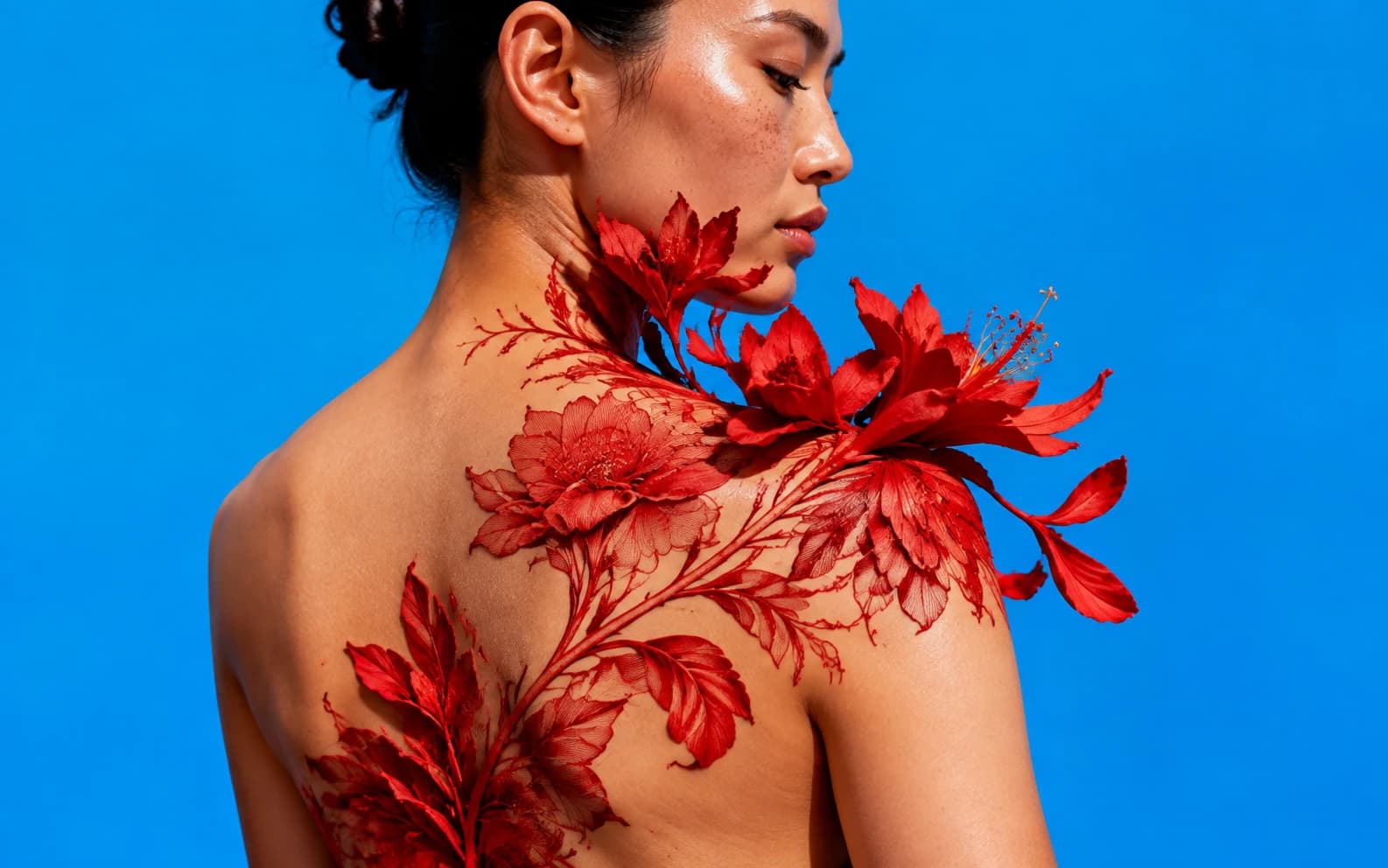
The single biggest problem with AI tattoo references: the image looks cool as digital art but would be impossible to actually tattoo. Lines blur into shading, details are too fine for skin, and the composition ignores body flow entirely. Across Nano Banana, Nano Banana 2, and Nano Banana Pro on Morphed, one technique consistently fixes this: style anchoring. Name one primary tattoo style and one supporting visual descriptor, then let the model render within those constraints.
"Cool wolf tattoo" produces digital art. "Neo-traditional wolf head with bold black outlines, limited color palette of red and gold, forearm placement, tattoo flash style" produces a reference image a tattoo artist can actually work from. That distinction is the entire difference between AI tattoo art that is useful and art that gets discarded at the consultation.
Quick reference: which tattoo style do you need?
| Category | Best For | Key Prompt Elements | Prompts |
|---|---|---|---|
| Geometric and Blackwork | Sacred geometry, mandalas, dotwork | Symmetry, clean linework, dotwork shading, black ink only | 4 prompts |
| Traditional and Old School | Bold classic motifs, flash collections | Bold outlines, limited palette, vintage flash aesthetic | 4 prompts |
| Fine-Line and Minimalist | Small tattoos, delicate placements | Single-weight lines, negative space, continuous line | 4 prompts |
| Watercolor | Painterly, artistic pieces | Soft color splashes, no hard outlines, bleed effects | 3 prompts |
| Japanese and Irezumi | Sleeves, back pieces, flowing compositions | Traditional motifs, flowing composition, wind bars, waves | 4 prompts |
| Neo-Traditional and Illustrative | Modern interpretive work, bold color | Thick outlines, expanded palette, illustrative rendering | 3 prompts |
| Nature and Botanical | Organic motifs, floral, fauna | Botanical detail, organic flow, realistic or stylized | 4 prompts |
| Flash Sheets and Stencils | Artist flash collections, stencil-ready output | Multiple designs, white background, pure black lines | 3 prompts |
Both Nano Banana and Nano Banana 2 are available on Morphed. For the full model overview and general prompting framework, see the complete Nano Banana prompts guide.
Why Nano Banana Produces Better Tattoo References Than Midjourney or DALL-E
Tattoo reference art has requirements that separate it from general illustration: clean line separation at high resolution, style-consistent rendering within a single tattoo convention, and compositions that respect body placement and flow. Most AI models treat tattoo prompts as illustration prompts, producing beautiful digital art with soft edges, blended colors, and detail density that would bleed into an unreadable mess on skin. Nano Banana handles these challenges because it follows linework and composition instructions literally rather than adding artistic reinterpretation that breaks tattoo conventions.
Based on generating tattoo prompts across Nano Banana, Nano Banana 2, Midjourney v6, and DALL-E 3, here's how they compare on the four criteria that matter most for tattoo references: line clarity (could the lines be traced for a stencil), style accuracy (did it stay within the named tattoo convention), body-placement composition (did it flow with the specified body area), and detail tattoobility (would the detail level survive on skin at the intended size).
| Feature | Nano Banana | Midjourney v6 | DALL-E / GPT Image | Flux |
|---|---|---|---|---|
| Line clarity and separation | Clean, traceable lines with consistent weight | Beautiful but lines blend into shading | Medium, often too soft for stencils | Good with detailed prompts |
| Style accuracy (staying within one convention) | Follows named style literally | Over-stylizes, mixes conventions | Generic, defaults to illustrative | Good |
| Geometric symmetry and precision | Strong, especially with v2 | Good but adds organic irregularity | Medium | Comparable |
| Body-placement composition | Follows placement cues accurately | Treats placement as backdrop, not constraint | Inconsistent | Good |
| Fine detail rendering (dotwork, mandala) | Strong (v2 significantly better) | High detail but too fine for skin | Medium detail | Good |
| Blackwork and solid fill | Clean fills, sharp edges | Sometimes adds gradients to solid areas | Flat but clean | Good |
| Setup required | None on Morphed | Discord or web app | ChatGPT Plus or API | Local install or hosted |
The biggest gap appeared in style consistency. Midjourney frequently added watercolor effects to geometric prompts and gradient shading to blackwork prompts, producing beautiful images that violated the named tattoo style. Nano Banana 2 adds sharper line separation for fine-line work and more consistent geometric symmetry for mandala and sacred geometry patterns.
The Style Anchoring Technique
The difference between a usable AI tattoo reference and digital art that gets ignored at the tattoo shop is style specificity. Compare these two approaches:
Generic prompt: "Wolf tattoo design, cool, detailed"
Anchored prompt: "Neo-traditional wolf head with bold black outlines, limited color palette of deep red and gold, ornamental frame with filigree detail, forearm placement concept, tattoo flash style"
The second prompt works because it names one specific tattoo style (neo-traditional), describes the line treatment (bold black outlines), limits the color palette to what a tattooist would actually use, and specifies a body placement that constrains the composition. The model treats each of these as a rendering instruction rather than a suggestion.
Here is the translation table for common tattoo style mistakes:
| Instead of This | Write This | Why It Works |
|---|---|---|
| "Detailed tattoo" | "Fine-line tattoo with single-weight lines" | Specifies the actual line technique |
| "Colorful tattoo" | "Traditional tattoo with red, green, and yellow palette" | Limits colors to a real tattoo convention |
| "Cool geometric design" | "Blackwork geometric with dotwork shading, sacred geometry patterns" | Names the sub-style and shading technique |
| "Japanese tattoo" | "Japanese irezumi style with flowing water, wind bars, and bold outlines" | Adds the compositional elements that define irezumi |
| "Watercolor tattoo" | "Watercolor tattoo with color bleed edges, no hard outlines, soft gradients" | Describes the specific visual properties of watercolor tattooing |
| "Minimalist tattoo" | "Single continuous line drawing, black ink only, no shading" | Defines what minimalism means in tattoo terms |
This technique applies to every category below. Always name the tattoo style first, then add the motif, line treatment, and placement.
Geometric and Blackwork Tattoos
Geometric and blackwork tattoos rely on clean lines, bold shapes, mathematical precision, and strong contrast. These are among the most AI-friendly tattoo styles because the model excels at rendering precise geometry, symmetry, and solid black fills.
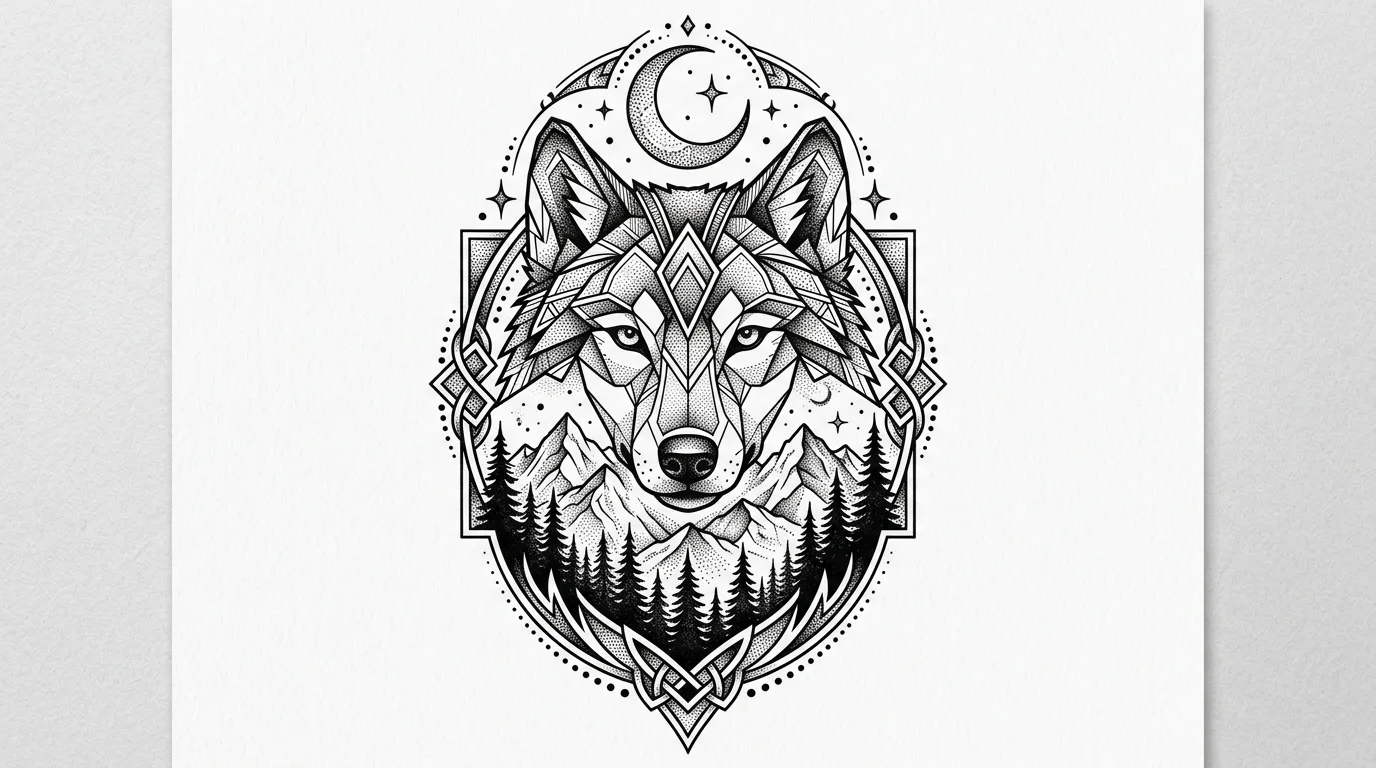
Prompt: "Geometric wolf tattoo design, black linework on white background, sacred geometry patterns radiating from wolf's eye, mandala elements framing the head, clean and precise linework, tattoo flash style, symmetrical composition, forearm placement concept"
The combination of animal and sacred geometry is one of the most requested styles in modern tattoo studios. "Sacred geometry patterns radiating from wolf's eye" gives the model a specific origin point for the geometric elements rather than scattering them randomly. "Forearm placement concept" constrains the aspect ratio to a vertical, slightly tapered shape that matches the forearm.
Prompt: "Blackwork geometric sleeve design, interconnected triangles and hexagons flowing from shoulder to wrist, dotwork gradient shading transitioning between solid black and skin, negative space creating secondary patterns, tattoo design reference sheet, arm placement with natural body flow"
Interconnected shapes create the flow essential for sleeve designs that wrap around the arm. "Dotwork gradient shading transitioning between solid black and skin" describes the specific technique blackwork artists use to create depth without gray tones. The negative space instruction prevents the model from filling every area with ink, which would produce a design that reads as a dark blob at distance.
Prompt: "Geometric lotus mandala tattoo, concentric circles with radiating petal patterns, black ink only, fine-line tattoo style with consistent single-weight lines, sternum or upper back placement, sacred geometry proportions based on golden ratio, tattoo stencil reference"
Lotus and mandala combinations are among the most timeless geometric designs. "Consistent single-weight lines" prevents the model from varying line thickness, which is critical for geometric work where uniform lines define the style. "Tattoo stencil reference" pushes the output toward clean, traceable artwork rather than shaded illustration.
Prompt: "Dotwork geometric mountain range tattoo, stippled shading creating gradient from dense to sparse dots, mountain silhouette within diamond frame, black ink only, forearm or calf placement concept, precise and mathematical, tattoo flash style"
Dotwork is a specific shading technique where thousands of individual dots create gradient and texture. "Stippled shading creating gradient from dense to sparse dots" describes the actual technique rather than just naming it. The diamond frame gives the composition a defined boundary that works well for standalone placements.
Traditional and Old School Tattoos
American traditional tattoos use bold black outlines, a limited palette of red, green, yellow, and blue, and classic motifs established in the early 20th century. The style is defined by what it does not include: no soft shading, no gradients, no unlimited color range. These constraints make it one of the clearest styles to prompt because the rules are rigid and well-documented.
Prompt: "American traditional rose tattoo design, bold black outlines with consistent heavy line weight, classic red petals and green leaves, minimal interior shading using parallel line hatching, vintage tattoo flash art aesthetic, standalone placement suitable for upper arm or forearm"
Bold outlines and a limited palette are the defining features of traditional work. "Parallel line hatching" is the specific shading technique used in traditional tattooing, as opposed to smooth gradient shading used in realism. "Vintage tattoo flash art aesthetic" triggers the model to reference the visual language of Sailor Jerry and early American flash.
Prompt: "Old school eagle tattoo with wings spread wide, patriotic red white and blue color palette, bold black outlines, banner below with space for text, traditional tattoo flash style, chest or upper back placement concept, symmetrical composition with eagle centered"
The eagle with spread wings is the quintessential American traditional chest piece. "Banner below with space for text" adds a compositional element the client can customize with their artist. Specifying "symmetrical composition with eagle centered" prevents the model from generating a dynamic, off-center pose that breaks the traditional convention.
Prompt: "Traditional panther head tattoo, crawling panther with claws extended, bold black fill with yellow eyes and red tongue, classic American traditional proportions, thick outlines, no gradient shading, tattoo flash sheet style, forearm or thigh placement"
The crawling panther is one of the most iconic traditional motifs. "Classic American traditional proportions" is important because modern AI models tend to render anatomically accurate animals rather than the stylized, slightly exaggerated proportions that define traditional tattoo art. "No gradient shading" reinforces the style boundary.
Prompt: "Traditional skull and dagger tattoo, skull with crossbones, dagger piercing through top, black and gray with red blood accent, classic tattoo design composition, flash sheet style with bold outlines and limited shading, bold and timeless, standalone design for upper arm"
Skull and dagger is a classic traditional pairing. "Black and gray with red blood accent" is a standard traditional palette variation. "Standalone design for upper arm" gives the model a specific size and placement context that affects composition density.
Fine-Line and Minimalist Tattoos
Fine-line tattoos use single-weight thin lines, generous negative space, and deliberate simplicity. This style has surged in popularity for small, delicate placements like the inner wrist, behind the ear, ankle, and fingers. The prompting challenge: AI models default to adding detail. You need to explicitly instruct the model to subtract.
Prompt: "Minimalist line art mountain range tattoo, single continuous line creating three peaks with a small sun, black ink only, no shading, no fill, single-weight fine line, white background, wrist or inner forearm placement, clean and delicate, tattoo design reference"
"Single continuous line" is a specific minimalist technique where the entire design is drawn without lifting the pen. This creates elegant, flowing compositions. "No shading, no fill" are critical negative instructions that prevent the model from adding visual weight that breaks the minimalist aesthetic.
Prompt: "Fine-line botanical tattoo, single stem wildflower with three leaves, delicate thin linework with no variation in line weight, small scale design for inner arm or ankle placement, realistic proportions rendered in minimal line style, black ink only, tattoo stencil quality"
Botanical subjects suit fine-line work because the natural forms translate well to simple line drawings. "Realistic proportions rendered in minimal line style" is an important distinction: the plant should look anatomically correct, just drawn with minimal lines rather than stylized into abstraction.
Prompt: "Minimalist cat silhouette tattoo, simple outline with no interior detail, negative space defining the form, single-weight fine line, tiny scale design approximately 2 inches, behind ear or inner wrist placement, clean and precise, tattoo reference on white background"
"Approximately 2 inches" gives the model a scale reference that affects how much detail is appropriate. At this size, any interior detail would blur and blend on skin over time. Tattoo artists consistently advise that fine-line work at small scale needs maximum simplicity.
Prompt: "Minimalist wave tattoo, single line ocean wave in Japanese-inspired style, black ink only, flowing horizontal composition for forearm or calf placement, Hokusai-influenced simplicity without the complexity, clean tattoo design reference, no shading or fill"
"Hokusai-influenced simplicity without the complexity" is a specific instruction: capture the aesthetic of The Great Wave but stripped to its essential line. This distinction matters because "Japanese wave" alone would trigger the model to generate the full, detailed Hokusai composition rather than a minimalist interpretation.
Watercolor Tattoos
Watercolor tattoos use soft edges, color splashes, paint bleed effects, and intentional imprecision that mimics the behavior of pigment on wet paper. This style is the most painterly and least tattoo-conventional, which makes prompting it different from other categories. You need to describe how the color behaves, not just what colors to use.
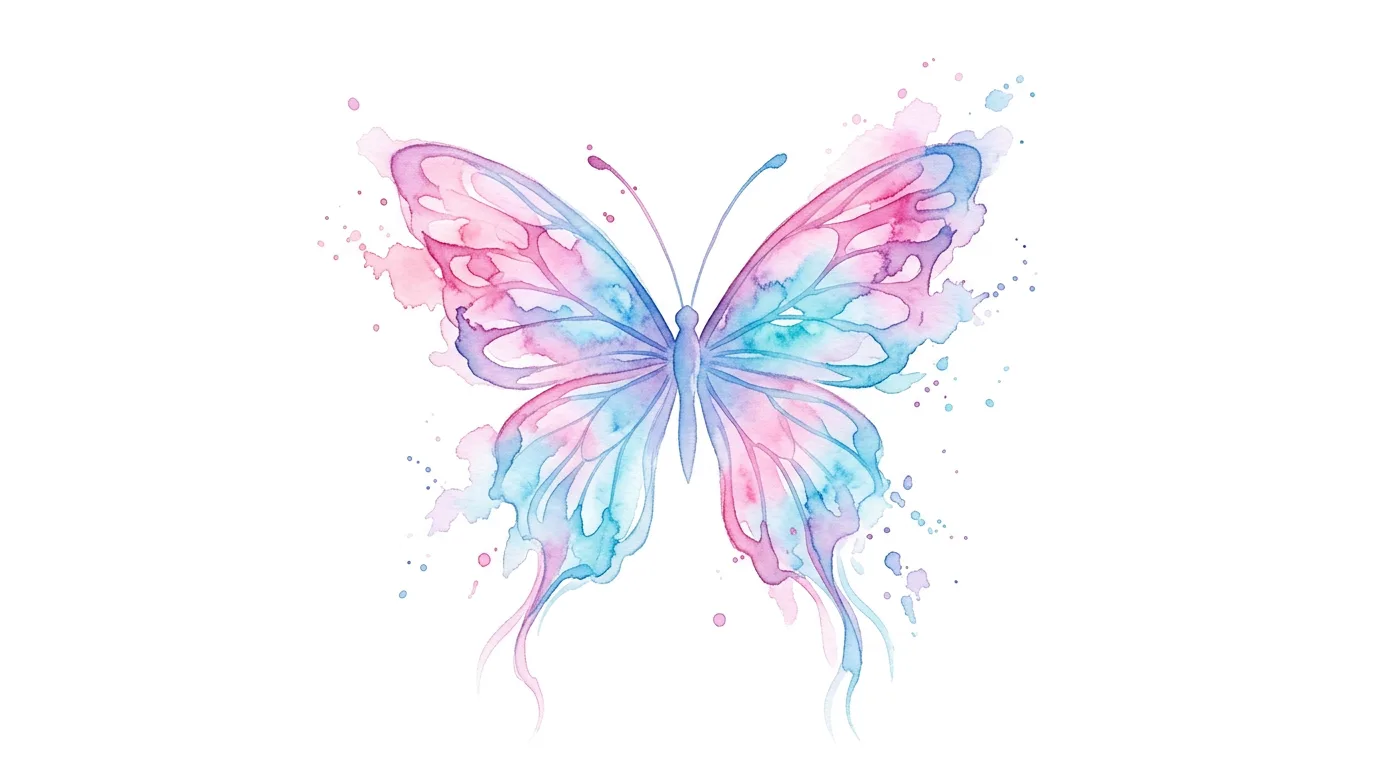
Prompt: "Watercolor butterfly tattoo design, soft color splashes in teal and coral bleeding beyond the wing outlines, painterly edges with no hard borders, color pooling at wing tips as if pigment settled on wet paper, delicate and flowing, tattoo inspiration reference, shoulder blade or upper arm placement"
"Color pooling at wing tips as if pigment settled on wet paper" describes a specific watercolor behavior that AI models understand and render convincingly. Without this level of color-behavior description, the model produces clean, even color fills that look like digital illustration rather than watercolor.
Prompt: "Watercolor peony tattoo, large bloom with petals in soft pink and magenta with color bleed effect extending beyond petal edges, subtle gray linework skeleton visible beneath the color, soft gradients mimicking wet-on-wet technique, artistic and fluid, forearm or thigh placement, tattoo design reference"
"Subtle gray linework skeleton visible beneath the color" is how real watercolor tattoos are structured: a fine-line framework gives the design legibility and longevity while the watercolor effect provides the artistic impression. Without this underlying structure, watercolor tattoos age poorly, and the AI reference should reflect this practical consideration.
Prompt: "Watercolor hummingbird tattoo, bird rendered in fine gray linework with watercolor splashes of purple and emerald radiating from the wings, splashed background with color drips and splatters, vibrant but soft color transitions, delicate and dreamy atmosphere, inner arm or ribcage placement, artistic tattoo style"
"Color drips and splatters" are intentional design elements in watercolor tattooing, not accidents. Including them in the prompt produces the controlled chaos that defines the style. "Fine gray linework" for the bird itself ensures the subject remains readable even as the color effects create atmosphere.
Japanese and Irezumi Tattoos
Japanese tattoo art follows centuries of compositional rules: flowing designs that follow body contours, symbolic motifs with specific cultural meanings, background elements like wind bars, clouds, and waves that create movement, and a hierarchy where the main subject dominates with background elements supporting. Prompting Japanese tattoo art requires naming these structural elements, not just the subject.
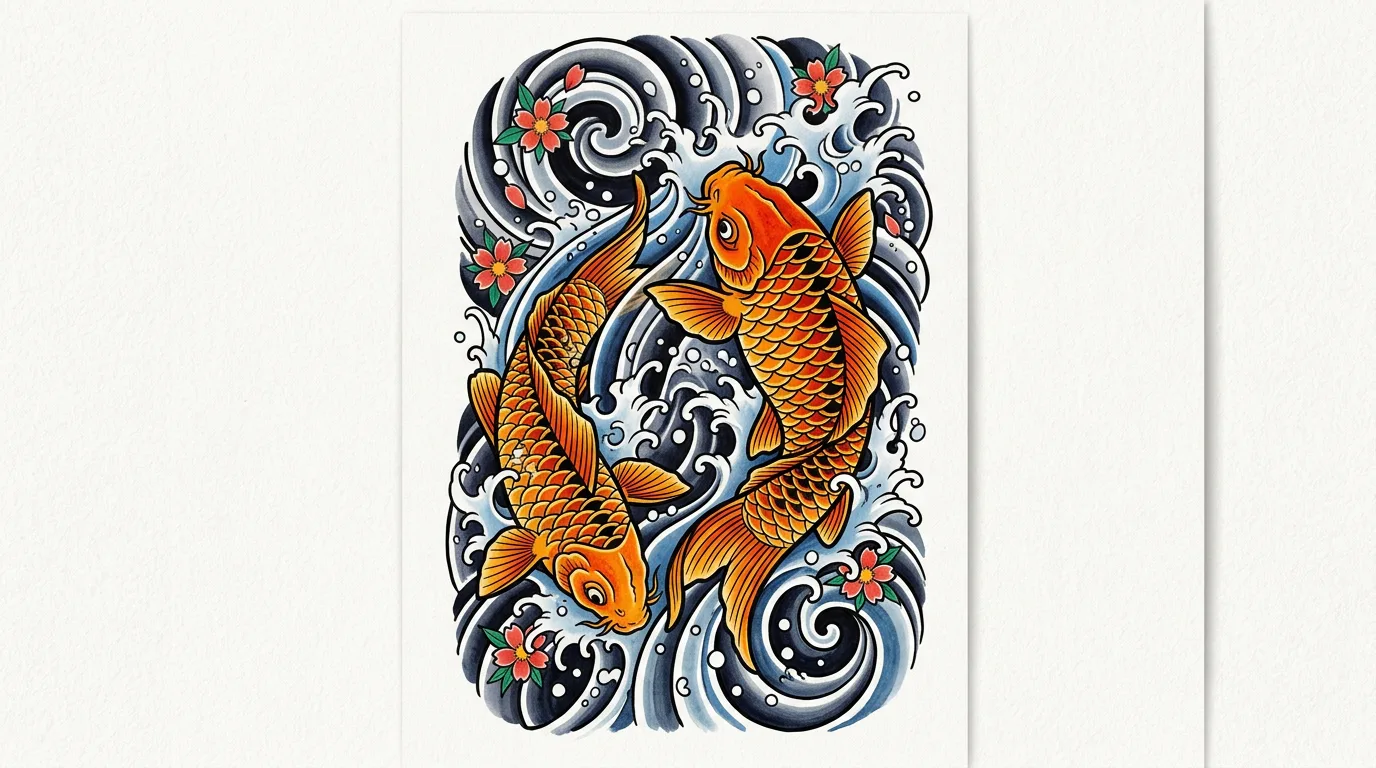
Prompt: "Japanese koi fish tattoo design, two koi swimming in opposite directions through flowing water, traditional Japanese tattoo style with bold black outlines and flat color fills in orange and gold, wave patterns and water splashes as background, full sleeve concept with composition following arm curvature, irezumi aesthetic"
"Two koi swimming in opposite directions" is a classic Japanese tattoo composition symbolizing perseverance and balance. "Flat color fills" is the traditional Japanese technique, distinct from the gradient shading used in Western realism. "Composition following arm curvature" is the critical instruction that makes this a tattoo reference rather than a rectangular illustration.
Prompt: "Japanese cherry blossom branch tattoo, delicate pink petals with some falling in wind, traditional irezumi style composition, black and gray branch with pink and white blossoms, wind bars indicating breeze direction, background of fading clouds, arm or shoulder flow with design wrapping around the limb, tattoo design reference"
"Wind bars indicating breeze direction" are a specific Japanese tattoo element: stylized parallel lines that show air movement. Including them signals to the model that you want authentic irezumi composition, not a generic floral design. "Petals falling in wind" adds the sense of transience that gives cherry blossom tattoos their cultural significance.
Prompt: "Japanese dragon tattoo, dragon coiling through clouds with scales rendered individually, traditional irezumi color palette of black, red, and gold, wind bars and cloud formations as background elements, bold black outlines with limited interior shading, full back piece or sleeve concept, powerful and dynamic composition"
The dragon is the most complex Japanese tattoo subject because every scale, whisker, and claw carries symbolic meaning. "Scales rendered individually" pushes the model to render the distinctive overlapping scale pattern rather than a smooth skin texture. Nano Banana 2 handles this level of repetitive detail significantly better than the original.
Prompt: "Japanese hannya mask tattoo, fierce expression with horns and fangs, traditional irezumi rendering with bold outlines, red and gold color palette on the mask, surrounded by peony flowers and swirling smoke, upper arm or chest placement concept, dramatic and powerful, tattoo flash reference"
The hannya mask is a classic Japanese tattoo motif representing jealousy transformed into a demon. "Surrounded by peony flowers and swirling smoke" follows the irezumi convention of pairing bold subjects with softer organic elements. The peony specifically symbolizes beauty and fragility in contrast to the mask's ferocity.
Neo-Traditional and Illustrative Tattoos
Neo-traditional tattooing takes the bold outlines and flat composition of American traditional and expands the palette, adds gradient shading, and incorporates more detailed illustrative rendering. It bridges the gap between the strict rules of traditional and the freedom of illustration. The prompting challenge: you need to specify which traditional conventions to keep and which to break.
Prompt: "Neo-traditional wolf portrait tattoo, bold black outlines framing a detailed wolf head with realistic fur texture, expanded color palette of deep teal, burnt orange, and gold, ornamental art nouveau frame with filigree scrollwork, gradient shading within bold outline sections, upper arm or thigh placement, tattoo flash style"
"Bold outlines framing detailed wolf head with realistic fur texture" describes the neo-traditional approach: maintain the structural clarity of traditional outlines but fill them with more detailed, illustrative rendering. "Art nouveau frame with filigree scrollwork" is a common neo-traditional compositional device that adds decorative complexity.
Prompt: "Neo-traditional moth tattoo, death's-head hawk moth with skull pattern on thorax, bold outline style with detailed wing pattern rendering, jewel-tone color palette of deep purple, emerald, and gold, geometric background elements behind wings, sternum or upper back placement concept, dark and ornate, tattoo design reference"
Moths are a signature neo-traditional subject because their wing patterns allow for the detailed interior rendering that defines the style. "Jewel-tone color palette" distinguishes neo-traditional from traditional, which uses primary colors. The geometric background adds a modern element that traditional designs would not include.
Prompt: "Neo-traditional portrait tattoo of a woman's face, bold outline defining the face shape, detailed interior rendering with gradient shading on skin tones, ornamental crown of flowers and crystals, deep rich color palette, art deco geometric elements framing the portrait, upper arm or calf placement, tattoo flash aesthetic"
Portraits in neo-traditional style maintain the readable outline structure while allowing for much more facial detail than traditional would permit. "Art deco geometric elements framing the portrait" is a specific compositional choice that gives the design architectural structure while keeping it distinct from realistic portrait tattooing.
Nature and Botanical Tattoos
Nature and botanical tattoos span the full range from photorealistic to highly stylized. The prompting approach depends on which end of that spectrum you want: realistic botanical illustration needs detail and accuracy, while stylized nature work needs clear line treatment and compositional flow.
Prompt: "Botanical fern tattoo design, detailed frond with accurate leaflet rendering showing pinnate leaf structure, black linework with subtle stipple shading for depth, scientific illustration aesthetic adapted for tattooing, forearm placement following the natural vertical growth pattern, organic flow from base to tip, tattoo design reference"
"Pinnate leaf structure" is the botanical term for the feather-like arrangement of fern leaflets. Using the correct botanical term produces more accurate rendering than "detailed fern." "Scientific illustration aesthetic adapted for tattooing" tells the model to reference the precise, clean style of botanical illustrations while keeping line weight appropriate for skin.
Prompt: "Wildflower bouquet tattoo, mixed composition of lavender, poppy, daisy, and thistle with leaves and seed pods, delicate linework with varying line weight for depth, feminine and natural arrangement, no hard geometric frame, organic composition that flows with body contour, upper arm or thigh placement, tattoo design reference"
Naming specific flower species rather than just "wildflowers" gives the model distinct shapes to render. Each flower has a different petal structure, and the variety creates visual interest. "No hard geometric frame" prevents the model from adding a border that would contradict the organic, flowing nature of wildflower compositions.
Prompt: "Moon phases and wolf silhouette tattoo, howling wolf against full moon with crescent phases flanking on either side, forest treeline silhouette along the bottom, nature tattoo aesthetic, horizontal composition for forearm or collarbone placement, black ink only with varying density for depth, symbolic and powerful, tattoo design reference"
"Moon phases flanking on either side" creates the horizontal banner composition popular for forearm and collarbone placements. "Varying density for depth" instructs the model to use solid black for the silhouette and lighter, less dense rendering for the background elements, creating visual hierarchy without introducing gray tones.
Prompt: "Realistic snake wrapped around peony flowers tattoo, detailed scale rendering on snake body, bold but accurate linework, peony rendered with layered petal depth, black and gray with selective red accent on peony petals, flowing S-curve composition for thigh or upper arm placement, nature tattoo style, tattoo design reference"
Snake and flower pairings are a cornerstone of nature tattoo design across multiple styles. "Detailed scale rendering" pushes the model to show individual scales rather than a smooth texture. "Selective red accent on peony petals" uses a common tattoo technique where a predominantly black-and-gray piece uses one accent color for focal emphasis.
Flash Sheets and Stencil-Ready Output
Flash sheets and stencil output are the most practically useful AI tattoo outputs because they are designed to be used directly in a tattoo workflow. Flash sheets show multiple small designs on a single page for client selection. Stencil output produces clean, high-contrast linework that can be traced or thermally transferred.
Prompt: "Traditional tattoo flash sheet, six small tattoo designs arranged in two rows of three on white background, designs include rose, anchor, swallow, skull, dagger, and heart, each with bold black outlines and classic red and green color palette, American traditional flash art style, clean separation between designs, tattoo shop wall reference"
"Six small tattoo designs arranged in two rows of three" gives the model an explicit grid layout. Without the arrangement instruction, multiple designs tend to overlap or merge. "Clean separation between designs" reinforces that each piece should be distinct and independently selectable.
Prompt: "Minimalist tattoo stencil sheet, eight tiny line-art designs on white background, designs include mountain, wave, moon, arrow, pine tree, compass, sun, and star, pure black single-weight lines only, no shading, no gray tones, no fill, stencil transfer quality, clean vector-like precision, suitable for thermal transfer printing"
"Pure black single-weight lines only, no shading, no gray tones, no fill" is a series of negative instructions that strip away everything except the essential lines. "Suitable for thermal transfer printing" references the actual process tattoo artists use to apply stencils to skin, which requires high-contrast, clean-edge artwork.
Prompt: "Japanese tattoo flash sheet, four medium designs arranged on white background, designs include koi fish, cherry blossom branch, dragon head, and hannya mask, traditional irezumi style with bold outlines and flat color fills, each design standalone with clear borders, tattoo shop reference art, professional flash collection style"
Japanese flash sheets follow different conventions than American traditional: the designs tend to be slightly larger and more detailed, with the flowing compositional elements that define irezumi. "Each design standalone with clear borders" prevents the background elements (waves, clouds, wind bars) from one design bleeding into the next.
Style Anchoring and Model Differences That Matter Most
Across generations in all eight categories on both Nano Banana and Nano Banana 2 on Morphed, a few patterns hold up consistently for line clarity, style accuracy, body-placement composition, and detail tattooability.
Style anchoring is the single biggest quality lever for tattoo design. Prompts that named one specific tattoo style ("neo-traditional," "blackwork geometric," "fine-line minimalist") and described the line treatment ("bold outlines," "single-weight fine lines," "dotwork shading") consistently produced style-accurate output. Prompts using generic descriptions ("cool tattoo," "detailed design") consistently produced style-inconsistent output, mixing conventions from multiple styles in ways that would be impractical to tattoo.
Nano Banana 2 handles fine-line and geometric work significantly better. The clearest model difference appeared in geometric symmetry and fine-line consistency. Mandala prompts came out cleaner and more symmetrical with Nano Banana 2, while the original more often let lines waver or symmetry break. For bold traditional work with thick outlines and solid fills, both models performed comparably.
Placement cues dramatically improve composition. "Sleeve concept" versus no placement instruction produced fundamentally different compositions. With placement, the model composed designs that flowed with body curvature, tapered where limbs narrow, and distributed detail density appropriately. Without placement, designs defaulted to rectangular, centered compositions that would need significant reworking by the tattoo artist.
Negative instructions prevent the most common failures. "No gradient shading" in traditional prompts, "no fill" in minimalist prompts, and "no hard outlines" in watercolor prompts each eliminated the single most common style violation in their respective categories. The model defaults to adding visual complexity; telling it what to leave out is as important as telling it what to include.
The diminishing returns threshold is around 40 words for tattoo prompts. Tattoo prompts benefit from style-specific vocabulary and placement cues but do not need the lengthy scene descriptions that landscape or product photography prompts require. Between 20 and 40 words produced the strongest results. Below 15 words, outputs defaulted to generic clip art. Above 50 words, the model began blending conflicting style instructions.
| Prompt Element | Impact on Quality | Best Practice |
|---|---|---|
| Style anchoring (naming one tattoo style) | Highest | "Neo-traditional with bold outlines" not "tattoo design" |
| Line treatment description | High | "Single-weight fine lines" not "detailed" |
| Body placement cue | High | "Forearm placement concept" not no placement |
| Negative instructions (what to exclude) | High | "No gradient shading" for traditional, "no fill" for minimalist |
| Motif specificity | Medium-high | "Death's-head hawk moth" not "moth" |
| Color palette constraints | Medium | "Red, green, yellow only" not "colorful" |
| Output format | Medium | "Tattoo flash style" or "stencil reference" not "tattoo design" |
| Prompt length | Medium | 20-40 words is the sweet spot for tattoo prompts |
When AI Tattoo References Are the Wrong Choice
AI-generated tattoo references work well for concept exploration and artist communication, but not for every situation. Being honest about limitations saves time and avoids disappointing consultations.
Skip AI tattoo references when:
- You need a final stencil with exact measurements. AI outputs are concept references, not production-ready stencils. A tattoo artist needs to redraw the design for the specific body area, adjusting line weight for skin thickness in that location, scaling detail density for the size, and accounting for body curvature that a flat image cannot represent. Treating AI output as a final stencil produces tattoos that do not age well.
- You need text or lettering in the design. AI models struggle with readable text in tattoo designs. Names, dates, quotes, and script lettering will be garbled or misspelled in most generations. For lettering tattoos, work directly with your artist or use a font reference instead.
- You need anatomically precise placement previews. "What will this look like on my specific arm" requires a photo overlay tool, not a text-to-image prompt. Upload your body photo on Morphed and use image editing prompts to preview placement on your specific body.
- Your design requires cultural sensitivity. Tattoos from Polynesian, Maori, indigenous, and sacred traditions carry specific cultural meanings and protocols. AI models do not understand these protocols and may generate culturally inappropriate combinations of symbols. For cultural tattoo designs, work with an artist who is trained in and authorized to create that cultural work.
- Fine detail will be scrutinized by tattoo enthusiasts. Communities on Reddit like r/tattoos and r/tattoo will spot AI-generated reference artifacts: slightly melted geometric lines, impossible shading transitions, and anatomically incorrect florals. For content targeting tattoo communities, verify every detail against real tattoo references before posting.
5 Mistakes That Make AI Tattoo References Unusable
1. Stacking Multiple Conflicting Styles
"Geometric watercolor traditional Japanese tattoo" asks the model to combine four distinct conventions that each have incompatible rules. Geometric uses precise lines; watercolor uses no outlines. Traditional uses bold, thick lines; Japanese uses flowing compositions with specific background elements. Pick one primary style and, at most, one supporting modifier: "geometric tattoo with subtle watercolor color accents" works because geometric remains the structural base.
2. Ignoring Line Weight
"Tattoo design" without specifying line weight produces inconsistent lines that shift from thick to thin randomly. Real tattoo styles have strict line weight conventions. Traditional uses bold, consistent heavy outlines. Fine-line uses thin, single-weight lines. Dotwork uses no continuous lines at all. State the line weight explicitly: "bold outlines with consistent heavy line weight" or "single-weight fine lines throughout."
3. Too Much Detail for the Intended Size
A wrist tattoo and a full back piece have radically different detail budgets. AI models do not understand this constraint unless told. "Intricate mandala with 500 individual elements, wrist tattoo" would produce a beautiful image that is physically impossible to tattoo at that size because the details would blur together within months. Always specify size or placement, and match detail density to what is realistic for that body area.
4. Missing Composition Format
"Rose tattoo" produces a centered, square-format design. But tattoos are not square. They wrap around arms, follow the curve of ribs, flow along collarbones. Specifying "vertical composition for forearm," "horizontal banner for collarbone," or "flowing sleeve concept" changes the output from a generic illustration to a body-aware design.
5. Requesting Photorealistic Rendering
"Photorealistic tattoo design, 8K, ultra-detailed, cinematic lighting" produces a beautiful digital painting that is useless as a tattoo reference. Tattoo reference art needs to be readable as linework and color regions, not as a photograph. Use "tattoo flash style," "tattoo design reference," or "tattoo stencil style" instead of photorealism keywords.
Prompt Construction Tips for Stronger Tattoo Results
-
Lead with the tattoo style. "Neo-traditional," "blackwork geometric," "fine-line minimalist," "Japanese irezumi," or "American traditional" should be the first words. This establishes the rendering rules before the model processes the subject.
-
Name the line treatment explicitly. "Bold black outlines," "single-weight fine lines," "dotwork stippling," or "no outlines, soft edges." Line treatment is the most important visual property of a tattoo design and should never be left for the model to guess.
-
Constrain the color palette. "Red, green, and yellow only" for traditional. "Black ink only" for blackwork. "Soft pastels with no primary colors" for watercolor. Unlimited color freedom produces designs that look like digital illustrations, not tattoos.
-
Include body placement. "Forearm placement," "sleeve concept," "sternum piece," or "behind the ear." This constrains composition, aspect ratio, detail density, and flow in ways that make the output actually useful for a tattoo consultation.
-
Use negative instructions for style purity. "No gradient shading" for traditional. "No fill" for fine-line. "No hard outlines" for watercolor. "No background elements" for standalone placements. Telling the model what to exclude is as important as telling it what to include.
-
Specify the output format. "Tattoo flash style" for clean, reference-ready single designs. "Flash sheet" for multiple designs. "Tattoo stencil reference" for high-contrast, line-only output. Each produces a fundamentally different result.
-
Use Nano Banana 2 for precision work. Nano Banana 2 produces sharper line separation, more consistent geometric symmetry, and finer dotwork detail. For bold traditional work, either model works. For fine-line, geometric, or mandala designs, Nano Banana 2 is the better choice. Both are available on Morphed.
-
Iterate with your artist, not alone. Generate three to five variations, then bring the closest one to your tattoo consultation. Your artist will redraw it for your body, adjusting everything the AI cannot account for: skin texture, body curvature, how the design will age, and line weights appropriate for the body area.
Frequently Asked Questions
What are the best Nano Banana prompts for tattoo design?
The best prompts specify three things: tattoo style (geometric, traditional, watercolor, Japanese, fine-line, blackwork), the central motif with a clear visual hierarchy, and body placement or scale cues. Adding "tattoo flash style" or "tattoo design reference" produces clean, stencil-appropriate output. The key technique is style anchoring: name one primary tattoo style and one supporting visual descriptor rather than stacking multiple conflicting styles. See the eight categories above for 30+ copy-paste ready examples.
Can I use Nano Banana tattoo designs for real tattoos?
Yes, as reference art. Tattoo artists on Reddit report that clients who bring AI-generated references communicate their intent noticeably faster than with verbal descriptions alone. Share the output with your artist as a starting point. They will redraw the design for skin, adjusting line weight, placement flow, and detail density for the specific body area. AI designs are concept art, not final stencils. For more on generating visual references, see our aesthetic picture prompts guide.
How do I get stencil-ready tattoo output from Nano Banana?
Include "tattoo stencil style, no gray tones, pure black lines" in your prompt and specify line thickness: "fine lines" for minimalist work, "bold outlines" for traditional. Adding "white background, no shading, clean vector lines" produces the cleanest stencil-ready output. Nano Banana 2 produces sharper line separation than the original, making it the better choice for stencil-quality reference art. Both models are available on Morphed.
What is the difference between Nano Banana and Nano Banana 2 for tattoo design?
Nano Banana 2 produces sharper linework, more consistent geometric symmetry, and finer detail in intricate patterns like mandalas, dotwork, and Japanese wave backgrounds. It maintains cleaner line separation than the original, especially for fine-line and geometric work. For simple bold-outline traditional designs, both models work well. For fine-line, geometric, or mandala work, Nano Banana 2 is the better choice. Both are available on Morphed.
Do these prompts work with Nano Banana Pro?
Yes. Every prompt in this guide works with Nano Banana, Nano Banana Pro, and Nano Banana 2. Pro produces the sharpest line rendering and most accurate geometric symmetry for complex mandala and sacred geometry compositions. Nano Banana 2 delivers close to Pro-level quality at faster generation speed, making it the best value option for most tattoo design use cases.
Can Nano Banana generate tattoo flash sheets?
Yes. Include "tattoo flash sheet, multiple designs on white background, traditional flash art layout" in your prompt. Nano Banana renders multiple small designs on a single sheet when instructed. This is useful for tattoo artists building flash collections or clients exploring several related motifs. Nano Banana 2 produces cleaner separation between individual designs on flash sheets. See the Flash Sheets and Stencils section above for copy-paste ready prompts.
How long should my tattoo design prompts be?
Between 20 and 40 words. Tattoo prompts need style-specific vocabulary, line treatment, and placement cues but do not need the lengthy scene descriptions that photography prompts require. Structure your prompt in three parts: tattoo style and line treatment first, then motif and composition, then placement and output format. Below 15 words, outputs are generic clip art. Above 50 words, the model blends conflicting style instructions.
Try These Prompts on Morphed
Copy any prompt from this guide into Morphed and generate your first tattoo reference in under a minute. Start with the geometric and traditional prompts (they are the most reliable), then experiment with fine-line and watercolor styles. Try the same prompt on both Nano Banana and Nano Banana 2 to see how each handles linework precision, geometric symmetry, and shading techniques.
More Nano Banana prompt guides:
- 80+ Nano Banana Prompts (main guide)
- Nano Banana 2 Prompts
- Anime Prompts
- Aesthetic Picture Prompts
- Logo Prompts
- Poster Prompts
- Wallpaper Prompts
- Social Media Prompts
- Boys Prompts
- Girls Prompts
Start creating tattoo design references with Nano Banana on Morphed →