

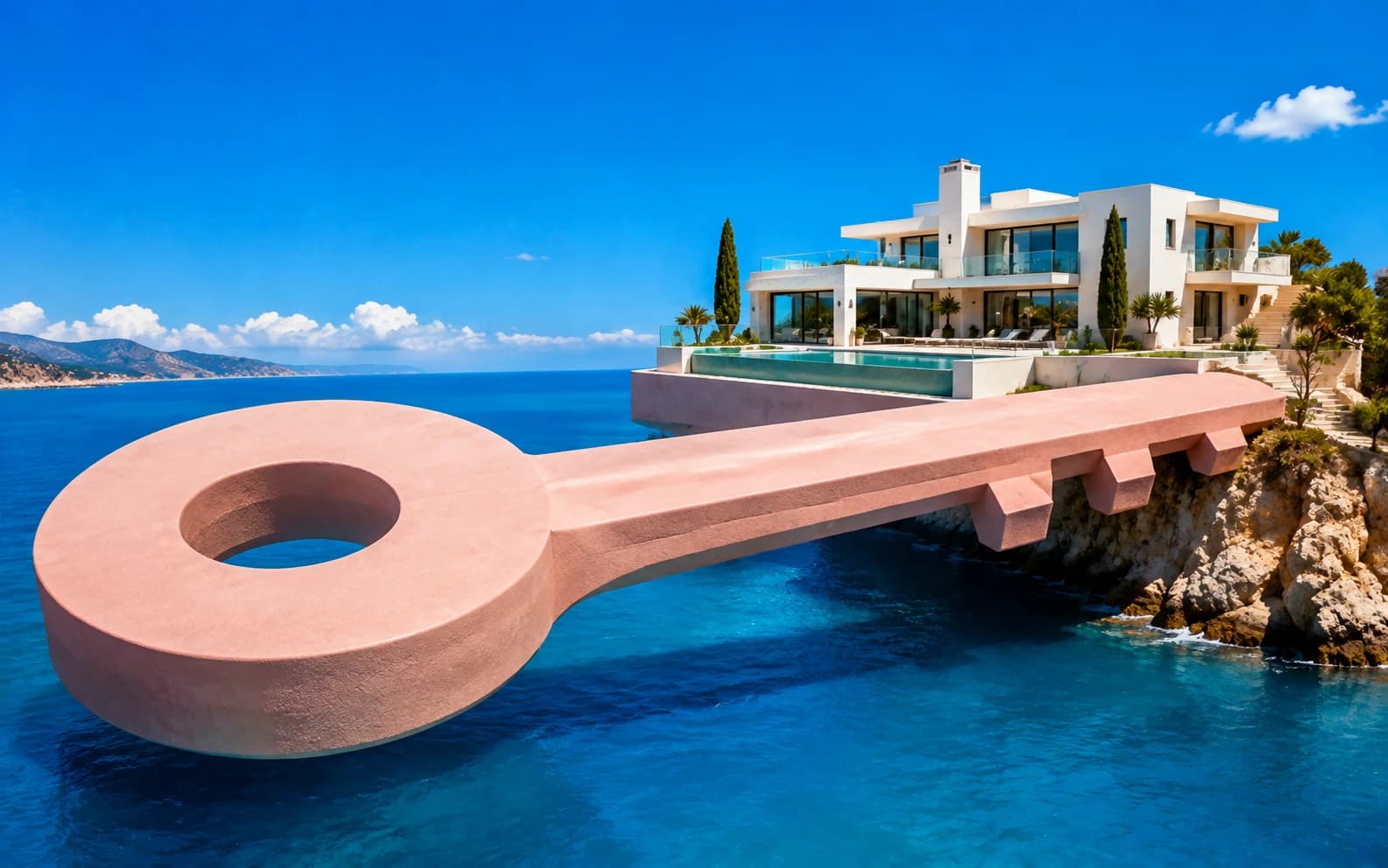
AI virtual staging costs $1 to $15 per image. Traditional staging runs $1,500 to $4,000 per listing for the first month. For agents managing 20+ active listings, the math is obvious. But most AI-generated listing photos fail for a specific reason: they look like interior design inspiration boards, not real estate listings. Across Nano Banana, Nano Banana 2, and Nano Banana Pro on Morphed, one technique consistently fixes this: spatial anchoring. Describe where light enters the room, where furniture sits relative to walls and windows, and what materials cover each surface.
"Staged living room, modern, bright" is a design mood board. "Staged living room with neutral gray sectional against the far wall, light oak hardwood floors, large windows on the left wall with sheer curtains, bright natural daylight from the left, wide-angle real estate listing photography" is a listing photo. That distinction determines whether buyers click or scroll past.
Quick reference: which listing photo do you need?
| Category | Best For | Key Prompt Elements | Prompts |
|---|---|---|---|
| Exterior Curb Appeal | First impression, MLS hero image | Bright overcast light, wide-angle, landscaping details | 4 prompts |
| Living Room Staging | Primary interior showcase | Neutral palette, 5-8 furniture pieces, natural daylight | 4 prompts |
| Kitchen Visualization | Highest-ROI room for buyers | Material specifics (quartz, shaker, subway tile), bright light | 3 prompts |
| Bedroom Staging | Supporting rooms, lifestyle feel | White bedding, minimal decor, soft diffused light | 3 prompts |
| Bathroom and Outdoor Spaces | Supporting listing images | Clean surfaces, spa aesthetic, bright even lighting | 3 prompts |
| Luxury Property Marketing | High-end listings, lifestyle content | Magazine-quality photography, aspirational settings | 4 prompts |
| Commercial Real Estate | Office, retail, and mixed-use listings | Open floor plans, functional staging, commercial style | 3 prompts |
| Social Media and Agent Branding | Property-adjacent marketing content | Lifestyle imagery, aspirational settings, brand building | 3 prompts |
Disclosure requirement: AI-generated staging photos must be labeled as "virtually staged" in your listings. NAR guidelines, California's AB 723, and most MLS systems require explicit disclosure. Every prompt in this guide produces imagery for supplemental marketing. Never present AI-generated images as actual property photos.
Both Nano Banana and Nano Banana 2 are available on Morphed. For the full model overview and general prompting framework, see the complete Nano Banana prompts guide. For design-focused room renders, check our Nano Banana prompts for interior design.
Why Nano Banana Produces Better Listing Photos Than Midjourney or DALL-E
Real estate photography exposes AI weaknesses that other subjects hide. Walls must converge to proper vanishing points. Furniture must sit on the floor plane at the correct scale. Natural light must enter from where windows are positioned. A model that fails any of these produces rooms that look like video game environments, not listing photos. Nano Banana handles this combination because it treats spatial relationships literally: light direction, furniture placement, and architectural proportions follow the physical rules described in the prompt.
Comparing Nano Banana, Nano Banana 2, Midjourney v6, and DALL-E 3 on Morphed across four criteria — architectural accuracy (correct wall angles, window proportions, ceiling height), furniture scale (pieces proportioned correctly to room size), lighting fidelity (light entering from described window positions), and listing readiness (would an agent use this in an MLS listing) — surfaces a consistent pattern.
| Feature | Nano Banana | Midjourney v6 | DALL-E / GPT Image | Flux |
|---|---|---|---|---|
| Architectural proportions (wall angles, ceiling) | Correct vanishing points, straight walls | Good but adds artistic perspective distortion | Medium, some wall curvature | Good |
| Furniture-to-room scale | Accurate in most prompts | Over-sizes furniture for visual impact | Variable, sometimes too small | Good with detailed prompts |
| Natural light from window position | Follows direction literally | Adds dramatic light regardless of windows | Medium fidelity | High fidelity |
| Neutral color palette accuracy | Renders beige/gray/white distinctly | Over-saturates, adds color grading | Good but sometimes cool-shifted | Good |
| Material rendering (hardwood, quartz, tile) | Strong texture differentiation | Beautiful but polished beyond realism | Medium, surfaces look flat | Good |
| Multi-room style consistency | Good (v2 significantly better) | Variable across rooms | Inconsistent | Comparable |
| Setup required | None on Morphed | Discord or web app | ChatGPT Plus or API | Local install or hosted |
The biggest gap appeared in lighting fidelity. Midjourney consistently added dramatic, magazine-style lighting to listing photo prompts, producing images that looked impressive but unrealistic for MLS use. Real listing photos use bright, even illumination. Nano Banana followed "bright overcast daylight" and "natural light from the left" instructions literally, producing the clean, neutral look that MLS compliance requires.
The Spatial Anchoring Technique
The difference between an AI room that looks like a design render and one that looks like a listing photo is spatial specificity. Compare these two approaches:
Design render prompt: "Modern living room, staged, bright and beautiful"
Listing photo prompt: "Staged living room with neutral gray sectional against the far wall, light oak hardwood floors, large windows on the left wall with sheer curtains letting in bright natural daylight, coffee table centered on area rug, wide-angle real estate listing photography"
The second prompt works because it describes spatial relationships: furniture position relative to walls, light source relative to windows, and the photography style that signals MLS-appropriate composition. The model uses these anchors to create a room that looks photographed, not rendered.
Here is the translation table for real estate spatial cues:
| Instead of This | Write This | Why It Works |
|---|---|---|
| "Bright room" | "Bright natural daylight from large windows on the left wall" | Specifies light source and direction |
| "Nice furniture" | "Neutral gray sectional against the far wall, coffee table centered on area rug" | Positions furniture in the space |
| "Modern kitchen" | "White shaker cabinets, quartz countertops, stainless steel appliances, subway tile backsplash" | Names specific materials buyers recognize |
| "Staged bedroom" | "King bed with white bedding centered on accent wall, nightstands with lamps on each side" | Creates symmetry and spatial logic |
| "Good photography" | "Wide-angle real estate listing photography, MLS-ready" | Triggers listing-specific composition |
| "Beautiful exterior" | "Manicured lawn, white siding, black shutters, bright overcast daylight, curb appeal focus" | Describes specific visual elements |
This technique applies to every category below. Anchor furniture to walls, light to windows, and always include a listing-style photography keyword.
Exterior Curb Appeal Shots
Curb appeal is the first image buyers see in any listing. These prompts create the bright, welcoming exterior shots that drive clicks on MLS and Zillow.
Prompt: "Modern single-family home exterior with manicured lawn, white siding, black shutters, welcoming front porch with rocking chairs, bright overcast daylight, wide-angle real estate photography, MLS listing style"
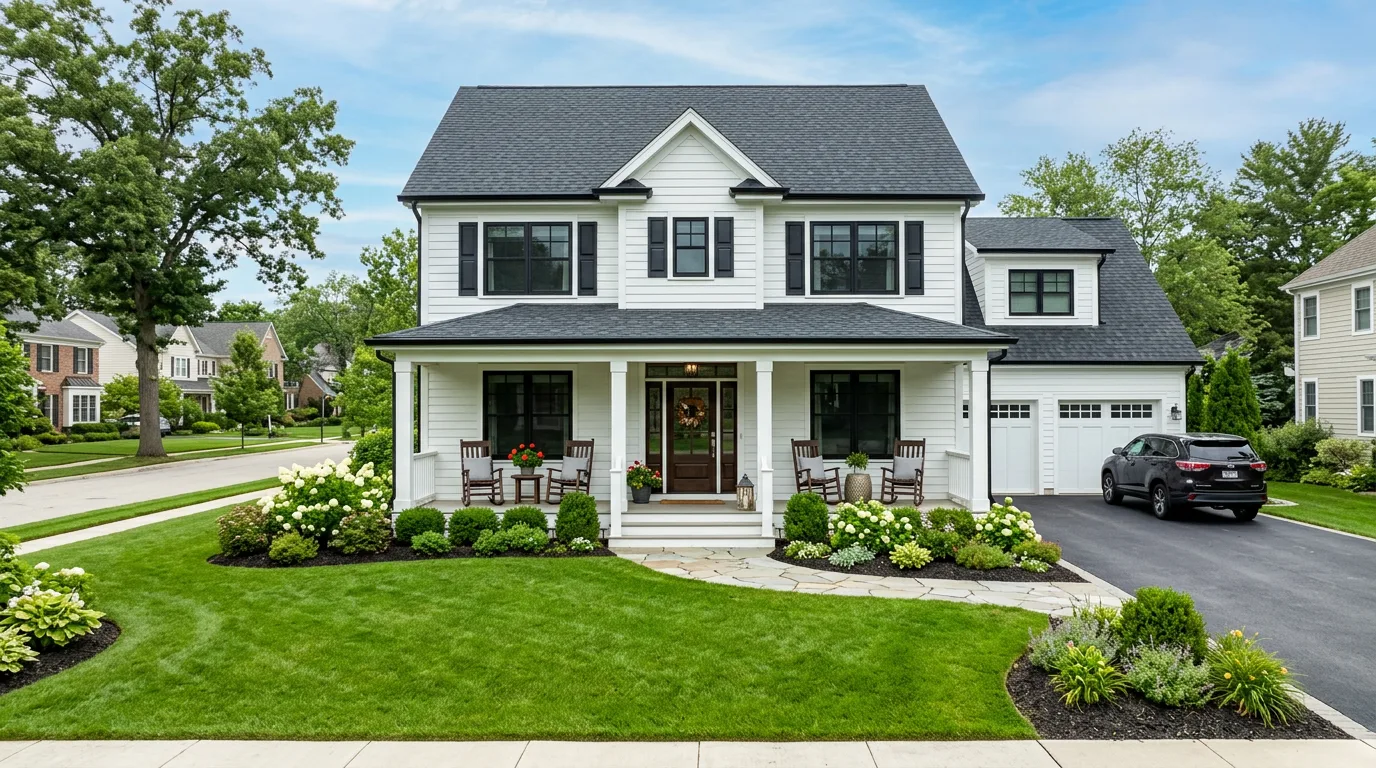
Overcast light avoids harsh shadows and keeps the facade evenly lit. This is the standard for listing photos because it shows architectural details clearly. "MLS listing style" signals listing-appropriate composition: the house centered, the lawn visible, no dramatic angles.
Prompt: "Suburban two-story house exterior at golden hour, red brick facade, white trim, mature trees framing the shot, warm afternoon sunlight, green lawn with stepping stone walkway, professional real estate photography, curb appeal focus"
Golden hour works for exterior shots when the light stays warm but not dramatic. "Mature trees framing the shot" creates natural vignetting without post-processing. Stepping stone walkways add depth and lead the viewer's eye to the front door, a composition technique from professional listing photography.
Prompt: "Contemporary condo building exterior with glass balconies, urban street context with street trees, blue sky with soft clouds, midday natural light, architectural real estate photography, clean modern lines"
Condo exteriors need urban context to establish neighborhood feel. "Street trees" and "urban street context" prevent the floating-building look common in AI architectural renders. Midday light works for condos because it shows glass and metal surfaces at their cleanest.
Prompt: "Ranch-style home exterior with attached garage, freshly painted gray exterior, white trim, newly paved driveway, colorful flower beds along front walkway, bright sunny day with blue sky, real estate drone-style wide shot showing full property"
Ranch-style homes benefit from wider framing that shows the horizontal footprint. "Drone-style wide shot" produces the elevated angle that captures the full property layout including the driveway, garage, and yard, which is increasingly expected in listings.
The Brightness Rule for Listing Photos
Real estate photography uses bright, even light. Always. "Bright overcast daylight," "soft golden hour," or "bright sunny day with blue sky." Never "moody," "dramatic," "dark," or "cinematic." Buyers associate dark images with problems. Every listing photo should feel bright, open, and welcoming. Prompts with the word "bright" in the first ten words produce noticeably more listing-appropriate results than prompts without brightness cues, which tend to default to interior-design aesthetics.
Living Room Staging
Living rooms set the tone for the entire listing. Virtual staging here has the highest impact on buyer interest of any room in the home.
Prompt: "Staged living room with neutral gray sectional sofa against far wall, light oak hardwood floors, large windows with sheer curtains on left side, bright natural daylight, minimalist decor with single potted fiddle leaf fig, coffee table on cream area rug, real estate listing photography, inviting and spacious"
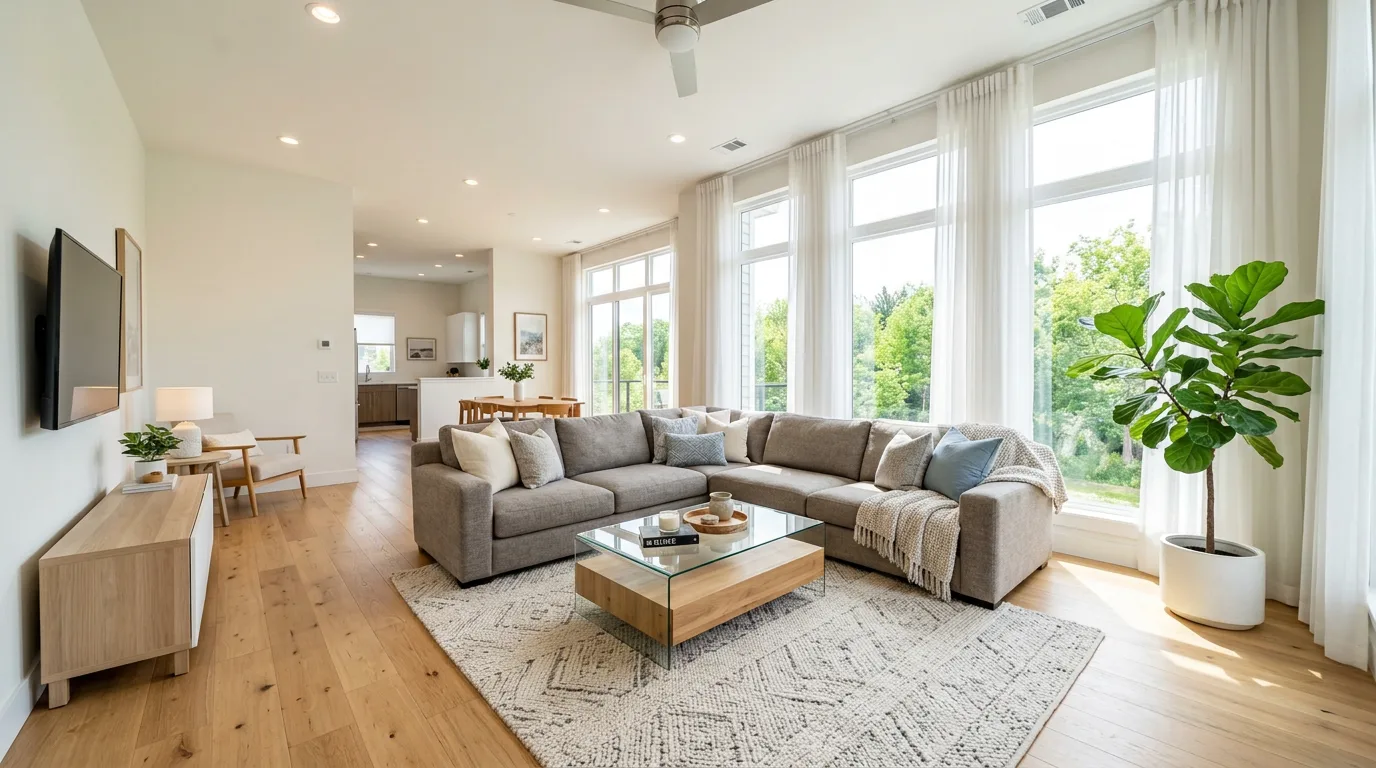
Neutral tones appeal to the widest audience. "Inviting and spacious" guides the composition toward open, airy framing that makes rooms feel larger. The fiddle leaf fig adds life without personalization. Notice the spatial anchoring: sofa against far wall, windows on the left, coffee table on rug. These position cues create a room that reads as photographed.
Prompt: "Modern living room staging with white walls, beige linen sofa facing stone fireplace, wooden coffee table, two indoor plants, floor-to-ceiling windows behind sofa with warm afternoon sunlight, MLS-ready real estate photography, staged for sale"
Fireplaces are a major selling point. Staging around them as the focal point creates a natural composition hierarchy. "Beige linen" is a specific fabric and color that produces a different texture than "beige sofa" alone.
Prompt: "Open-concept living and dining area staging, neutral palette with gray sofa and white dining table with four chairs, hardwood floors throughout, large sliding glass doors to patio on right wall, bright natural daylight flooding in, wide-angle real estate listing photography, open floor plan staging"
Open-concept spaces need furniture that defines zones without walls. "Gray sofa and white dining table" create two distinct areas within one frame. "Wide-angle" is critical here to capture the full open layout.
Prompt: "Cozy family room with L-shaped sectional in charcoal, shag area rug in cream, built-in bookshelves flanking a linear gas fireplace, recessed lighting plus table lamp on side table, warm evening interior with soft ambient glow, lifestyle real estate photography, family-friendly staging"
Evening interior shots work for bonus listing images that show how the home feels when lived in. "Built-in bookshelves flanking a linear gas fireplace" describes specific architectural features that add perceived value. This is a supplemental image, not the primary listing shot.
Kitchen Visualization
Kitchens are the highest-ROI room in any listing. Buyers scrutinize countertop materials, cabinet style, and appliance brands. Material specifics matter more here than any other room because kitchen finishes directly influence perceived home value.
Prompt: "Staged modern kitchen with white shaker cabinets, quartz countertops, stainless steel appliances, subway tile backsplash, large island with two upholstered bar stools, pendant lights over island, bright natural light from window above sink, real estate listing photography, clean and functional"
White shaker cabinets and quartz are the top buyer preferences. The island with bar stools suggests space for entertaining and casual dining. "Pendant lights over island" is a detail that signals an updated, move-in-ready kitchen. "Window above sink" is the most common kitchen window placement and gives the model a realistic light source position.
Prompt: "Updated kitchen with light wood cabinets, white marble countertops, brass hardware, three pendant lights over island, small herb planter on windowsill, stainless steel range and hood, soft morning light from east-facing window, staged for sale, professional real estate photo"
"East-facing window" with "morning light" is a spatial detail that grounds the lighting in reality. Brass hardware is trending in kitchen design and signals a recently updated space to buyers.
Prompt: "Galley kitchen staged for listing, dark navy lower cabinets, white upper cabinets, butcher block countertops, brushed nickel hardware, open shelving with minimal white dishware, bright overhead and under-cabinet lighting, narrow but functional, real estate photography, maximizing small space"
Galley kitchens need prompts that acknowledge and work with the narrow layout. "Maximizing small space" signals to the model that the composition should make the kitchen feel efficient rather than cramped. Two-tone cabinets (navy lower, white upper) is a design choice that photographs well and adds visual interest without overwhelming a small space.
Bedroom Staging
Bedrooms need to feel calm, clean, and spacious. The staging formula is simple: neutral bedding, minimal decor, and soft light. Buyers want to project their own style onto bedrooms, so the less personality in the staging, the better.
Prompt: "Master bedroom staging with king bed centered on accent wall, crisp white bedding with neutral gray accent pillows, wooden nightstands with simple ceramic lamps on each side, large windows with soft natural light on right wall, real estate listing photography, calm and spacious, neutral palette"
White bedding reads as clean and luxurious in every listing. Symmetrical nightstands on each side of the bed create a balanced, organized composition. "Centered on accent wall" anchors the bed in the space and gives the composition a focal point.
Prompt: "Guest bedroom with queen bed, soft blue and white bedding, single wooden nightstand with reading lamp, sheer curtains on window behind bed with soft diffused daylight, small potted succulent on nightstand, staged for real estate, inviting and peaceful"
Guest bedrooms need lighter staging to avoid looking overdecorated for the room size. A single nightstand instead of two communicates the room size honestly while still looking staged and intentional.
Prompt: "Kids bedroom staged for listing, single bed with simple striped bedding in white and light blue, small desk with chair by window, floating shelf with a few books, bright cheerful natural daylight, real estate listing photography, family-friendly appeal"
Kids rooms benefit from simple, gender-neutral staging. "Striped bedding in white and light blue" avoids themed decor that narrows the buyer pool. A desk by the window suggests the room functions as both sleeping and study space, increasing perceived utility.
Bathroom and Outdoor Spaces
Bathrooms and outdoor areas are supporting images that round out a listing. Bathrooms need a clean, spa-like quality. Outdoor spaces need to show usable square footage.
Prompt: "Modern bathroom staged for listing, white subway tile walls, floating double vanity in light wood with vessel sinks, large frameless mirror, glass-enclosed walk-in shower visible in background, bright clean overhead and sconce lighting, real estate listing photography, spa-like and clean"
"Floating double vanity" and "glass-enclosed walk-in shower" are specific features that signal an updated bathroom. "Spa-like and clean" pushes the aesthetic toward the bright, minimal look that performs best in listings.
Prompt: "Backyard patio staged for real estate, covered pergola with string lights, outdoor dining set for six on stone patio, green lawn beyond, mature privacy fence with landscaping, warm golden hour light, wide-angle shot showing full outdoor living space, lifestyle real estate photography"
Outdoor spaces sell lifestyle. "Covered pergola with string lights" suggests an entertainment-ready space. "Mature privacy fence with landscaping" addresses the privacy concern that matters to buyers. The wide-angle shot captures the full usable area.
Prompt: "Half bathroom with pedestal sink, neutral wallpaper in subtle geometric pattern, oval mirror with brass frame, single sconce light, small vase with dried eucalyptus on a floating shelf, bright clean lighting, real estate listing photography, charming powder room"
Half baths need minimal staging. One decorative element (eucalyptus on a shelf) prevents the room from looking completely empty while keeping the focus on the fixtures and finishes.
Luxury Property Marketing
High-end listings need aspirational, magazine-quality imagery. These prompts produce content for luxury property websites, social media campaigns, and printed marketing materials. The composition style shifts from "listing photo" to "architectural editorial."
Prompt: "Luxury estate exterior with grand stone entrance and columns, circular driveway with fountain, manicured landscaping with mature hedges and specimen trees, golden hour sunlight creating long shadows across the lawn, architectural real estate photography, high-end listing style, shot on medium format"
"Circular driveway with fountain" and "specimen trees" are luxury-specific details. The medium format camera reference produces the color depth and resolution feel associated with high-end architectural publications.
Prompt: "Luxury living room with floor-to-ceiling windows and city skyline view at dusk, modern furniture in neutral tones with marble accent table, warm ambient interior lighting mixed with blue-hour sky through windows, crystal chandelier as ceiling focal point, high-end real estate photography, editorial quality"
The blue-hour timing with interior lighting creates the warm-versus-cool contrast that defines luxury twilight photography. "Crystal chandelier as ceiling focal point" gives the model a specific luxury element that anchors the composition upward, a hallmark of high-ceiling photography.
Prompt: "Luxury master suite with upholstered headboard in cream velvet, designer bedding in white and gold, sitting area with two accent chairs by window with panoramic view, soft golden hour light from floor-to-ceiling windows, cashmere throw draped over chair arm, premium real estate listing photography"
Fabric specifics matter in luxury staging. "Cream velvet," "designer bedding in white and gold," and "cashmere throw" describe materials that carry distinct visual properties. Without these, the model defaults to generic fabric rendering that does not read as luxury.
Prompt: "Luxury outdoor infinity pool overlooking ocean coastline, travertine pool deck with modern loungers and white umbrellas, lush tropical landscaping framing the view, late afternoon sunlight reflecting on water surface, high-end real estate lifestyle photography, resort-quality amenity"
Infinity pools need a vanishing edge against a vista. "Travertine pool deck" and "modern loungers" are material and furniture specifics that distinguish a luxury pool from a standard backyard setup. "Resort-quality amenity" signals the aspirational composition style.
Commercial Real Estate Prompts
Commercial listings need functional, professional imagery that helps tenants and investors visualize the space. The staging approach is different from residential: less personality, more utility.
Prompt: "Modern open-plan office space with rows of standing desks, ergonomic task chairs, floor-to-ceiling windows with city view, bright natural overhead light supplemented by LED panels, polished concrete floors, glass-walled meeting room visible in background, commercial real estate listing photography, professional and functional"
Office listings benefit from showing the space in use without specific branding. "Standing desks" and "ergonomic task chairs" signal a modern, employee-friendly workspace. "Glass-walled meeting room" adds depth and shows the floor plan configuration.
Prompt: "Retail storefront interior staged for commercial lease listing, open floor plan with clean white walls, track lighting on ceiling, large display window with natural light at front, polished concrete floors, minimal staging with two display tables, commercial real estate photography, turnkey retail space"
Retail spaces need to show the blank canvas while hinting at potential. "Minimal staging with two display tables" prevents the space from looking completely empty while keeping it generic enough for any tenant's vision.
Prompt: "Restaurant space staged for commercial listing, open kitchen with stainless steel equipment visible, dining area with booth seating along exposed brick wall, pendant lighting over tables, warm ambient lighting plus natural light from front windows, commercial real estate photography, operational restaurant layout"
Restaurant listings benefit from showing the kitchen-to-dining relationship. "Open kitchen with stainless steel equipment" signals that the space comes with infrastructure, reducing perceived buildout costs for prospective tenants.
Social Media and Agent Branding Content
Not every real estate image is a listing photo. Agents need lifestyle content for social media, email newsletters, and personal branding. These prompts produce property-adjacent imagery that builds an aspirational brand without representing a specific listing.
Prompt: "Lifestyle real estate content, coffee and open laptop on kitchen island in bright modern kitchen, morning sunlight streaming through window, fresh flowers in vase, aspirational lifestyle photography, warm and inviting, real estate agent social media content"
"Coffee and open laptop" creates the work-from-home-in-a-beautiful-kitchen narrative that resonates with buyers dreaming about their next home. This is branding content, not a listing photo.
Prompt: "Seasonal real estate content, front porch of craftsman home decorated for autumn with pumpkins and warm blankets on rocking chairs, fallen leaves in yard, warm afternoon light, seasonal curb appeal, real estate marketing photography"
Seasonal content performs well on social media because it is timely and shareable. "Craftsman home" is a specific architectural style that reads as authentic rather than generic.
Prompt: "Real estate lifestyle flat lay, house keys on marble countertop next to a sold sign, champagne glasses, new homeowner celebration, soft overhead lighting, real estate social media content, closing day celebration"
"Closing day celebration" flat lays are among the most shareable real estate content formats. The specific objects (keys, sold sign, champagne) tell a story in a single frame.
What Actually Improves Real Estate Prompts Across Both Models
Comparing real estate prompts across all eight categories on both Nano Banana and Nano Banana 2 on Morphed for architectural accuracy, furniture scale, lighting fidelity, and listing readiness surfaces a few consistent patterns.
Spatial anchoring is the single biggest quality lever for real estate photos. Prompts that described furniture positions relative to walls and light sources relative to windows produced noticeably more listing-ready results than prompts using only aesthetic descriptors ("modern, bright, staged"), which tend to produce design-inspiration images that would not pass MLS review. Adding three spatial cues (furniture position, light source location, camera angle) was the minimum threshold for reliable listing-quality output.
Nano Banana 2 handles architectural proportions significantly better. The clearest model difference appeared in rooms with multiple windows, high ceilings, and open floor plans. Nano Banana 2 maintains correct wall angles and ceiling height proportions noticeably more reliably than the original. For multi-room listings where consistency matters, Nano Banana 2 carried the same material palette and architectural style across rooms more reliably.
Material-specific kitchen prompts outperformed generic descriptions every time. "White shaker cabinets, quartz countertops, stainless steel appliances, subway tile backsplash" produced a kitchen that buyers would recognize as move-in-ready. "Modern updated kitchen" produced a stylized render that looked like a design magazine rather than a listing. Named materials (quartz, subway tile, shaker) function as rendering instructions that produce specific textures the model can differentiate.
The "MLS listing style" keyword is the single most effective photography style cue. Among all photography style descriptors tested ("professional photography," "architectural photography," "real estate photography," "MLS listing style"), "MLS listing style" produced the most consistently listing-appropriate composition, lighting, and framing. It signals bright, even lighting, centered composition, and wide-angle framing, all in two words.
Brightness cues in the first ten words noticeably improve listing readiness. Prompts that opened with "bright" or "well-lit" before room description produced usable listing photos significantly more often than prompts where brightness appeared later or not at all. Nano Banana assigns visual weight based on word position, so front-loading the brightness instruction matters.
| Prompt Element | Impact on Quality | Best Practice |
|---|---|---|
| Spatial anchoring (furniture position, light source) | Highest | "Sectional against far wall, daylight from left windows" not "staged room" |
| Brightness cue in first 10 words | High | "Bright natural daylight" before room description |
| Material specifics (quartz, shaker, hardwood) | High | "White shaker cabinets, quartz countertops" not "modern cabinets" |
| Photography style keyword | High | "MLS listing style" or "real estate listing photography" |
| Wide-angle camera reference | Medium-high | "Wide-angle real estate photography" for full-room captures |
| Neutral palette specification | Medium | "Neutral gray, beige, white, light oak" not just "neutral" |
| Room-appropriate lighting | Medium | Kitchens: bright. Bedrooms: soft. Living rooms: warm natural |
| Prompt length | Medium | 25-45 words is the sweet spot for real estate prompts |
MLS Compliance and Disclosure Requirements
AI-generated staging photos are a powerful marketing tool, but compliance is not optional. Here is what agents need to know.
NAR Code of Ethics (nationwide): Requires "clear and conspicuous" disclosure of digitally manipulated listing photos. This applies to all AI-generated staging, sky replacements, and property enhancements. The standard disclosure label is "Virtually Staged."
California AB 723 (effective January 1, 2026): Goes further than NAR guidelines. Requires agents to disclose AI alterations and provide a link, URL, or QR code so buyers can access the original unaltered images. This means you need to retain the original vacant-room photos and make them accessible.
MLS-specific policies: Most MLS systems now have explicit policies requiring labeling of virtually staged photos. Check your local MLS rules. Common requirements include photo-level tags ("Virtually Staged"), listing description notes, or watermarks.
Best practices for compliance:
- Label every AI-generated image with "Virtually Staged" in the photo caption or overlay.
- Keep the original vacant-room photo and make it available on request (required in California).
- Do not alter structural elements (add windows, remove walls, change room size) as this crosses from staging into misrepresentation.
- Use AI for furniture and decor staging only. Do not use AI to change the property's actual features.
- Disclose in the listing description that "select photos are virtually staged" even if your MLS does not require it. Transparency builds trust.
When AI Real Estate Photos Are the Wrong Choice
AI-generated property imagery works well for many purposes, but not all. Being honest about limitations saves time and protects your license.
Skip AI real estate photos when:
- You need photos of the actual property. These prompts generate fictional rooms. Buyers are legally entitled to see what the property actually looks like. AI supplements listing photos; it never replaces them. Upload actual photos and use editing prompts on Morphed to enhance lighting or change time of day on real property images.
- Accuracy will be scrutinized at showings. If your AI-staged living room shows a sectional that would not physically fit in the real room, buyers feel misled when they visit. Match furniture scale in your prompts to the actual room dimensions. A "compact two-seat sofa" for a small room, not a "generous sectional."
- You need accurate floor plans or room dimensions. AI does not understand real square footage. A generated room may suggest the space is larger, differently proportioned, or has more windows than reality. Never use AI-generated images to represent room size.
- Your MLS prohibits AI-generated content. Some MLS systems have stricter policies than others. Verify your local rules before using any AI-generated imagery in listings.
- The image will be used for appraisals, insurance, or legal purposes. AI-generated property images are not documentation of a property's actual condition. Do not use them for insurance claims, damage documentation, or any legal proceeding.
5 Mistakes That Make AI Listing Photos Look Fake
1. Over-Staging the Room
Real staging uses 5 to 8 pieces of furniture per room. AI prompts that describe 15+ items create cluttered, unrealistic spaces that look like furniture showrooms. A vacant room with one key piece (a bed, a sofa) looks more believable than a room crammed with everything. Count your furniture items before generating. Living room: sofa, coffee table, rug, one accent chair, one plant. Kitchen: bar stools, pendant lights, countertop accessories. Bedroom: bed, nightstands, lamps. That is enough.
2. Wrong Lighting for Listing Photography
Kitchens and bathrooms need bright, clean, even light. Living rooms can be slightly warmer. Bedrooms benefit from soft, diffused light. But "dramatic moody lighting" in any listing photo makes the space look uninviting and raises buyer suspicion. Real estate photographers use the brightest, most even light possible because it makes rooms feel larger and cleaner. Your prompts should do the same.
3. Furniture That Does Not Fit the Space
Describing a "large sectional sofa" in a prompt for a 10x12 room creates obviously wrong proportions that signal AI immediately. Match furniture scale to room size descriptions: "compact two-seat sofa" for small spaces, "generous sectional" for large rooms. If you know the actual room dimensions, reference them in your mind when choosing furniture descriptors.
4. Inconsistent Style Across the Listing
If the living room has mid-century modern furniture and the bedroom has farmhouse style, the listing looks incoherent and obviously staged by AI. Use the same style descriptors for every room in a listing: "modern neutral staging, light oak and white palette, bright natural daylight." Only swap the room type and key furniture pieces. This produces a cohesive listing set that looks like one photographer staged one home.
5. Missing the Listing Photography Look
Generic "beautiful room" prompts produce images that look like interior design inspiration, not listing photos. The difference is subtle but critical: listing photos are bright, evenly lit, wide-angle, and compositionally centered. Design photos use dramatic angles, moody lighting, and artistic framing. Always include "real estate listing photography," "MLS-ready," "MLS listing style," or "staged for sale" to trigger the right composition and framing conventions.
Prompt Construction Tips for Stronger Listing Photos
-
Front-load brightness. Start every prompt with "Bright natural daylight" or "Well-lit" before describing the room. Nano Banana assigns visual weight based on word order, so the brightness cue needs to come first for listing-appropriate results.
-
Anchor furniture to walls and floors. "Sectional against the far wall" and "coffee table centered on area rug" tell the model where objects sit in space. Without these anchors, furniture floats or clusters unnaturally.
-
Name materials, not just styles. "White shaker cabinets, quartz countertops, light oak hardwood floors" renders dramatically better than "modern updated kitchen." Material names function as texture and finish instructions for the model.
-
Specify wide-angle for every room. Real estate photography is shot at 16-24mm. "Wide-angle real estate photography" captures the full room and prevents the cropped, narrow framing that makes rooms look smaller.
-
Keep furniture count to 5-8 items. List each piece explicitly rather than saying "fully furnished." Explicit items give the model clear targets. Excessive items create cluttered, unrealistic compositions.
-
Use "MLS listing style" as your default photography keyword. It is the single most effective style cue for producing listing-appropriate composition, lighting, and framing.
-
Match palette across rooms. Use "neutral gray, white, and light oak palette" in every room prompt for a cohesive listing set. Consistent materials across rooms signal that one stager made intentional choices.
-
Add one lived-in detail for realism. "Small stack of books on coffee table," "herb planter on kitchen windowsill," or "folded throw blanket on sofa arm." One detail prevents the sterile, obviously-generated quality. More than two details risks clutter.
Frequently Asked Questions
What are the best Nano Banana prompts for real estate photos?
The best prompts depend on the listing type. For exterior curb-appeal shots, use "bright overcast daylight" with "wide-angle real estate photography" and "MLS listing style." For virtual staging, describe 5 to 8 pieces of neutral furniture with specific materials ("light oak hardwood," "quartz countertops," "neutral gray sectional"). For luxury properties, add aspirational details like "floor-to-ceiling windows with city skyline view" and "editorial quality." The key technique across all categories is spatial anchoring: describe where light enters, where furniture sits relative to walls and windows, and what materials cover each surface. See the eight categories above for 25+ copy-paste ready examples.
Is AI virtual staging legal for real estate listings?
AI virtual staging is legal but must be disclosed. NAR's Code of Ethics requires "clear and conspicuous" disclosure of digitally manipulated listing photos. California's AB 723, effective January 1, 2026, requires agents to disclose AI alterations and provide access to the original unaltered images. Most MLS systems now require explicit labeling of virtually staged photos. Label every AI-generated image as "Virtually Staged." Never present AI-generated images as actual property photographs. See the MLS Compliance section above for detailed requirements.
Can Nano Banana replace professional real estate photography?
No. Nano Banana generates fictional properties and staged rooms. Buyers expect and are legally entitled to see real photographs of the actual property. Use AI for virtual staging of vacant rooms, marketing content, social media, and lifestyle imagery. For photos of your actual listing, hire a photographer, then optionally use Morphed to enhance lighting, swap time of day, or add sky replacements on the real images.
What is the difference between Nano Banana and Nano Banana 2 for real estate?
Nano Banana 2 offers improved architectural consistency: straighter wall lines, more accurate window proportions, and better furniture-to-room scale. Nano Banana 2 produces noticeably more correctly proportioned rooms with accurate vanishing points than the original. For multi-room listings where style consistency matters across 5 to 10 rooms, Nano Banana 2 maintains the same material palette more reliably. Both models are available on Morphed.
How do I get consistent staging across a full listing?
Use the same material palette, lighting description, and style keywords for every room: "bright natural daylight, neutral gray and white palette, light oak hardwood, real estate listing photography, staged for sale." Only swap the room type and key furniture pieces. This approach produces noticeably more visually cohesive multi-room listing sets with Nano Banana 2 than varying the palette per room.
Do these prompts work with Nano Banana Pro?
Yes. Every prompt in this guide works with Nano Banana, Nano Banana Pro, and Nano Banana 2. Pro produces the most accurate architectural proportions and natural light rendering for complex scenes like open floor plans with multiple light sources. Nano Banana 2 delivers most of Pro's quality at faster generation speed, making it the best value option for most real estate use cases.
What about commercial real estate photography?
The same principles apply with adjusted staging. Use "commercial listing style," "open floor plan," and "professional and functional" for office spaces. Retail spaces need "turnkey retail" cues. Restaurant spaces benefit from showing the kitchen-to-dining layout. Keep staging minimal and functional. See the Commercial Real Estate section above for copy-paste ready prompts.
Try These Prompts on Morphed
Copy any prompt from this guide into Morphed and generate your first listing image in under a minute. Start with the exterior curb-appeal prompts (they are the most reliable for beginners), then move to living room staging and kitchen visualization. Try the same prompt on both Nano Banana and Nano Banana 2 to see how each handles architectural proportions, material rendering, and lighting fidelity.
More Nano Banana prompt guides:
- 80+ Nano Banana Prompts (main guide)
- Nano Banana 2 Prompts
- Interior Design Prompts
- Product Photography Prompts
- Landscape Prompts
- Social Media Prompts
- Aesthetic Picture Prompts
- Professional Headshot Prompts
- Wallpaper Prompts
- Boys Prompts
Start creating real estate images with Nano Banana on Morphed →