

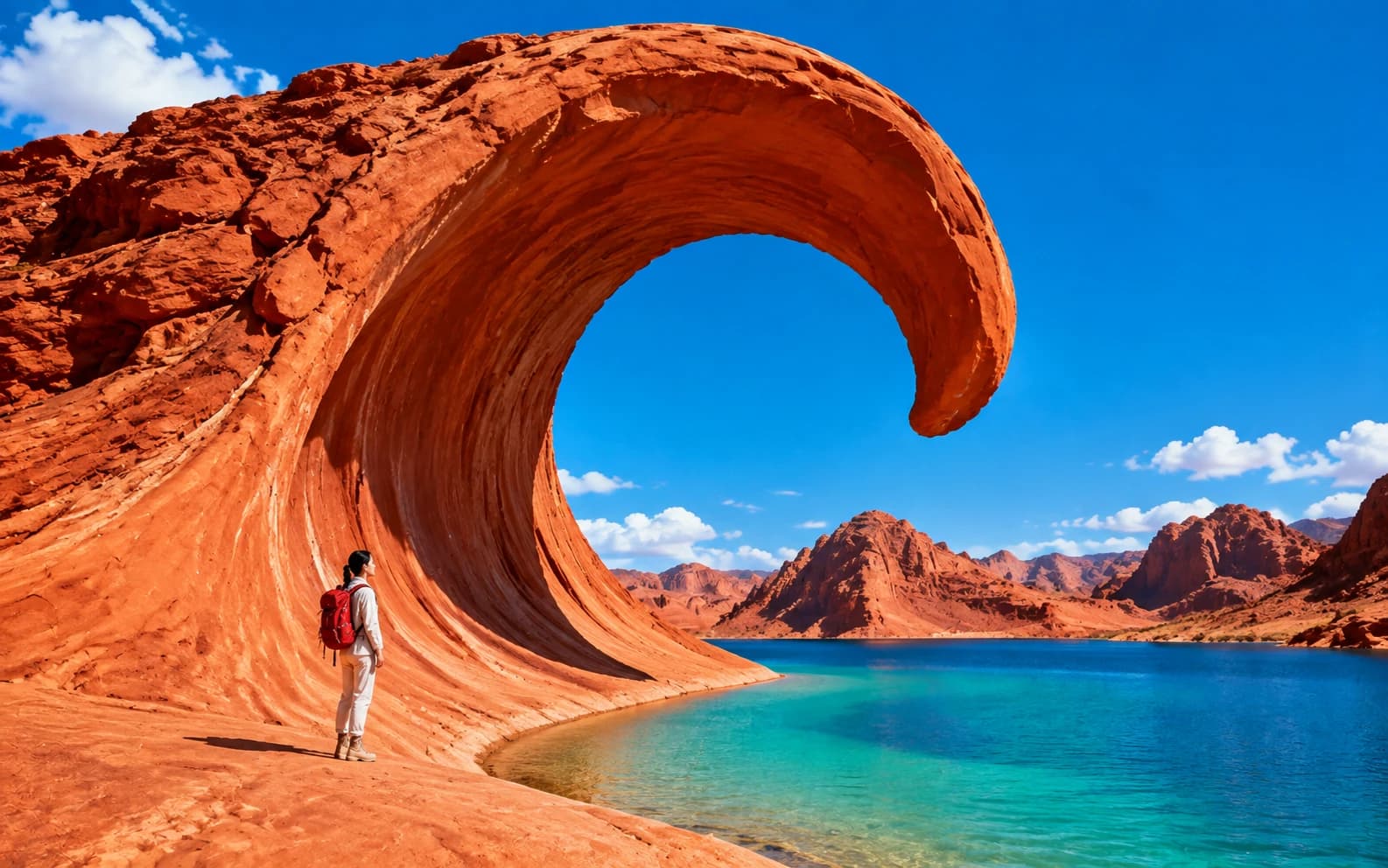
Nano Banana generates landscapes with atmospheric perspective, volumetric haze, and natural light falloff rather than the oversaturated HDR look most AI models default to. These 25+ prompts use a three-layer depth technique (foreground, mid-ground, background) across six scene categories, with specific lighting and composition instructions that produce images with real visual depth.
What this guide covers:
- 25+ copy-paste prompts across six landscape categories (mountains, oceans, forests, deserts, cityscapes, dramatic skies)
- Three-layer depth technique that transforms flat AI landscapes into images with scale and visual journey
- Time-of-day lighting guide with specific prompt phrases for each hour
- Lens and camera references that control perspective and compression
- 5 common mistakes that produce generic, postcard-like results
- Nano Banana vs. Nano Banana 2 comparison for landscape generation
For a broader overview of all prompt categories, see our complete Nano Banana prompts guide. For model-specific techniques, see our Nano Banana 2 prompts guide. Both Nano Banana and Nano Banana 2 are available on Morphed.
Why Does Nano Banana Handle Landscapes Better Than Other AI Models?
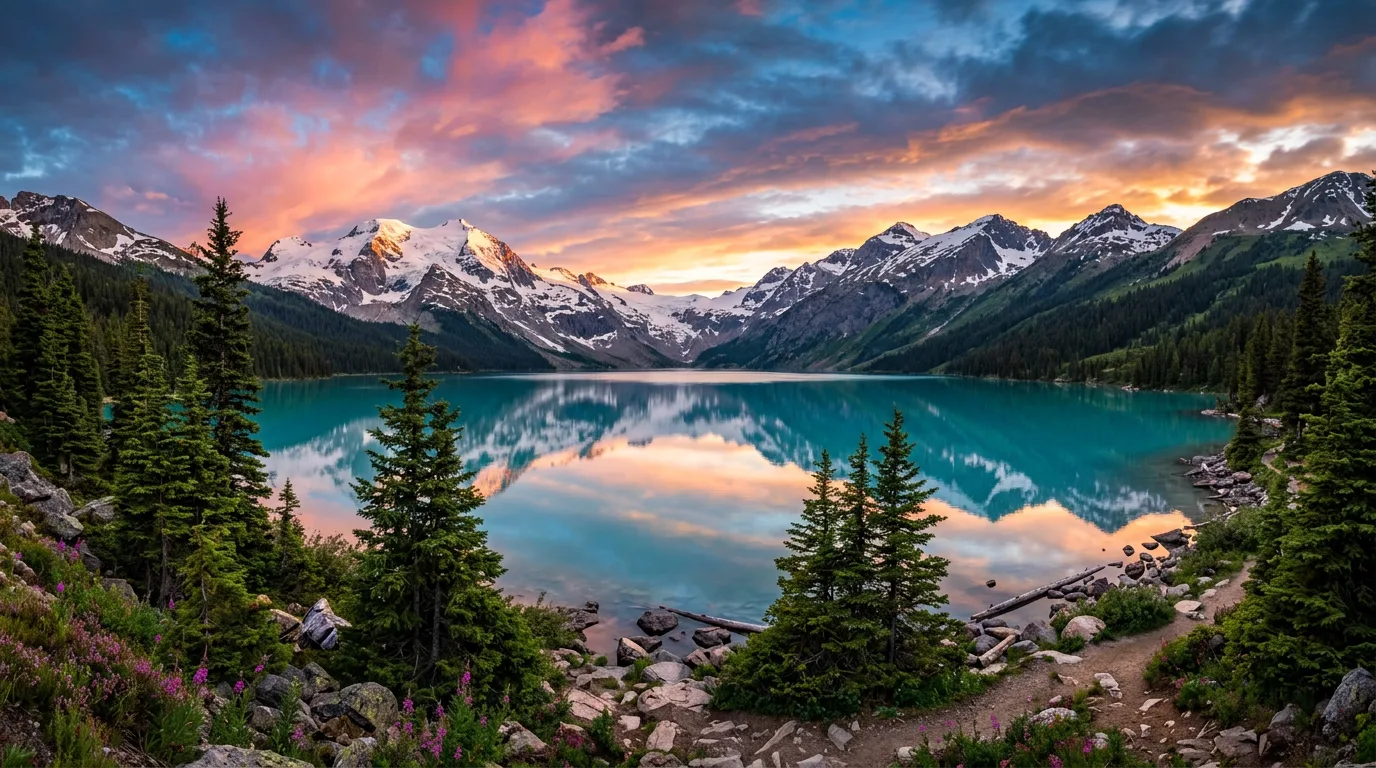
Landscape photography depends on atmospheric depth: fog thinning between mountain layers, light shifting from warm foreground to cool distant peaks, a lake reflecting the sky with slight distortion rather than a perfect mirror. Nano Banana renders these optical effects naturally because it follows lighting and atmosphere instructions literally rather than applying generic stylization.
Where most AI models oversaturate and flatten, Nano Banana preserves the gradual light falloff and color shift that real atmosphere creates. Water, clouds, and haze behave optically rather than decoratively. This makes it particularly effective for scenes that depend on depth: layered mountain ranges, misty forests, and coastal scenes with spray and atmosphere.
Nano Banana 2 adds sharper fine detail in distant foliage and rock textures, native 4K output for large-format prints and wallpapers, and 14 aspect ratios including ultrawide panoramic formats. For landscape work specifically, NB2's resolution advantage is significant: distant tree lines and rock faces retain detail rather than blurring into color blobs. Both models are on Morphed.
| Feature | Nano Banana | Nano Banana 2 | Nano Banana Pro |
|---|---|---|---|
| Atmospheric perspective | Strong natural haze and light falloff | Strong, with sharper distant detail | Strongest, best for complex multi-layer scenes |
| Max resolution | 1K | 4K native | 2K |
| Aspect ratios | Standard set | 14 ratios including ultrawide | Standard set |
| Distant detail (foliage, rock) | Good, softens at distance | Sharp retention at distance | Sharp with more nuance |
| Speed | Fast | Fast | Slower, higher fidelity |
| Best landscape use | Quick generation, social media | Wallpapers, prints, panoramas | Fine art, complex compositions |
How the Three-Layer Depth Technique Works
Professional landscape photographers compose in three layers: foreground, mid-ground, and background. The viewer's eye moves through these layers, creating a sense of depth and scale that flat compositions cannot achieve. AI prompts should replicate this structure explicitly.
Flat prompt (no depth): "Beautiful mountain landscape at sunset"
Three-layer prompt (with depth): "Moss-covered granite rocks in foreground, alpine lake reflecting snow-capped mountains in mid-ground, dramatic golden hour clouds in background, landscape photography, shot on Sony A7R IV 24mm"
The difference is dramatic. The flat prompt produces a generic postcard because the model has no depth instruction. The three-layer prompt creates an image with scale and visual journey: the viewer's eye moves from the rocks to the lake to the mountains to the sky.
The formula: Foreground element with texture + mid-ground subject + background with atmosphere + time of day + camera reference.
Each component does specific work. The foreground creates scale and immediacy. The mid-ground provides the subject. The background adds context and atmosphere. The camera reference controls perspective: 24mm wide-angle exaggerates depth and makes foregrounds feel immersive, while 200mm telephoto compresses layers and makes distant mountains feel stacked. Time of day controls the entire mood.
Which Lighting Produces the Most Dramatic Landscapes?
Time of day is the single most important variable in landscape photography. The same scene looks completely different at each hour, and the prompt phrase you use directly controls the result.
| Time | Light Quality | Best For | Prompt Phrase |
|---|---|---|---|
| Pre-dawn | Deep blue, still, misty | Lakes, valleys, forests | "Pre-dawn blue hour, still water, morning mist" |
| Golden hour (sunrise) | Warm, directional, long shadows | Mountains, prairies, coastlines | "Sunrise golden hour, warm directional light" |
| Morning | Clean, neutral, slight warmth | Forests, waterfalls, meadows | "Clear morning light, neutral tones" |
| Midday | Harsh, flat, minimal shadows | Deserts, tropical beaches (only these) | "Midday harsh sun" (usually avoid this) |
| Golden hour (sunset) | Warm, dramatic, deep shadows | Everything | "Sunset golden hour, dramatic warm light" |
| Blue hour | Cool, moody, balanced ambient | Cityscapes, coastlines | "Blue hour, balanced natural and artificial light" |
| Night | Artificial or moonlight | Cityscapes, astrophotography | "Moonlit night, starry sky" |
Midday is the one time of day to avoid for most landscapes. The overhead sun creates flat, shadowless scenes with no drama. The exception is tropical scenes and desert environments where harsh light is part of the aesthetic.
Advanced lighting keywords that improve results: "volumetric haze," "god rays through clouds," "rim light on mountain edges," "golden light raking across terrain," "cool shadow fill in valleys." These specific terms give the model precise lighting instructions rather than relying on generic "good lighting."
Mountain and Alpine Landscape Prompts
Mountain scenes demand scale, drama, and atmospheric depth. Snow-capped peaks, glacial lakes, and high-altitude light create iconic imagery that depends on the three-layer technique more than any other category.
Prompt: "Moss-covered granite boulders in foreground, alpine lake at sunset with mirror-perfect reflection of snow-capped mountains, golden light on peaks, crystal clear water, dramatic cumulus clouds, landscape photography, shot on Sony A7R IV 24mm"
The moss-covered boulders create foreground interest and scale. The mirror reflection doubles the mountain's impact. The 24mm wide-angle reference creates an expansive, immersive perspective.
Prompt: "Wild alpine flowers in foreground, misty mountain valley at dawn, layers of peaks fading into fog, soft diffused light, moody and atmospheric, landscape photography style, cinematic composition"
Flowers add color and scale. Layers and mist create the atmospheric depth that makes mountain scenes feel vast. Dawn light is softer and more ethereal than golden hour.
Prompt: "Pine tree framing the left side, Swiss Alps meadow with wildflowers, mountain backdrop, blue sky with cumulus clouds, summer alpine photography, vibrant greens and blues, wide-angle landscape"
The pine tree creates a natural frame: a real photography composition technique called foreground framing. The frame draws the viewer's eye inward toward the mountain backdrop.
Prompt: "Stream flowing over rocks in immediate foreground, mountain range in background, autumn colors in mid-ground tree line, overcast soft lighting, Pacific Northwest landscape style"
Prompt (telephoto compression): "Layered mountain ridges receding into distance, each ridge progressively lighter and bluer, atmospheric haze between layers, shot on 200mm telephoto, compressed depth, minimalist mountain landscape"
The 200mm telephoto reference compresses the layers so mountains appear stacked on top of each other. This is the opposite of the wide-angle approach and produces a completely different aesthetic: flat, graphic, and hypnotic rather than immersive.
Coastal and Ocean Landscape Prompts
Coastal scenes combine water movement, dramatic geology, and atmospheric light. The key differentiator is water behavior: long exposure for silky smooth, frozen motion for dramatic waves, or calm reflections for peaceful scenes.
Prompt: "Weathered driftwood in foreground, dramatic coastal cliff at golden hour, waves crashing against rocks with spray and foam, warm sunset light on stone, landscape photography, long exposure water effect"
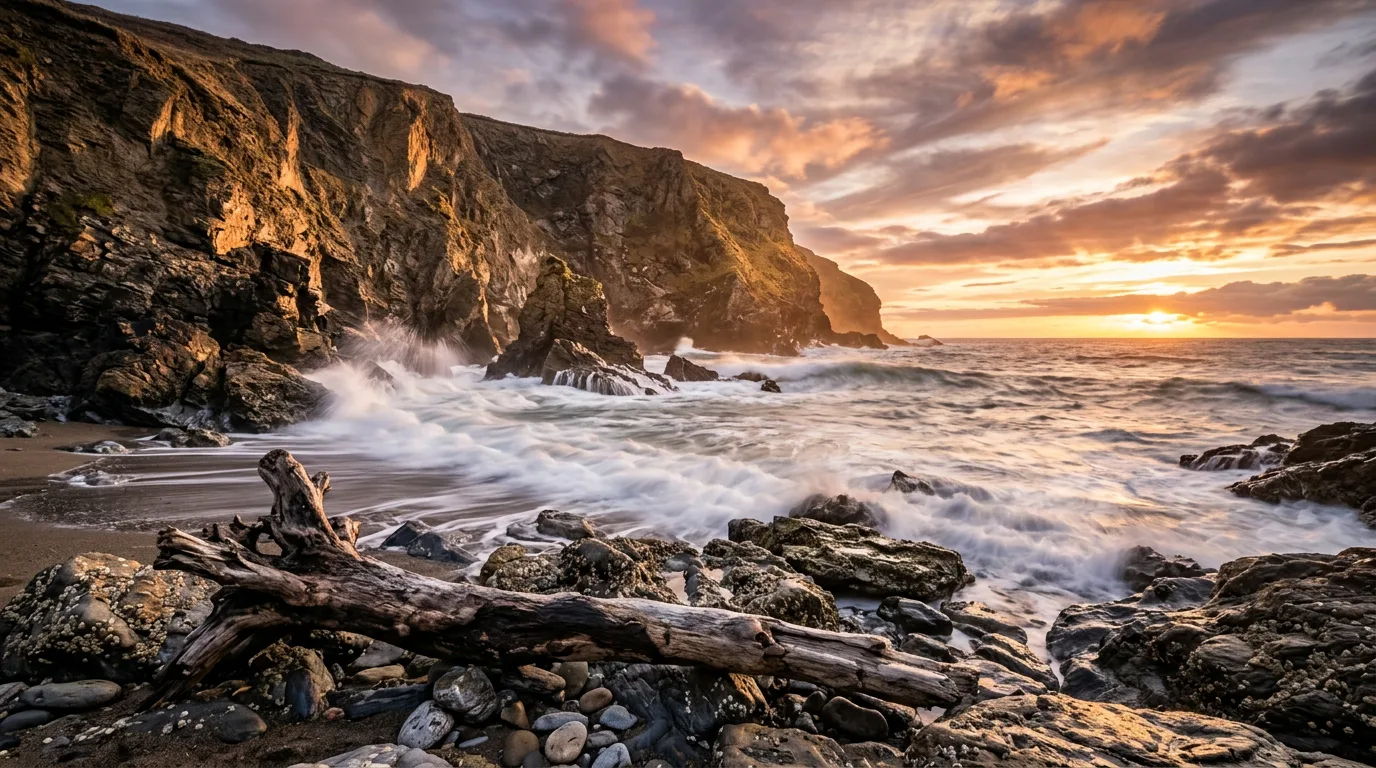
The driftwood anchors the foreground. Waves and spray add motion and energy. The "long exposure water effect" instruction creates silky water motion rather than frozen droplets.
Prompt: "Tide pool with colorful sea life in foreground, tropical beach at sunrise, palm trees silhouetted against soft pink and orange sky, calm turquoise water, paradise landscape photography, peaceful and serene"
Prompt: "Rugged coastline with sea stacks, overcast moody sky, gray and blue palette, wet rocks reflecting sky in foreground, documentary landscape photography, raw and dramatic"
Prompt: "Wave retreating over dark volcanic sand, leaving foam patterns, sunset colors reflected in wet sand, Iceland-inspired black beach, moody and otherworldly, wide-angle close to ground"
Close-to-ground perspective exaggerates the foreground and creates a dramatic, immersive feel. This is a technique real landscape photographers use with tripods set at ankle height. Adding "wide-angle close to ground" or "low angle" to any coastal prompt changes the entire composition.
Forest and Woodland Landscape Prompts
Forest scenes rely on light filtering through canopy, layers of foliage at different depths, and a sense of immersion. The critical element is light interaction: sunbeams, dappled shadows, and the way canopy filters color.
Prompt: "Fern-covered forest floor in foreground, sunbeam through ancient forest canopy, rays of light through mist, moss-covered trunks in mid-ground, green and gold tones, enchanted woodland photography, shallow depth of field on foreground ferns"
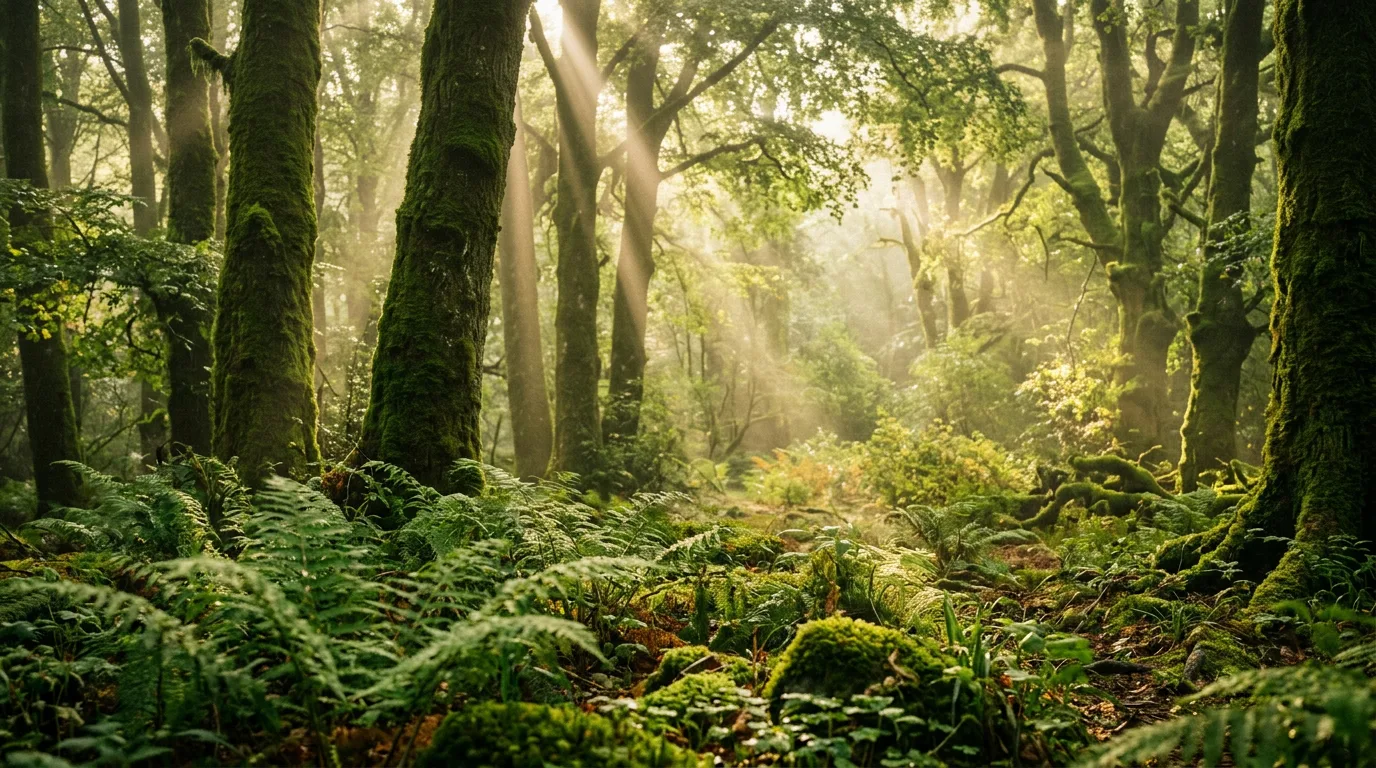
Ferns and moss add texture. Sunbeams create focal points and visual magic. Shallow depth of field draws the eye from sharp foreground ferns through the softer background.
Prompt: "Fallen autumn leaves on a narrow path in foreground, golden canopy tunnel above, trees in full fall colors on both sides, warm afternoon light filtering through, cozy and nostalgic, landscape photography style"
The path creates leading lines, the strongest compositional tool in landscape photography. Leading lines pull the viewer's eye through the scene along a natural trajectory.
Prompt: "Dense bamboo forest, vertical stems receding into distance, soft diffused green light, Japan-inspired, minimalist and serene, low angle looking up"
Prompt: "Birch tree grove, white bark peeling, snow on ground, soft overcast winter light, minimal and stark, Scandinavian forest aesthetic"
Season control tip: The same forest prompt produces dramatically different results when you swap the season keyword. "Ancient oak forest, morning mist" with "spring, fresh green buds" versus "autumn, deep orange and red canopy" versus "winter, bare branches with frost" produces three completely different images from the same base scene.
Desert and Arid Landscape Prompts
Desert scenes offer stark beauty, dramatic shadows, and vast scale. The key challenge is avoiding emptiness: without the three-layer technique, desert prompts produce flat expanses of sand with nothing for the eye to hold onto.
Prompt: "Cracked earth texture in immediate foreground, sand dunes at golden hour with rolling curves and sharp shadows, warm orange and gold tones, minimalist desert landscape, shot on medium format"
Cracked earth adds foreground texture and tells a story about the environment. Medium format reference produces rich color depth and fine detail in the sand textures.
Prompt: "Saguaro cactus silhouette in foreground, Monument Valley style mesas in mid-ground, dramatic sunset sky with red and purple clouds, iconic American Southwest landscape, wide-angle"
Prompt: "Desert oasis with palm trees, small pool reflecting sky, surrounded by dunes, golden hour, rare and precious feeling, landscape photography"
Prompt: "Joshua trees in foreground, Milky Way arching across sky, desert night astrophotography, long exposure, cool blue and purple tones, shot on Sony A7R IV 14mm with star tracker"
Desert astrophotography is a specific niche that performs well on social media and as wallpapers. The 14mm ultra-wide reference captures the full arc of the Milky Way. For best results with astro prompts, use Nano Banana 2 for the sharper star detail at 4K resolution.
Cityscape and Urban Landscape Prompts
Urban landscapes combine architecture, light, and human scale. The key difference from natural landscapes is artificial lighting: city scenes at blue hour and night introduce color contrasts between warm interior lights and cool ambient sky that natural scenes do not have.
Prompt: "Bridge railing in foreground, city skyline at blue hour, lights beginning to turn on, reflection in river, urban landscape photography, cinematic and grand"
The bridge railing creates foreground framing. Blue hour balances natural and artificial light, which is why virtually every professional cityscape photo is shot in this 20-minute window.
Prompt: "Wet cobblestone street in foreground, narrow European alley at golden hour, warm light on old buildings, architectural landscape photography, charming and historic"
Wet surfaces add reflections and richness. Adding "wet" or "rain-slicked" to any urban prompt instantly improves the result.
Prompt: "Rain-slicked pavement in foreground, Tokyo street at night, neon signs reflected in puddles, cyberpunk urban landscape, moody and vibrant"
Prompt: "Empty park bench in foreground, autumn tree-lined path, city park with distant skyscrapers, morning mist, urban nature landscape, contemplative mood"
Golden Hour and Dramatic Sky Prompts
Golden hour and dramatic skies elevate any landscape. In these prompts, the light and sky themselves become the subject rather than just the backdrop.
Prompt: "Prairie grass blowing in wind in foreground, open prairie at golden hour, dramatic clouds with god rays breaking through, epic landscape photography, warm and hopeful, medium format film look"
Prompt: "Lightning bolt splitting dark sky, storm clouds over ocean, rough waves, dark and moody, dramatic sky dominates frame, landscape photography, powerful and awe-inspiring"
Prompt: "Lavender field rows leading to horizon, purple and gold tones at sunset, soft clouds, romantic landscape photography, dreamy and idyllic, leading lines composition"
Lavender rows create strong leading lines that pull the eye to the horizon. Any scene with natural rows (vineyards, crop fields, tulip fields) benefits from this "rows leading to horizon" pattern.
Nano Banana vs. Nano Banana 2 for Landscapes: What to Expect
Both models run the same landscape prompts on Morphed. Where they differ, the pattern below reflects mountain, coastal, forest, desert, cityscape, and dramatic-sky scenes using the three-layer depth technique with specific lighting and camera references.
Atmospheric perspective: Both models handled atmospheric haze and light falloff well. On mountain scenes with 3+ layers of ridges, Nano Banana 2 maintained slightly sharper definition on distant peaks (visible rock texture on the third ridge versus color-only blobs on NB1).
Water rendering: Coastal long-exposure effects were comparable. Both models produced convincing silky water from the "long exposure water effect" prompt phrase. NB2 rendered more detailed foam patterns on wave retreat prompts.
Forest light: Sunbeam prompts (god rays through canopy) produced the most visually striking results on both models. NB2's advantage was subtle but consistent: individual leaves in the canopy were distinguishable rather than a soft green mass, particularly in the mid-ground.
Resolution for prints: This is where NB2 pulls ahead significantly. At 4K native output, landscape images hold detail at wallpaper and print sizes without upscaling artifacts. NB1 images need Morphed's upscaler for anything larger than social media use.
Recommendation: Use Nano Banana for quick iterations and social media landscapes. Use Nano Banana 2 for wallpapers, prints, and any scene where distant detail matters (mountain ridges, forest depth, cityscape architecture).
5 Mistakes That Produce Flat, Generic Landscapes
1. No Foreground Element
The most common mistake. "Mountain landscape at sunset" produces a flat scene with no depth. Adding "moss-covered rocks in foreground" transforms it. Every landscape prompt should have a textured foreground element.
2. Midday Lighting by Default
Unless you are generating a tropical beach or desert scene, midday sun produces flat, harsh, shadowless landscapes. Golden hour, blue hour, dawn, and overcast light all produce more dramatic and atmospheric results. Always specify time of day.
3. Generic Sky Descriptions
"Blue sky" is the least interesting sky option. "Dramatic cumulus clouds with golden light," "thin cirrus clouds in pink sunset," or "storm clouds with single break of light" all produce more compelling results. Name the cloud type and the lighting interaction.
4. Missing Atmospheric Depth
Real landscapes have atmospheric perspective: distant objects appear lighter, bluer, and less detailed due to atmosphere. Add "layers fading into haze" or "mountains softening into distance" to trigger this effect. Without it, foreground and background appear at the same visual distance.
5. No Compositional Structure
"Beautiful mountain landscape" has no composition instruction. "Leading lines toward mountain peak," "foreground framing with pine branches," or "S-curve river leading to mountains" give the model specific compositional tools to work with. Real photographers plan composition deliberately, and the model needs the same direction.
When AI Landscapes Are the Wrong Choice
AI-generated landscapes are not always the right tool. These are the specific scenarios where they fall short:
Editorial or documentary use. If you need a photo of an actual location for journalistic, editorial, or documentary purposes, AI generation will produce something that looks like the place but is not the place. Geological features, vegetation patterns, and architectural details will be plausible but fabricated.
Geographically accurate travel content. An AI-generated "Yosemite Valley at sunrise" will capture the mood but may invent rock formations or misplace waterfalls. If geographic accuracy matters (travel guides, location marketing), use real photography or clearly label AI images.
Print sales as fine art photography. Buyers of fine art landscape prints expect real places captured by a photographer. AI landscapes are better suited for wallpapers, backgrounds, concept art, and social media rather than gallery sales.
Matching a specific real-world reference. If a client says "I want something that looks exactly like this reference photo," AI generation is unpredictable. It will interpret the mood but not replicate exact compositions. Use image-to-image workflows on Morphed for closer reference matching.
Tips for Stronger Landscape Prompts
-
Always include foreground. Rocks, flowers, sand texture, tree branches, fence posts, or anything with texture and detail close to the camera.
-
Specify time of day explicitly. "Golden hour," "blue hour," "dawn," "overcast" controls mood more than any other single variable.
-
Reference camera and lens. "Shot on Sony A7R IV 24mm" for wide expansive landscapes. "Medium format" for rich color depth. "Telephoto 200mm" for compressed, layered mountain scenes.
-
Control the sky. Name the cloud type and lighting. "Dramatic cumulus with god rays" is specific enough to produce stunning results. "Blue sky" is never specific enough.
-
Use composition terms. "Leading lines," "rule of thirds," "foreground framing," "S-curve" translate directly to layout decisions the model can execute.
-
Add atmospheric depth keywords. "Layers fading into haze," "distant mountains softening," "morning mist in valley," "volumetric haze" all increase the sense of distance and scale.
-
Match mood to intent. "Moody and atmospheric" for fine art. "Vibrant and hopeful" for travel. "Raw and documentary" for editorial.
-
Experiment with seasons. The same base prompt with different season keywords produces entirely different images. Swap "spring, fresh green" for "autumn, deep red and orange" or "winter, frost and bare branches."
Frequently Asked Questions
What are the best Nano Banana prompts for landscape photography?
The best prompts use the three-layer technique (foreground, mid-ground, background), specify time of day, include camera references, and control the sky. "Moss-covered rocks in foreground, alpine lake reflecting mountains, dramatic golden hour clouds, landscape photography, shot on Sony A7R IV 24mm" is a strong template. See all six categories above for 25+ ready-to-use examples.
Can Nano Banana create realistic landscape images?
Yes. Nano Banana renders atmospheric perspective, volumetric haze, and natural light falloff that most AI models flatten into oversaturated HDR. Use "landscape photography" as your style keyword and reference real camera equipment. Nano Banana 2 adds sharper distant detail and native 4K output for print-quality landscapes.
How do I get dramatic skies in my landscape prompts?
Specify the cloud type ("dramatic cumulus," "storm clouds," "thin cirrus"), lighting effect ("god rays," "golden light on cloud edges"), and mood ("dramatic," "ominous," "peaceful"). Time of day matters: golden hour and approaching storms produce the most dramatic skies. Avoid "blue sky" as it produces the least interesting results.
What camera reference should I use for landscape prompts?
"Sony A7R IV 24mm" for wide vistas with exaggerated depth. "Medium format" for rich detail and color depth. "Telephoto 200mm" for compressed mountain layers that appear stacked. The lens focal length has more impact than the camera body: 24mm feels expansive and immersive, 200mm feels graphic and layered.
Where can I run these landscape prompts?
On Morphed with Nano Banana, Nano Banana 2, and Nano Banana Pro. Nano Banana 2 is recommended for landscapes because of 4K native output and sharper distant detail. The platform includes built-in upscaling for wallpaper and print quality.
Generate Landscapes on Morphed
Run these landscape prompts on Morphed and experiment with time of day, weather conditions, and season. The same mountain scene at golden hour versus blue hour produces dramatically different results worth comparing side by side.
Related guides: Nano Banana prompts for wallpapers | Nano Banana prompts for aesthetic pictures | Nano Banana prompts for real estate | Nano Banana 2 prompts guide | Complete Nano Banana prompts guide