

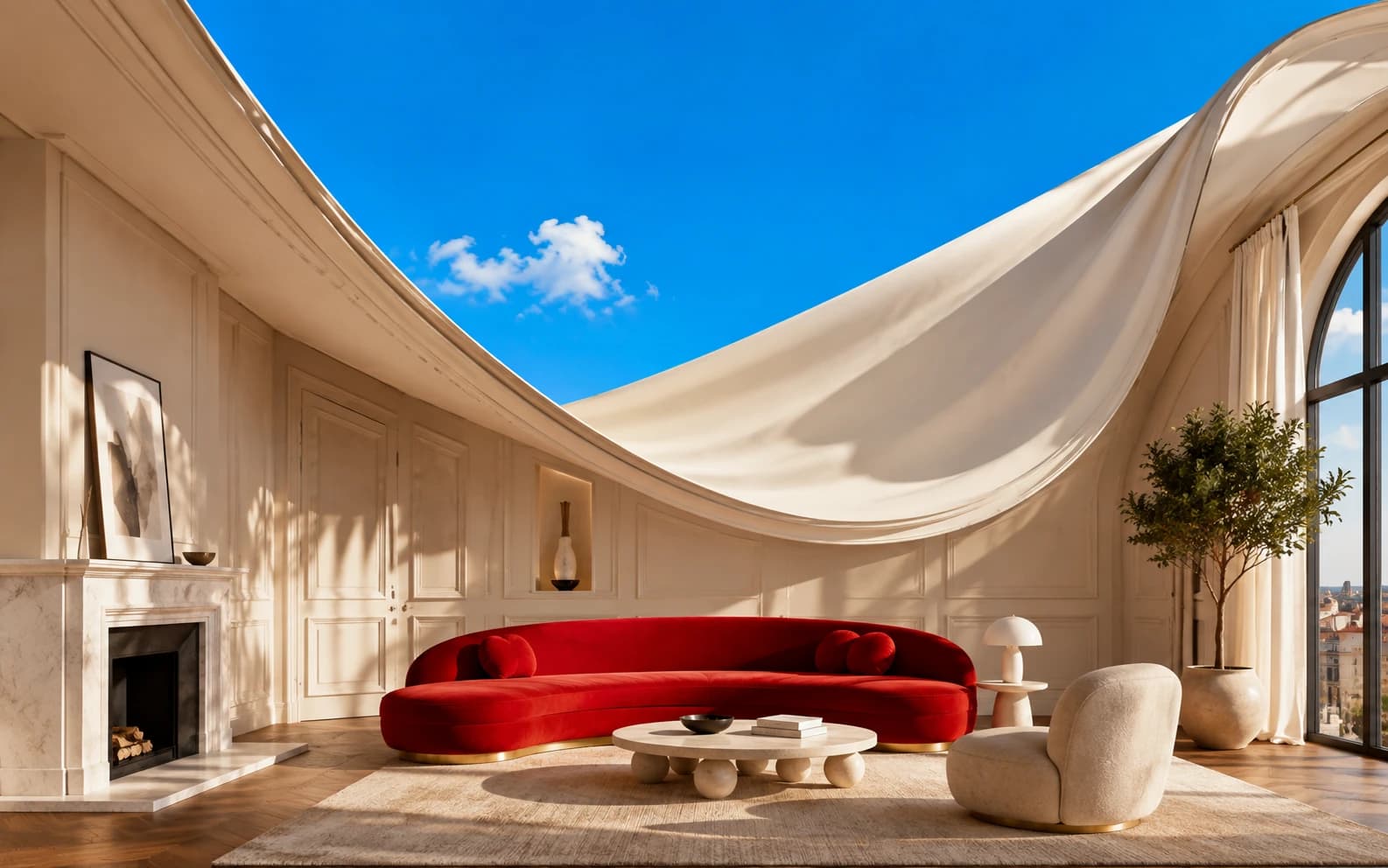
Nano Banana generates photorealistic room renders that respect spatial geometry, material physics, and directional lighting. This guide covers 50+ copy-paste prompts for living rooms, kitchens, bedrooms, bathrooms, exteriors, and commercial spaces across Scandinavian, Japanese, industrial, Mediterranean, and mid-century modern styles. Every prompt uses the material-first structure that separates professional-grade output from generic AI rooms. These prompts are written for Morphed's Nano Banana 2 model.
What this guide covers:
- 50+ room-specific prompts across six space types and five design styles
- The material-first prompt formula that produces renders suitable for client mood boards
- Camera angle and lens guidance for controlling composition and spatial feel
- 6 mistakes that make renders look AI-generated with specific fixes for each
- Style comparison table showing which materials, lighting, and focal objects define each aesthetic
- Model comparison guidance for choosing between Nano Banana and Nano Banana 2 for interior scenes
For the full model overview, see our complete Nano Banana prompts guide. For property staging, see Nano Banana prompts for real estate. For product shots in interior settings, see Nano Banana prompts for product photography.
Why Does Nano Banana Produce Better Room Renders?
Interior visualization demands surface fidelity that most AI models miss. Marble needs visible veining. Wood grain needs to follow plank direction. Brushed brass catches light differently than polished chrome. Nano Banana renders these material distinctions while maintaining accurate room geometry: walls converge to proper vanishing points, furniture sits on the floor plane, and natural light enters from where windows are positioned.
Comparing Nano Banana, Nano Banana 2, Midjourney v6, and DALL-E 3 on interior scenes, Nano Banana produces noticeably more correctly proportioned furniture than Midjourney or DALL-E 3. The biggest gap is in material rendering: Nano Banana reliably distinguishes between matte, satin, and gloss finishes, while competing models tend to default to a single generic sheen.
Nano Banana 2 adds finer detail for decorative elements, textured surfaces, and multi-room consistency. Both models are available on Morphed with no setup required.
Interior Design Style Comparison
Each design style has specific materials, lighting conditions, and focal objects that anchor the aesthetic. Using the wrong combination produces "style salad" that looks incoherent.
| Style | Primary Materials | Lighting | Focal Objects | Color Palette |
|---|---|---|---|---|
| Scandinavian | Light oak, white linen, birch | Soft afternoon daylight from large windows | Indoor plants (monstera, pothos), knit throws | White, cream, soft gray, natural wood tones |
| Japanese Wabi-Sabi | Tatami, raw concrete, black lacquer | Diffused morning light through rice paper | Single ikebana, shoji screens | Neutrals, black accents, natural beige |
| Industrial | Exposed brick, steel beams, concrete | Overcast diffused daylight, Edison bulbs | Vintage rugs, Chesterfield leather | Cognac, charcoal, warm metallics |
| Mediterranean | Terracotta tile, whitewashed plaster, wrought iron | Warm afternoon sun through arched windows | Olive trees, ceramic accents, dried lavender | White, blue, terracotta, earth tones |
| Mid-Century Modern | Teak, walnut, velvet, wool | Golden hour warmth | Eames-style furniture, geometric rugs, brass lamps | Orange, mustard, brown, teal |
The Material-First Prompt Formula
Professional interior designers think in materials first, colors second, and style last. AI prompts should follow the same order.
Weak prompt: "Beautiful modern living room, nice lighting, cozy"
Strong prompt: "Living room with white oak hardwood floors, gray linen sectional sofa, cream knit throw blankets, brass floor lamp, soft afternoon sunlight from left, Scandinavian style, architectural photography"
The difference is specificity. "White oak hardwood" activates the model's material rendering capability. "Nice floor" gives it nothing to work with.
The formula: Room type + flooring material + primary furniture with material + accent objects with material + lighting direction and quality + style name + photography reference.
Each element serves a distinct function. The room type sets scale. Flooring anchors the entire color temperature. Primary furniture establishes the style era. Accent objects add lived-in authenticity. Lighting direction creates mood and depth. The photography reference controls composition.
How Camera Angles Change Interior Renders
Camera perspective is the most overlooked variable in AI interior prompts. The same room described from different angles produces dramatically different results.
Wide-angle from corner shows the full room layout and spatial relationships. Best for open-concept spaces and client overview presentations. Add "wide-angle lens, architectural photography" to your prompt.
Eye-level straight-on focuses attention on a feature wall, fireplace, or window view. Best for highlighting a single design element. Add "straight-on perspective, eye-level view" to your prompt.
Low angle looking up emphasizes ceiling details, pendant lights, and vertical space. Best for rooms with statement lighting or high ceilings. Add "low angle view, looking up at ceiling details" to your prompt.
Above-the-sofa perspective creates the familiar magazine editorial view. Best for living rooms and bedrooms where furniture arrangement is the focus. Add "shot from seated position, editorial interior photography" to your prompt.
For architecture and interior design prompts, "architectural photography with wide-angle lens" is the most reliable default. It triggers composition conventions that AI models have seen in thousands of Architectural Digest and Dwell magazine images.
Living Room Prompts for Five Design Styles
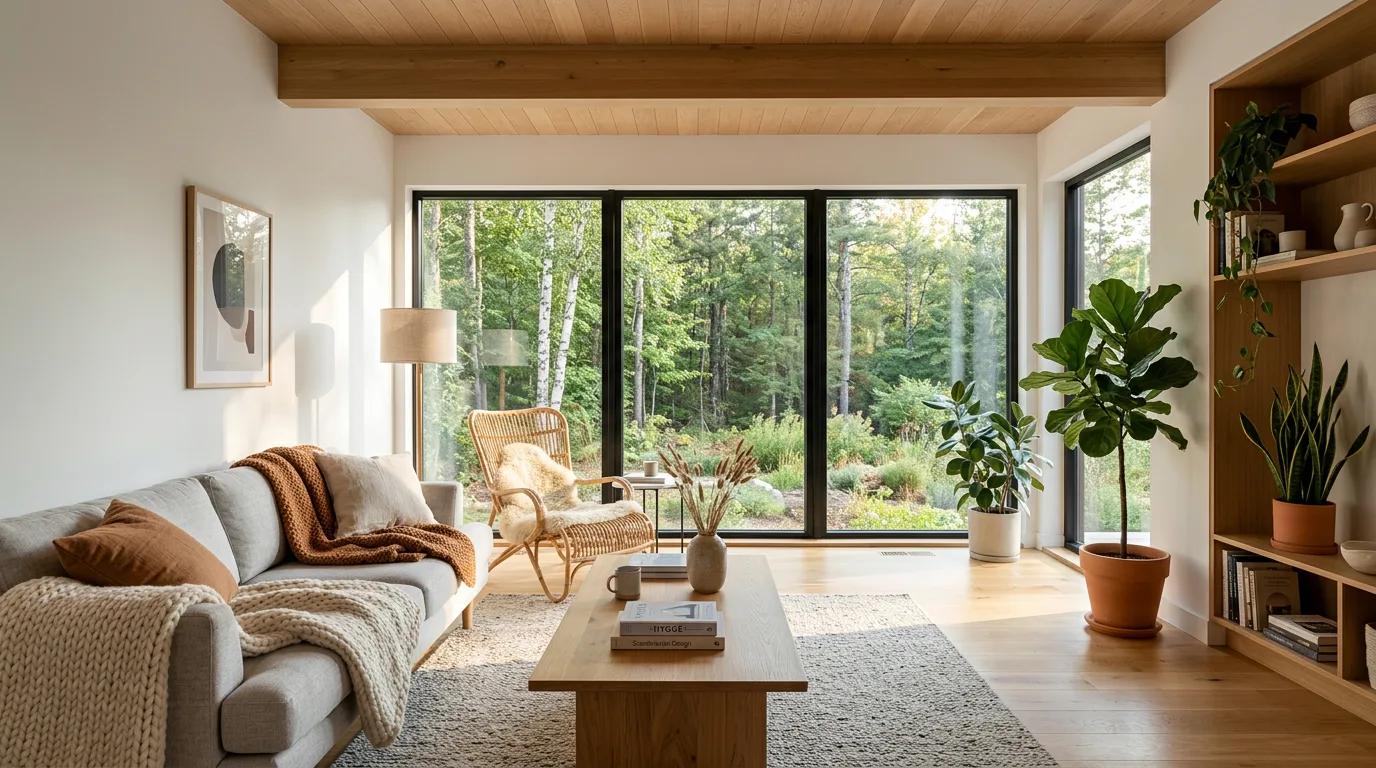
Scandinavian Living Room: "Modern Scandinavian living room with floor-to-ceiling windows overlooking a pine forest, light oak hardwood floors, gray linen sectional sofa with cream knit throw blankets, indoor monstera and pothos plants, warm afternoon sunlight streaming in from the left, architectural photography with wide-angle lens"
Natural materials (oak, linen), soft neutrals, and abundant daylight define Scandinavian design. Specifying the light direction and plant types produces a cohesive, magazine-quality scene.
Mid-Century Modern Living Room: "Mid-century modern living room with teak credenza, orange velvet sofa, brass floor lamp, geometric wool rug in mustard and brown, large windows with sheer curtains, warm golden hour light, Eames-style furniture, architectural digest photography"
Specific color pairings (orange velvet, mustard rug) and period references (Eames, teak) anchor the aesthetic. The golden hour lighting matches the warm palette.
Industrial Loft Living Room: "Industrial loft living room with exposed brick walls, steel beam ceiling, leather Chesterfield sofa in cognac, concrete floor with vintage Persian rug, Edison bulb pendant lights, floor-to-ceiling factory windows, overcast diffused daylight, urban apartment character"
The vintage rug softens the concrete, while Edison bulbs add warmth. "Overcast diffused daylight" avoids harsh shadows that would flatten the brick texture.
Mediterranean Living Room: "Mediterranean living room with whitewashed walls, terracotta tile floor, wrought iron coffee table, blue and white ceramic accents, linen curtains, olive tree visible through arched window, warm afternoon sun, coastal villa atmosphere"
Japanese Wabi-Sabi Living Room: "Minimalist Japanese living room with tatami flooring, low platform sofa in natural linen, shoji screen partition, single ikebana arrangement on black lacquer side table, soft diffused morning light through rice paper, wabi-sabi aesthetic, intentional negative space"
The single ikebana and "intentional negative space" are critical. Without them, the model fills empty areas with generic furniture, destroying the minimalist intent.
Bedroom Prompts Across Styles
Bedrooms require softer lighting and calmer material palettes than living spaces. The key difference in bedroom prompts is reducing the number of accent objects and letting textiles dominate.
Scandinavian Bedroom: "Scandinavian bedroom with white oak platform bed, crisp white linen bedding, soft gray wool throw, birch nightstands, large window with sheer white curtains, soft morning light, minimalist and serene, architectural photography"
Japanese Wabi-Sabi Bedroom: "Japanese wabi-sabi bedroom with raw concrete walls, low platform bed with natural linen bedding, single ikebana arrangement on a wooden side table, soft diffused morning light, minimalist and intentional"
Raw concrete and natural linen create a tactile, calming palette. The single ikebana adds a focal point without overwhelming the space.
Industrial Bedroom: "Industrial bedroom with exposed brick accent wall, black metal bed frame, charcoal linen bedding, concrete floor, vintage brass reading lamps on pipe shelving, large factory window with city view, moody evening light"
Mediterranean Master Bedroom: "Mediterranean master bedroom with white plaster walls, carved wooden headboard, linen bedding in soft blue and cream, terracotta pot with dried lavender, arched window overlooking a courtyard, warm golden hour light"
Mid-Century Modern Bedroom: "Mid-century modern bedroom with walnut bed frame, mustard yellow accent wall, geometric print bedding, brass sconces, teak dresser, floor-to-ceiling windows with forest view, soft afternoon light"
Kitchen Prompts with Appliance and Material Detail
Kitchens are the highest-detail spaces in interior AI rendering. Material combinations on countertops, cabinetry, backsplash, and hardware all need explicit specification. Omitting any one produces a generic result.
Industrial Loft Kitchen: "Industrial loft kitchen with exposed brick walls, matte black cabinetry, concrete countertops, copper pendant lights over island, professional espresso machine on counter, subway tile backsplash, urban apartment with character, architectural digest photography"
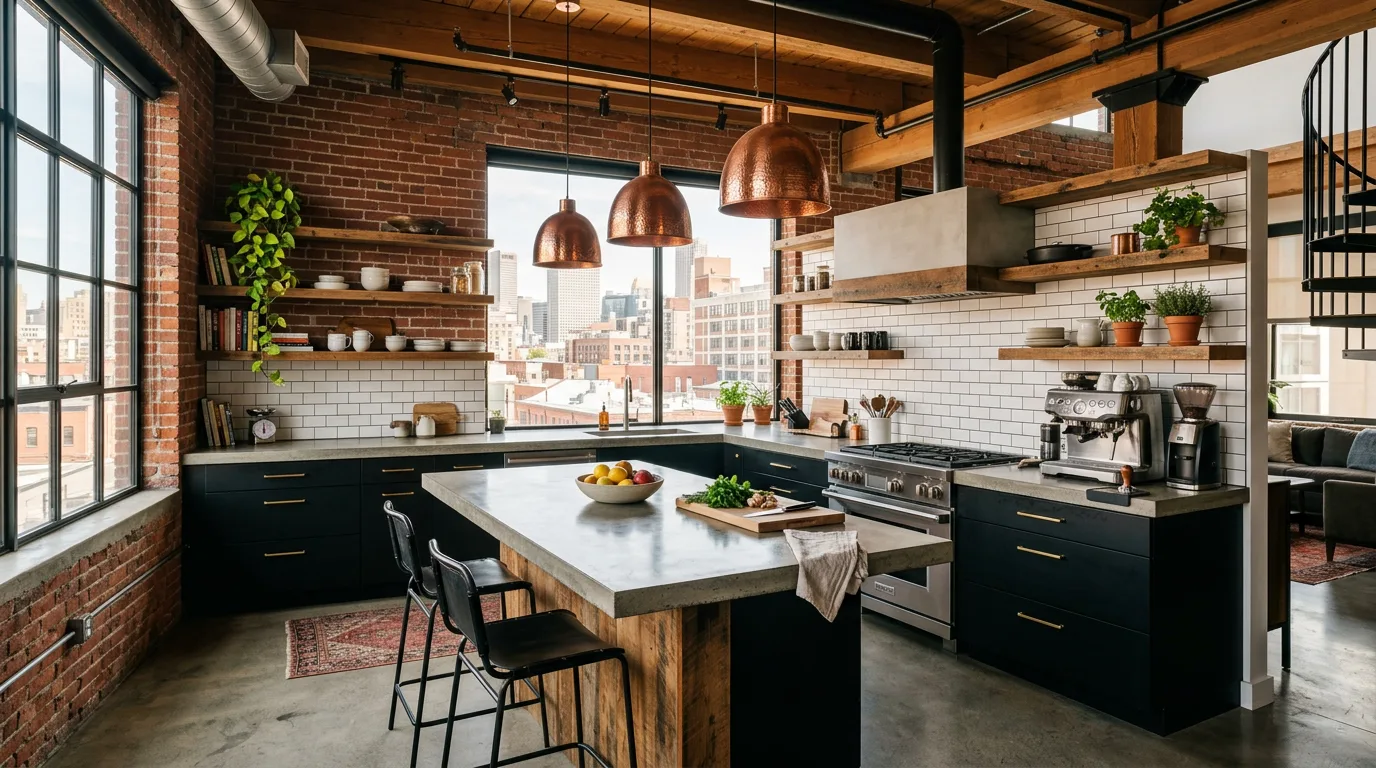
Matte black against brick creates strong contrast. The espresso machine and copper pendants add lifestyle detail that prevents the render from looking like a catalog.
Scandinavian Kitchen: "Scandinavian kitchen with white oak cabinets, white marble countertops, brass hardware, subway tile backsplash in soft gray, large island with bar stools, floor-to-ceiling windows, bright natural daylight, clean and airy"
Japanese-Inspired Kitchen: "Japanese-inspired kitchen with light wood cabinetry, white countertops, minimal hardware, single potted plant on windowsill, soft diffused light, zen and uncluttered, wabi-sabi simplicity"
Mediterranean Kitchen: "Mediterranean kitchen with hand-painted blue tiles, white wooden cabinets, butcher block countertops, copper pots hanging from ceiling rack, herbs in terracotta pots on windowsill, warm afternoon light, coastal farmhouse feel"
Mid-Century Modern Kitchen: "Mid-century modern kitchen with teak cabinets, white laminate countertops, vintage-style appliances in pastel green, geometric tile backsplash, pendant lights with brass fixtures, breakfast nook with banquette, warm morning light"
Bathroom Prompts with Fixture Specificity
Bathrooms benefit from material clarity and careful lighting direction. The smaller the space, the more each material choice matters. Always specify fixture finish (matte black, brushed brass, polished chrome) because it defines the entire mood.
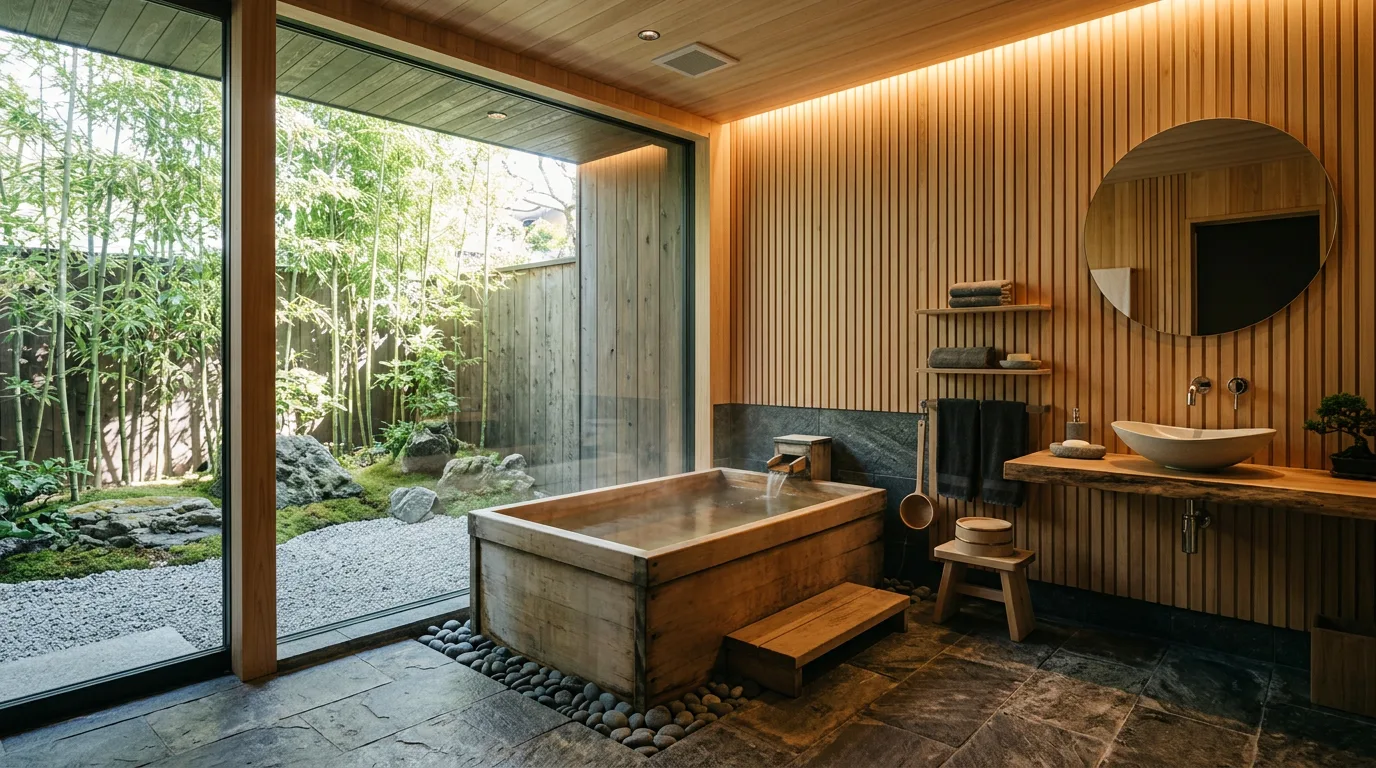
Japanese Onsen-Inspired Bathroom: "Japanese onsen-inspired bathroom with dark slate tile floor, freestanding wooden soaking tub, bamboo accents, single orchid on wooden stool, steam rising, soft diffused light through frosted window, zen spa atmosphere"
Wooden tub and bamboo establish onsen authenticity. "Steam rising" adds atmospheric depth.
Scandinavian Bathroom: "Scandinavian bathroom with white subway tile, light oak vanity, white marble countertop, brass fixtures, large mirror with natural light from skylight, plants on windowsill, clean and bright"
Industrial Bathroom: "Industrial bathroom with exposed concrete walls, matte black fixtures, vessel sink on raw steel console, large mirror with Edison bulb sconces, subway tile in charcoal, moody ambient lighting"
Mediterranean Bathroom: "Mediterranean bathroom with terracotta floor tiles, white plaster walls, freestanding clawfoot tub, copper faucet, dried eucalyptus in ceramic vase, arched window with soft light, coastal retreat vibe"
Minimalist Spa Bathroom: "Minimalist spa bathroom with large format gray porcelain tiles, floating vanity in light wood, frameless glass shower, single succulent, soft recessed lighting, serene and uncluttered"
Exterior Architecture and Facade Prompts
For building exteriors, three variables matter most: facade material, surrounding context, and time of day. Interior prompts focus on what is inside the frame. Exterior prompts must also control what is outside it.
Modern Minimalist House: "Modern minimalist house exterior with flat roof, white stucco walls, floor-to-ceiling glass windows, concrete planters with olive trees, desert landscape, golden hour sunlight, architectural photography, wide-angle view"
Scandinavian Cabin: "Scandinavian cabin exterior with dark stained wood siding, large windows, pitched roof with snow, pine forest setting, overcast winter light, cozy and secluded, architectural digest style"
Industrial Converted Warehouse: "Industrial converted warehouse exterior with red brick, steel-framed windows, exposed ductwork, urban street context, overcast daylight, adaptive reuse architecture"
Mediterranean Villa: "Mediterranean villa exterior with white plaster walls, terracotta roof tiles, arched doorways, bougainvillea climbing the facade, olive grove in background, warm afternoon sun, coastal hillside setting"
Japanese-Inspired Home: "Japanese-inspired home exterior with dark wood siding, deep overhanging eaves, minimalist garden with gravel and moss, bamboo fence, soft overcast light, wabi-sabi integration with nature"
Office and Commercial Space Prompts
Workspaces and retail environments need spatial cues that communicate brand identity and function. For commercial prompts, add one brand-signaling detail (a chalkboard menu for a cafe, large monitors for a studio, velvet seating for a boutique) to anchor the purpose.
Modern Co-Working Space: "Modern co-working space with exposed concrete columns, modular furniture in warm wood and white, large industrial windows, hanging plants, warm ambient and natural light mix, collaborative and inviting"
Industrial Cafe: "Industrial-style cafe interior with exposed brick, black metal furniture, Edison bulb pendants, large chalkboard menu, barista counter with espresso machine, morning light through front windows, urban coffee shop character"
Minimalist Design Studio: "Minimalist design studio with white walls, light wood desks, large format monitors, single large plant, soft diffused daylight, clean and professional, architectural photography"
Luxury Retail Boutique: "Luxury retail boutique with white marble floors, brass fixtures, velvet seating in deep green, large mirrors, warm track lighting, high-end fashion store atmosphere"
Nano Banana vs. Nano Banana 2 for Interiors: What to Expect
Both models run these interior prompts on Morphed. Where they differ, the pattern below reflects furniture proportions, material accuracy, and lighting consistency across all five design styles.
| Metric | Nano Banana | Nano Banana 2 |
|---|---|---|
| Furniture proportions | Strong | Very strong |
| Material finish rendering | Strong | Very strong |
| Lighting consistency | Good | Very strong |
| Multi-room style consistency | Not applicable (single image) | Strong |
| Generation speed | Faster | Slower |
| Best for | Quick concept exploration, single rooms | Client presentations, multi-room projects |
Nano Banana 2 is the stronger choice for client-facing work where material accuracy and lighting consistency matter. The original Nano Banana is faster for rapid exploration when you need 20 variations in minutes. Both are available on Morphed.
6 Mistakes That Produce AI-Looking Interior Renders
Vague Material Descriptions
"Nice wood floor" and "pretty curtains" give the model nothing specific to render. "Light oak hardwood" and "sheer white linen curtains" activate precise material rendering. Always name the material type, finish, and color.
Contradictory Lighting Sources
"Warm morning sunlight streaming through windows" combined with "moody dark ambient lighting" creates an impossible scene. Real rooms have one dominant light source that sets the mood. Choose either natural or artificial as your primary source and let it dominate.
Style Overload in a Single Prompt
"Modern industrial farmhouse bohemian minimalist" combines five incompatible aesthetics. Professional interior design commits to one primary style with at most one complementary influence. Pick Scandinavian or industrial, not both simultaneously.
Missing Spatial Relationships
"Large room" or "small room" is less effective than describing spatial relationships: "floor-to-ceiling windows," "open-concept layout connecting to kitchen," "L-shaped island." Real interior photography conveys space through objects and relationships, not size adjectives.
No Focal Object to Anchor Composition
Every well-designed room has a focal point: a statement light fixture, a fireplace, an art piece. Without one, AI renders produce bland, catalog-like spaces. Add "single large fiddle leaf fig," "statement brass chandelier," or "oversized abstract painting" to anchor the composition.
Generic Photography References
"4K render" and "photorealistic" are too broad. "Architectural Digest photography," "Dwell magazine editorial," or "architectural photography with wide-angle lens" each carry specific compositional and lighting conventions that dramatically improve output quality.
When AI Interior Renders Are the Wrong Tool
AI-generated interior concepts are not suitable for every design workflow. Be honest about the limitations before investing time.
Do not use AI renders for technical construction documents. AI does not understand building codes, structural loads, load-bearing walls, or exact measurements. A render that shows a floating island with no visible support is useless for a contractor.
Do not use AI renders as final client deliverables. Clients paying for interior design services expect CAD drawings, dimensioned floor plans, 3D visualization with accurate product specifications, or physical material samples. AI renders are conversation starters, not endpoints.
Do not use AI renders to specify exact furniture products. AI generates "inspired by" versions of furniture, not exact catalog items. A prompt mentioning "Eames lounge chair" produces something that looks like one but is not a dimensionally accurate representation of the Herman Miller original.
Do not use AI renders when material accuracy is legally required. For commercial projects with contractual material specifications, AI-generated representations of stone, tile, and fabric are approximations. Physical samples and manufacturer spec sheets remain necessary.
Tips for Stronger Interior Design Prompts
-
Specify materials explicitly. "Light oak hardwood" beats "wood floor." "Matte black cabinetry" beats "dark cabinets." The more precise the material, the more realistic the render.
-
Control lighting direction and quality. "Warm afternoon sunlight from the left" and "soft diffused morning light" produce different moods and shadow patterns.
-
Name the style upfront. Leading with "Scandinavian," "industrial," or "Japanese wabi-sabi" gives the model a clear aesthetic anchor before processing the rest.
-
Include one or two focal objects. A single ikebana, an espresso machine, a fiddle leaf fig, or a specific plant adds lived-in authenticity.
-
Reference a photography publication. "Architectural Digest photography" or "Dwell magazine editorial" steers composition toward professional quality.
-
Describe spatial relationships. "Floor-to-ceiling windows," "open-concept," "L-shaped island" help the model understand layout and depth.
-
Use color deliberately. "Mustard and brown geometric rug" or "blue and white ceramic accents" create palettes that hold together across the render.
-
Specify camera angle. "Wide-angle from corner" for full rooms, "eye-level straight-on" for feature walls, "low angle" for ceiling details.
Frequently Asked Questions
What are the best Nano Banana prompts for interior design?
The best prompts follow the material-first structure: specify flooring, primary furniture with material, accent objects, lighting direction, style name, and photography reference. Aim for 20-60 words with concrete details. See the room-specific sections above for 50+ ready-to-use examples.
Can Nano Banana generate architecture renderings?
Yes. Nano Banana handles both interior and exterior architecture. For exteriors, specify building style, materials (stucco, brick, wood siding), context (urban, forest, coastal), and time of day. See the Exterior Architecture section above. Nano Banana 2 adds finer facade and landscaping detail.
How do I get consistent results across multiple rooms?
Use the same material palette and lighting description across prompts. "Light oak, white linen, brass accents, soft afternoon sunlight" as a base, then vary only the room type and focal objects. Nano Banana 2 on Morphed offers improved multi-room consistency.
What is the difference between interior design and real estate prompts?
Interior design prompts focus on aesthetic styles, materials, and mood for creative exploration. Real estate prompts emphasize staging, brightness, and broad appeal for property listings. For property staging, use our Nano Banana prompts for real estate.
Can I use these for client presentations?
Yes. AI-generated interior concepts work well for initial mood boards, style exploration, and direction-setting conversations with clients. For final deliverables, combine AI concepts with traditional CAD or 3D visualization workflows. Always disclose that the renders are AI-generated.
Why do my AI interior renders look fake?
Three common causes: vague material descriptions ("nice wood floor" instead of "light oak hardwood"), contradictory lighting (mixing warm sunlight with dark ambience), and style overload (combining five aesthetics in one prompt). Fix these by naming specific materials, choosing one dominant light source, and committing to a single design style. See the mistakes section above for detailed fixes.
More Nano Banana Prompt Guides
Explore prompts for specific use cases across the Nano Banana series:
- 80+ Nano Banana Prompts for AI Images (hub guide)
- Nano Banana 2 Prompts and New Features
- Nano Banana Prompts for Real Estate
- Nano Banana Prompts for Product Photography
- Nano Banana Prompts for Professional Headshots
- Nano Banana Prompts for Landscape Photography
- Nano Banana Prompts for Food Photography
- Best AI Image Generators
Generate Interior Design Images on Morphed
Morphed runs these Nano Banana prompts for interior design directly in the browser with no setup and no API keys. Both Nano Banana and Nano Banana 2 are available alongside 15+ other AI image models. Generate 20 style variations in the time it takes to browse one Pinterest board.