

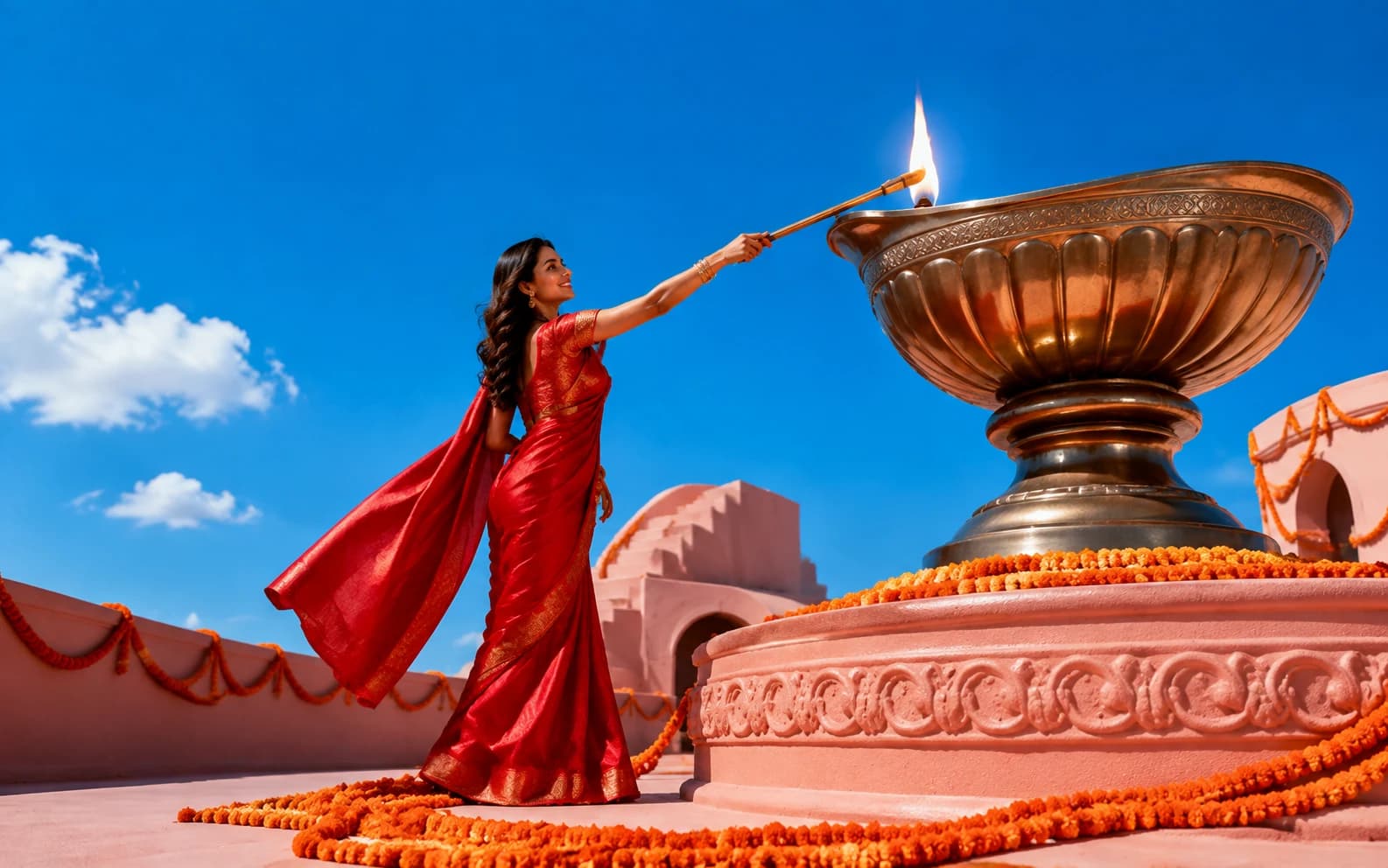
The single biggest problem with AI Diwali images: warm-toned lighting on a vaguely Indian scene that could be any festival from Navratri to Pongal. The diyas look like generic candles. The rangoli looks like a mandala coloring book. The outfits are a mashup of regional styles that no one actually wears together. Across Nano Banana, Nano Banana 2, and Nano Banana Pro on Morphed, one technique consistently fixes this: cultural layering. Describe Diwali-specific elements in stacked layers of material, light, and ritual detail rather than relying on "Indian festival" as a prompt.
"Diwali celebration" is too vague and produces a generic warm-toned scene. "Brass diyas arranged on white marble threshold, marigold toran draped across doorframe, turmeric-yellow rangoli in traditional kolam pattern, warm candlelight from diyas casting long shadows" gives the model enough stacked cultural detail to render something that looks specifically like Diwali, not a stock image of South Asian festivity.
Quick reference: which Diwali scene do you need?
| Category | Best For | Key Prompt Elements | Prompts |
|---|---|---|---|
| Diya and Rangoli Scenes | Hero images, social posts, editorial | Material-specific diya descriptions, kolam patterns, warm directional light | 4 prompts |
| Family Celebration Moments | Shareable family content, WhatsApp stories | Activity-based interaction, multi-generational cues, candid style | 4 prompts |
| Traditional Outfit Portraits | Fashion content, portrait posts, Instagram | Exact garment names (Banarasi, Kanjeevaram), jewelry pieces, fabric lighting | 4 prompts |
| Pooja and Spiritual Scenes | Devotional content, temple imagery, reverent tone | Ritual actions, specific deity references, sacred fire lighting | 4 prompts |
| Fireworks and Night Scenes | Dramatic visuals, rooftop celebrations, sparklers | Long exposure, volumetric light, silhouettes, dark background contrast | 4 prompts |
| Couple Portraits | Romantic Diwali content, engagement announcements | Shared ritual moments, coordinated outfits, intimate lighting | 3 prompts |
| Greeting Card Designs | WhatsApp forwards, social media cards, invitations | Clean composition, text space, motif-forward design, color palette control | 3 prompts |
| Retro and Bollywood Styles | Viral social content, nostalgic aesthetics, creative edits | Film stock references, vintage color science, cinematic framing | 4 prompts |
Both Nano Banana and Nano Banana 2 are available on Morphed. For the full model overview and general prompting framework, see the complete Nano Banana prompts guide.
Why Nano Banana Renders Diwali Scenes Better Than Other AI Models
Diwali imagery combines three of the hardest rendering challenges in AI photography simultaneously: warm candlelight that must glow without blowing out highlights, intricate geometric patterns in rangoli that require mathematical symmetry, and richly embroidered textiles where individual thread detail matters. Most AI models fail at one or more of these when they coexist in the same frame. Nano Banana handles this combination because its lighting engine treats diya candlelight as a physically accurate point light source rather than a generic warm filter applied to the entire image.
Comparing Nano Banana, Nano Banana 2, Midjourney v6, and DALL-E 3 on four criteria — lighting accuracy (did diya glow look like real candlelight or a yellow filter), pattern fidelity (were rangoli designs symmetrical and culturally recognizable), textile rendering (could you see embroidery thread detail), and cultural authenticity (were garments, jewelry, and settings specifically Diwali rather than generic South Asian) — surfaces a consistent pattern.
| Feature | Nano Banana | Midjourney v6 | DALL-E / GPT Image | Flux |
|---|---|---|---|---|
| Diya candlelight rendering | Warm point-source glow, natural falloff | Over-saturated golden wash, artistic | Clean but flat, lacks flicker quality | Good with detailed prompts |
| Rangoli pattern symmetry | Good geometric accuracy (v2 significantly better) | Beautiful but often asymmetric | Medium, patterns break at edges | Good |
| Textile embroidery detail | Thread-level detail with fabric names | Over-polished, loses handcraft quality | Medium, fabric looks printed | Good with technical prompts |
| Cultural specificity (Diwali vs. generic) | Follows cultural terms literally | Sometimes Westernizes or blends festivals | Inconsistent regional details | Good with detailed prompts |
| Multi-element scenes (diya + rangoli + outfit) | Handles stacked elements coherently | Strong but adds artistic reinterpretation | Often drops one element | Comparable |
| Setup required | None on Morphed | Discord or web app | ChatGPT Plus or API | Local install or hosted |
The biggest gap appeared in cultural specificity. Midjourney frequently blended Diwali elements with generic Indian festival imagery, producing rangoli that looked more like henna patterns and diyas that looked like tea candles. Nano Banana preserved the cultural distinctions specified in the prompt. Nano Banana 2 adds sharper rangoli symmetry and improved warm-tone rendering for candlelight scenes.
The Cultural Layering Technique
The difference between a generic "Indian festival" image and an authentic Diwali photo is cultural specificity stacked in layers. Compare these two approaches:
Flat prompt: "Diwali celebration, festive, beautiful, warm lighting"
Layered prompt: "Brass diyas arranged in row on white marble steps, marigold toran draped on carved wooden doorframe, turmeric-yellow rangoli in kolam pattern, warm golden candlelight casting directional shadows, festive Diwali photography"
The second prompt works because it stacks four culturally specific layers: material (brass diyas, white marble), decoration (marigold toran, carved doorframe), pattern (kolam-style rangoli), and light (candlelight with directional shadows). Each layer gives the model a concrete rendering instruction instead of a vague mood word.
Here is the translation table for common Diwali elements:
| Instead of This | Write This | Why It Works |
|---|---|---|
| "Candles" | "Brass diyas with cotton wicks, mustard oil flame" | Diya-specific material tells the model the exact object shape and flame quality |
| "Decoration" | "Marigold toran on doorframe, mango leaf garland" | Named decorations are visually distinct from generic party decor |
| "Pattern on floor" | "Rangoli in kolam pattern with rice flour and turmeric powder" | Kolam is a specific geometric style; materials affect color and texture |
| "Traditional outfit" | "Red Banarasi silk saree with gold zari border" | Fabric name + weave type + border detail produce accurate textile rendering |
| "Warm lighting" | "Diya candlelight from below, warm golden glow with soft shadow" | Directional light source with position produces realistic illumination |
| "Festive jewelry" | "Kundan necklace, jhumka earrings, gold bangles on both wrists" | Named jewelry types are distinct visual objects the model recognizes |
This technique applies to every category below. Stack culturally specific material, pattern, and light layers in every prompt.
Diya and Rangoli Scenes
Diyas and rangoli are the visual signature of Diwali. These prompts focus on the objects themselves as subjects, using warm candlelight and pattern detail to create hero images and editorial-quality shots.
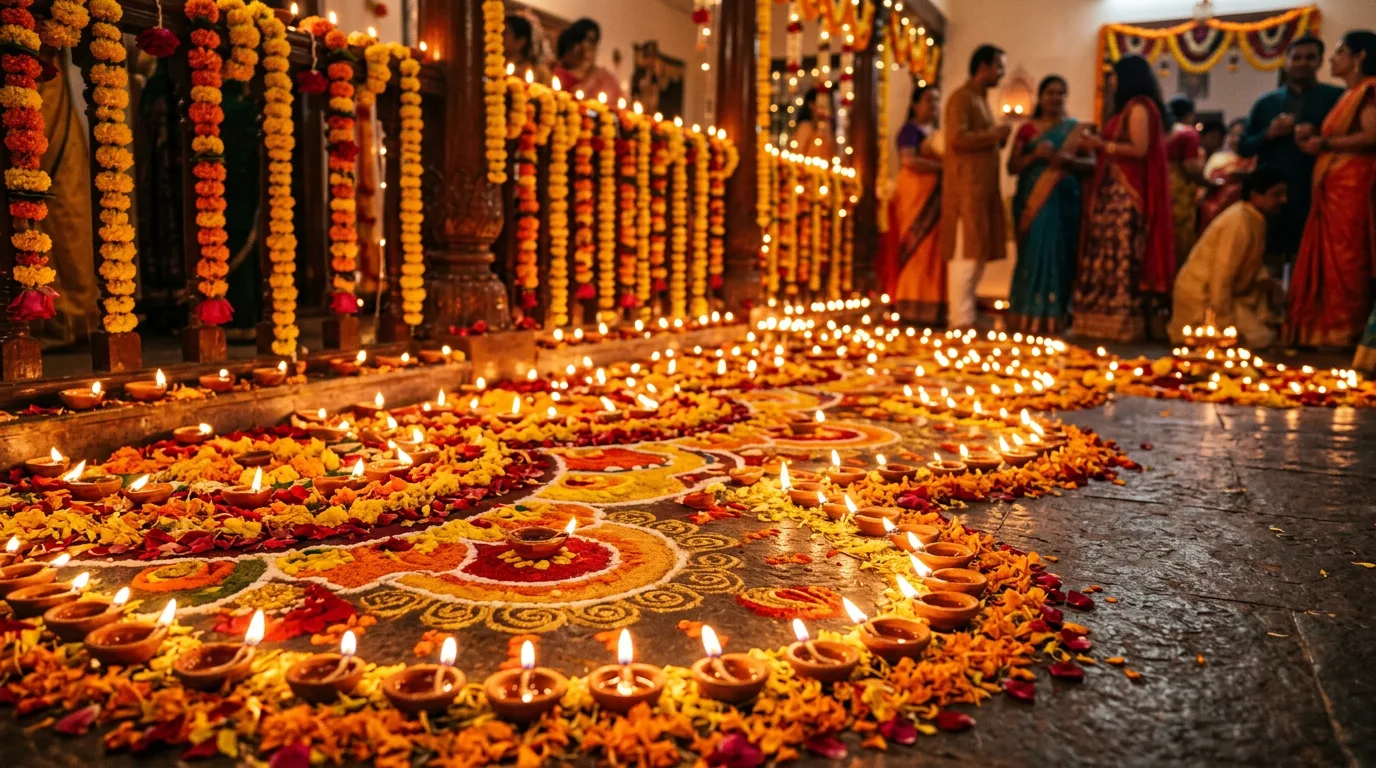
Prompt: "Row of lit brass diyas on white marble steps, warm golden glow radiating from cotton wicks, rangoli design in foreground with geometric kolam pattern in red and white powder, soft bokeh of fairy lights in background, Diwali festival photography, shot on Canon EOS R5 85mm f/1.4"
The brass material instruction gives the diya body a specific metallic sheen. White marble creates clean contrast against the warm flame glow. "Red and white powder" for the rangoli avoids the rainbow explosion that generic "colorful rangoli" produces. The 85mm reference compresses the background into creamy bokeh while keeping the diyas and rangoli sharp.
Prompt: "Overhead shot of intricate rangoli design, colorful powder in saffron, vermilion, and white arranged in traditional geometric and floral patterns, small clay diyas placed at each petal point, fresh marigold petals scattered between sections, Diwali decoration, detailed and vibrant, natural daylight from above"
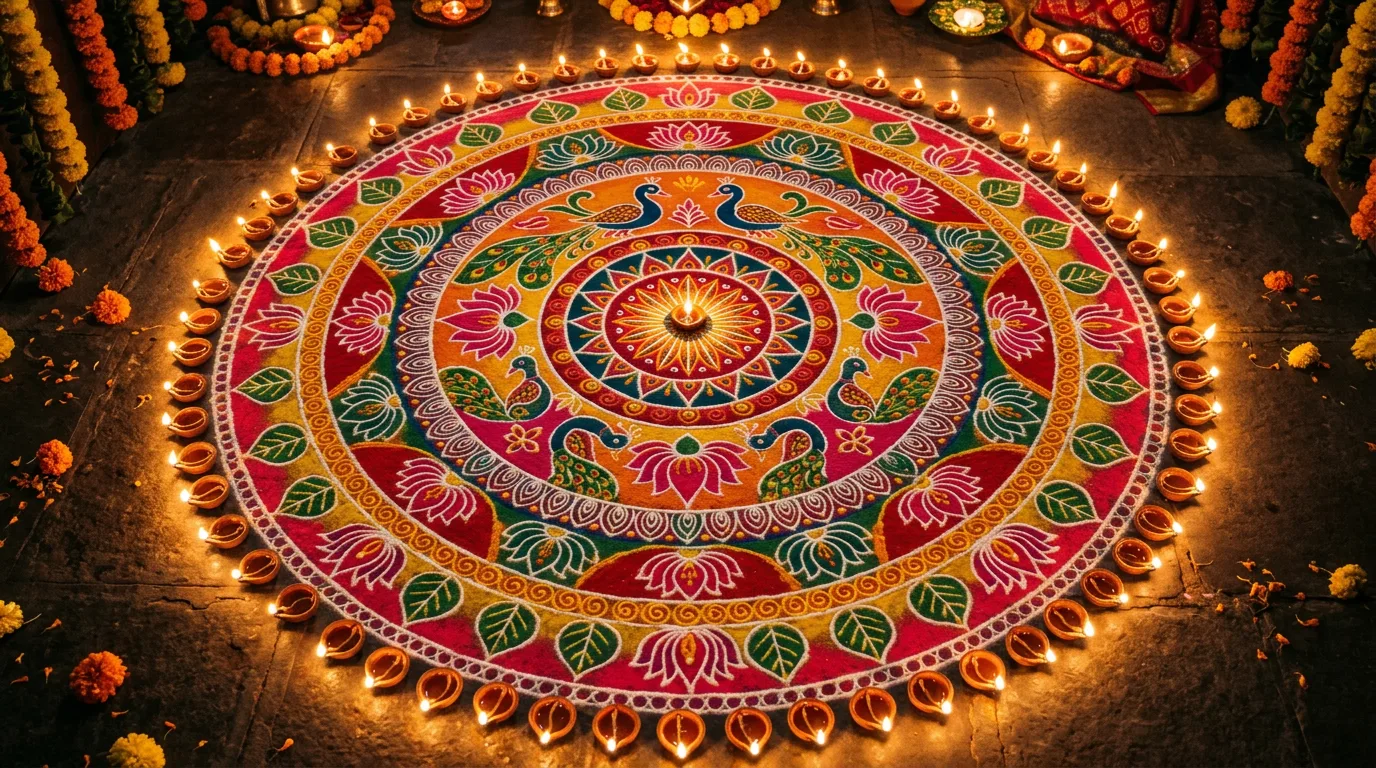
Overhead angle showcases the full rangoli symmetry. Naming specific powder colors (saffron, vermilion, white) prevents the over-saturated rainbow effect. "Each petal point" gives the model a rule for diya placement that produces orderly, authentic arrangements. Marigold petals add a traditional organic element that grounds the geometric design.
Prompt: "Close-up of single clay diya with lit cotton wick, mustard oil flame dancing slightly, warm golden light illuminating carved brass plate underneath, dark background with soft out-of-focus diya bokeh behind, intimate Diwali still life, macro photography style, shallow depth of field"
The single-diya close-up is the most reliable Diwali prompt because it gives the model one clear subject with simple lighting physics. "Mustard oil flame" is a specific fuel reference that produces a warmer, yellower flame quality than generic "candle." The dark background maximizes the light-to-dark contrast that symbolizes Diwali.
Prompt: "Courtyard floor covered with elaborate rangoli in concentric circles, fresh flower petals filling sections between powder lines, rows of lit diyas tracing the rangoli border, evening twilight sky visible above, wide-angle Diwali courtyard scene, warm and inviting, architectural framing with pillars on sides"
The courtyard setting with pillars adds architectural context that places the rangoli in a traditional Indian home environment. "Concentric circles" gives the rangoli a specific geometric structure. Fresh flower petals mixed with powder is an authentic rangoli technique that adds texture variation the model renders well.
Family Celebration Moments
Family gatherings are the emotional core of Diwali. The challenge is the same as any group AI photo: producing people who look connected rather than like strangers sharing a frame. The technique is activity-based prompting. Give every family member a specific role in a shared Diwali ritual.
Prompt: "Indian family of four gathered around a large floor rangoli, grandmother guiding young girl's hand to place a diya, father lighting sparklers with teenage son, warm living room with marigold garlands on shelves, candid Diwali celebration moment, lifestyle photography, warm ambient diya light mixing with soft room light"
"Grandmother guiding young girl's hand" creates a specific physical interaction between two family members. The father-son sparkler moment gives the other pair their own activity. Two simultaneous activities in one frame produce a scene that reads as a real family moment rather than a posed group shot.
Prompt: "Mother and daughter in coordinated red and gold outfits, mother applying haldi paste to daughter's cheeks, daughter giggling with eyes scrunched, soft natural window light from left, intimate pre-Diwali preparation moment, warm and tender, documentary photography style"
Pre-Diwali preparation rituals are the candid moments that produce the most emotionally authentic images. "Haldi paste to cheeks" is a specific physical action that generates a convincing interaction. "Eyes scrunched" while giggling gives the model a facial expression cue through physical description rather than an abstract emotion word.
Prompt: "Extended Indian family exchanging gift boxes during Diwali, wrapped presents in gold and red paper, grandmother receiving a box with both hands and surprised expression, children sitting on floor with sweets and dry fruit boxes around them, warm tungsten lighting, joyful and celebratory, wide-angle family documentary photography"
Gift exchange (especially of sweets and dry fruits) is a defining Diwali tradition. "Both hands and surprised expression" gives the grandmother a specific pose and emotion cue. "Sweets and dry fruit boxes" adds culturally accurate props that distinguish this from a generic gift-giving scene.
Prompt: "Indian family on rooftop during Diwali night, children waving sparklers creating light trails, parents standing behind with arms around each other watching, city skyline with distant fireworks, string lights along rooftop railing, warm and festive atmosphere, cinematic night photography, slight motion blur on sparkler trails"
Rooftop celebrations are one of the most iconic Diwali settings. The parents-watching-children dynamic creates natural emotional hierarchy. "Slight motion blur on sparkler trails" adds the long-exposure quality that makes sparkler photos feel captured rather than staged. City skyline with distant fireworks places the intimate family moment against the larger celebration.
Traditional Outfit Portraits
Diwali outfit portraits need the same cultural layering technique applied to garments, jewelry, and fabric. The key: name the exact textile weave, the specific jewelry pieces, and how diya light interacts with the fabric surface. Generic "traditional outfit" produces a costume-party look. Specific textile terms produce authentic fashion photography.
Prompt: "Woman in deep red Banarasi silk saree with intricate gold zari border and pallu, kundan necklace and jhumka earrings catching diya light, maang tikka centered on forehead, soft studio lighting with warm diya glow accent from below-right, elegant Diwali portrait, fashion editorial photography, shallow depth of field"
"Banarasi silk" and "gold zari border" are specific textile terms that produce a recognizably different fabric from "red saree." Kundan, jhumka, and maang tikka are three distinct jewelry types the model renders as separate objects. "Diya glow accent from below-right" adds the warm Diwali lighting as a secondary source layered on studio lighting.
Prompt: "Man in ivory raw silk sherwani with gold zardozi embroidery on collar and cuffs, matching mojari shoes, standing in courtyard with lit diyas on steps behind, warm golden hour side light, dignified Diwali portrait, shot on medium format camera, rich color depth"
"Raw silk sherwani" produces a different texture than generic "traditional outfit." "Zardozi embroidery on collar and cuffs" tells the model exactly where the detail should appear. Mojari shoes are a specific traditional footwear that completes the outfit. Medium format camera reference produces the color depth and tonal richness associated with high-end portrait photography.
Prompt: "Young girl in vibrant magenta lehenga choli with mirror work and gold thread border, small gold bangles on both wrists, holding a lit diya in cupped hands, innocent wonder on her face, soft warm light from the diya illuminating her face from below, Diwali portrait, dreamy and gentle, 85mm f/1.4 bokeh"
"Mirror work and gold thread border" are specific embellishment techniques on lehenga choli that produce texture the model can render. "Lit diya in cupped hands" with "illuminating her face from below" creates the iconic Diwali portrait lighting where the face is lit by the warm glow of a diya held at chest level.
Prompt: "Couple in coordinated Diwali outfits, woman in emerald green Kanjeevaram saree with gold temple border, man in charcoal kurta with subtle gold embroidery, both holding a brass puja thali with diya and flowers, warm indoor lighting with fairy light bokeh behind, Diwali couple portrait, elegant and festive, editorial wedding photography style"
Coordinated outfits with specific fabric names (Kanjeevaram for her, charcoal kurta for him) produce a cohesive couple portrait. The puja thali with diya and flowers gives both people a shared object to hold, which creates physical connection in the frame. "Temple border" is a specific Kanjeevaram saree motif the model recognizes.
Pooja and Spiritual Scenes
Diwali pooja scenes combine devotional atmosphere with warm lighting from diyas, incense, and sacred fire. These prompts require ritual-specific actions and setting details that distinguish Diwali worship from generic prayer imagery.
Prompt: "Temple entrance at dusk illuminated by hundreds of small clay diyas arranged on every step and ledge, devotees in silhouette entering through carved stone archway, warm golden glow enveloping the entire facade, atmospheric smoke from incense, devotional Diwali scene, architectural photography, wide angle showing full temple front"
Hundreds of diyas on a temple facade is one of the most iconic Diwali visuals. "Carved stone archway" adds architectural specificity. "Devotees in silhouette" solves the crowd-rendering problem by keeping people as atmospheric shapes rather than requiring detailed faces. Incense smoke adds volumetric atmosphere.
Prompt: "Close-up of woman's hands performing aarti with brass diya lamp, five flames in circular motion, soft warm glow illuminating her hennaed hands and gold bangles, idol of Lakshmi in soft focus behind with fresh marigold garland, intimate puja moment, devotional Diwali photography, shallow depth of field"
"Performing aarti" is a specific ritual action (circular motion of flame before deity) that generates a recognizable pose. "Five flames" describes the traditional panch-pradeep aarti lamp. "Idol of Lakshmi" places this specifically during Diwali (Lakshmi Puja is the central worship on Diwali night). Hennaed hands and gold bangles add culturally accurate detail.
Prompt: "Family gathered around home mandir for Diwali puja, father offering prasad to small Ganesh and Lakshmi idols decorated with fresh flowers, mother ringing a small brass bell, children sitting cross-legged with hands folded, warm diya light and incense smoke creating sacred atmosphere, documentary photography, intimate and reverent"
The home mandir (household shrine) is where most Diwali puja actually happens. Ganesh and Lakshmi together are the specific deities worshipped during Diwali. Each family member has a distinct role: father offering prasad, mother ringing bell, children with folded hands. Activity-based posing produces natural group composition.
Prompt: "Temple corridor with rows of lit oil lamps on both sides receding into distance, symmetrical composition, warm orange light and deep shadows creating dramatic contrast, stone pillars with carved detail visible, grand and peaceful Diwali temple scene, architectural photography, leading lines drawing eye to illuminated deity at far end"
Symmetry and leading lines create a powerful architectural composition. "Illuminated deity at far end" gives the corridor a focal point and narrative purpose. "Oil lamps" rather than generic "lights" produces the specific flame quality and brass lamp shapes associated with temple illumination.
Fireworks and Night Scenes
Diwali night with fireworks, sparklers, and illuminated skylines creates the most dramatic category of prompts. The challenge is rendering light sources against dark backgrounds without the image looking like a video game screenshot. Specify one primary light source and describe its behavior explicitly.
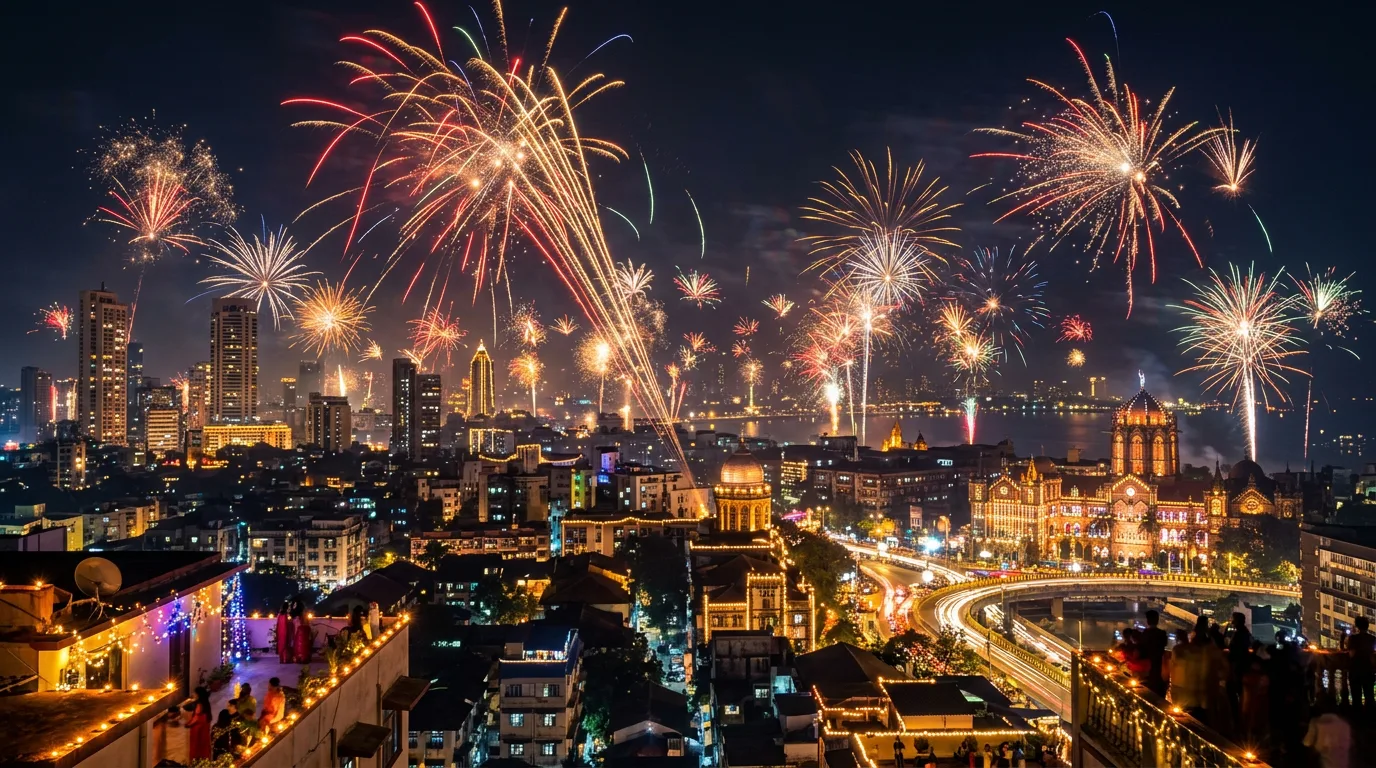
Prompt: "Diwali night fireworks bursting over city skyline in cascading gold and red sparks, long exposure light trails creating arcs across dark sky, lit buildings and rooftops with small diyas visible below, celebratory and grand, landscape photography, shot on tripod with 2-second exposure, vibrant against deep blue-black sky"
"Cascading gold and red sparks" describes specific firework behavior rather than generic "colorful fireworks." The 2-second exposure reference tells the model to render light trails rather than frozen bursts. "Deep blue-black sky" rather than pure black preserves some atmospheric depth in the background.
Prompt: "Child holding lit sparkler at arm's length, golden sparks creating star-burst pattern around their hand, wonder and delight on face illuminated by sparkler glow, dark Diwali evening background with distant fairy lights, candid and magical, shallow depth of field, warm-toned night photography"
"Star-burst pattern around their hand" describes the specific visual effect of a sparkler. "Wonder and delight" combined with "illuminated by sparkler glow" creates the classic Diwali childhood moment where the face is lit entirely by the sparkler. Shallow depth of field keeps the background lights as atmospheric bokeh.
Prompt: "Aerial view of neighborhood during Diwali night, houses and rooftops outlined with strings of lights and small diyas, scattered firework bursts at different heights, warm glow from every doorway and window, birds-eye perspective showing the scale of celebration, dramatic Diwali cityscape, night photography"
The aerial perspective is uncommon in competitor content and shows the collective scale of Diwali illumination across an entire neighborhood. "Outlined with strings of lights and small diyas" creates the distinctive Diwali look where every building edge is traced with light. Multiple firework bursts at different heights add depth to the sky.
Prompt: "Rooftop Diwali celebration, family silhouettes against firework-lit sky, steel railing with small diyas placed along it, string lights creating warm canopy overhead, distant city buildings with lit windows, warm and festive night atmosphere, cinematic composition, 24mm wide angle capturing both intimate rooftop and expansive sky"
The rooftop setting is one of the most authentic Diwali scenes. "Diyas placed along railing" and "string lights creating warm canopy" add two layers of close-range light sources that frame the silhouettes. The 24mm wide angle captures the full sky drama while keeping the rooftop details visible.
Couple Portraits for Diwali
Diwali couple portraits blend romantic positioning with festival-specific elements. The technique is the same as the wedding photography guide: describe a shared ritual action rather than just two people standing together.
Prompt: "Indian couple in coordinated festive outfits, woman in red silk saree with gold jewelry, man in black bandhgala jacket, both lighting a large brass diya together with their hands overlapping, warm golden glow from diya illuminating their faces from below, rooftop with city lights bokeh behind, romantic Diwali couple portrait, cinematic color grading"
"Hands overlapping" on the diya creates physical connection. The diya-from-below lighting produces the warm, intimate illumination that is distinctly Diwali. "Bandhgala jacket" is a specific formal Indian menswear that suits the occasion without defaulting to generic kurta.
Prompt: "Couple surrounded by lit diyas on floor, sitting cross-legged facing each other, foreheads nearly touching, woman's hennaed hands resting on man's, soft warm ambient light, intimate Diwali evening, shallow depth of field with diya flames creating warm bokeh circles, tender and romantic, lifestyle photography"
"Foreheads nearly touching" is the most reliable two-person intimacy pose for AI generation. "Hennaed hands resting on man's" adds a culturally specific physical interaction. "Diya flames creating warm bokeh circles" uses the surrounding diyas as both atmospheric and compositional elements.
Prompt: "Couple watching fireworks from balcony, shot from behind showing them leaning on railing together, her head on his shoulder, firework burst reflected in glass door beside them, string lights along balcony edge, warm and romantic Diwali night moment, environmental portrait, 35mm documentary style"
The behind-the-couple angle avoids the complex face-rendering challenge while maintaining romantic energy. The glass door reflection adds a secondary firework image. "String lights along balcony edge" frames the couple in warm light against the dark sky.
Diwali Greeting Card Designs
Greeting card prompts need clean composition, strong motifs, and deliberate space for text. The key distinction from other Diwali prompts: greeting cards are designs, not photographs. Use design language rather than photography language.
Prompt: "Diwali greeting card design, centered brass diya with large flame motif, radiating mandala pattern in gold line art on deep burgundy background, ample negative space at top and bottom for text overlay, warm gold and burgundy color palette, minimalist and elegant, print-ready composition, clean vector-inspired edges"
"Ample negative space at top and bottom" explicitly reserves room for "Happy Diwali" and a personal message. "Gold line art on deep burgundy" is a specific and sophisticated color combination. "Vector-inspired edges" produces cleaner design elements than photorealistic rendering.
Prompt: "Modern Diwali greeting card, geometric rangoli pattern as central element, bold jewel tones in emerald, ruby, and gold, contemporary minimalist design with clean lines, circular diya icon integrated into rangoli center, space for text on right third, fresh and festive, suitable for digital sharing"
"Right third" for text space creates an asymmetric layout suitable for landscape social media cards. Jewel tones (emerald, ruby, gold) are a contemporary Diwali palette that appeals to younger audiences while staying culturally rooted. "Circular diya icon integrated into rangoli center" merges two Diwali symbols into one cohesive design element.
Prompt: "Watercolor style Diwali card, soft lotus and diya illustration, cream and warm gold background with subtle texture, delicate marigold border along edges, handpainted aesthetic, space for message in center, warm and inviting, artistic greeting card composition"
Watercolor style produces artistic results that feel handcrafted. "Delicate marigold border" adds a Diwali-specific framing element. Cream and warm gold is a sophisticated neutral palette that works for both personal and professional Diwali greetings.
Retro and Bollywood-Inspired Diwali Scenes
Retro Diwali portraits have become one of the most viral AI image trends, particularly the 1990s Bollywood aesthetic. These prompts produce nostalgic, cinematic results that blend vintage film quality with Diwali elements.
Prompt: "1990s Bollywood movie poster style Diwali scene, couple celebrating with sparklers in a haveli courtyard, woman in bright orange chiffon saree flowing in motion, man in silk kurta, dramatic Bollywood lighting with star filter on sparkler highlights, vintage Kodak Gold 200 color science, grainy film texture, retro cinematic quality"
"Haveli courtyard" is a specific architectural setting associated with Bollywood golden-age films. "Star filter on sparkler highlights" produces the distinctive cross-shaped light flare from 1990s cinematography. Kodak Gold 200 produces the warm, slightly oversaturated color palette that defines the era.
Prompt: "Retro 1980s style Diwali family portrait, family of four posed formally in front of decorated home entrance, matching festive outfits, large marigold garland frame around the doorway, studio flash aesthetic with slight red-eye glow, Fujicolor C200 film look, vintage family album quality, nostalgic and warm"
The formal pose with studio flash aesthetic recreates the specific look of 1980s Indian family studio photography. "Slight red-eye glow" is a counterintuitive detail that actually sells the vintage authenticity. "Vintage family album quality" signals a specific era of imperfect, beloved photography.
Prompt: "Cinematic Diwali night scene in Bollywood style, woman in deep red lehenga standing on illuminated terrace with diyas lining every edge, dramatic wind catching dupatta, city fireworks behind, anamorphic lens flare from brightest diya, Kodak Vision3 500T cinema film stock, wide aspect ratio, epic and romantic"
"Anamorphic lens flare" produces the horizontal light streak associated with cinema lenses. Kodak Vision3 500T is a specific cinema film stock used in Bollywood productions, producing distinct color rendering under tungsten (warm) light. The wide aspect ratio reinforces the cinematic quality.
Prompt: "Vintage polaroid style snapshot of Diwali celebration, candid moment of family lighting diyas together, warm amber cast typical of instant film, white polaroid border, slightly overexposed highlights from diya flames, nostalgic 1990s quality, casual and authentic, Diwali family memory"
The polaroid format produces a distinctly casual, snapshot aesthetic. "Slightly overexposed highlights from diya flames" replicates how instant film handles bright point light sources. The white border is compositionally important for the polaroid effect and differentiates this from other Diwali prompts.
What Actually Improves Diwali Prompts Across Both Models
Comparing Diwali prompts across all eight categories on both Nano Banana and Nano Banana 2 on Morphed for lighting accuracy, pattern fidelity, cultural authenticity, and textile rendering surfaces a few consistent patterns.
Cultural layering is the single biggest quality lever for Diwali photos. Prompts that stacked specific cultural elements (named textile weaves, specific jewelry pieces, ritual actions, traditional color combinations) produced noticeably more culturally accurate Diwali imagery than prompts using only generic descriptors ("Indian festival," "traditional outfit," "warm celebration"), which often produced results indistinguishable from Navratri, Eid, or Holi. The cultural layer stack was the largest single factor in whether the image read as specifically Diwali.
Nano Banana 2 handles rangoli symmetry and diya lighting significantly better. The clearest model difference appeared in rangoli geometry and candlelight rendering. Prompts involving "geometric kolam pattern" or "concentric circle rangoli" produced more consistently symmetrical results with Nano Banana 2, while the original more often broke pattern symmetry or went asymmetric at the edges. Diya flame rendering is noticeably warmer and more realistic on Nano Banana 2.
Named textile weaves improved outfit portraits dramatically. "Red saree" produced a generic red drape in most outputs. "Red Banarasi silk saree with gold zari border" produced visible weave texture, metallic thread sheen, and accurate border patterning. The model uses fabric names (Banarasi, Kanjeevaram, raw silk, chiffon) as rendering instructions for texture, weight, and sheen behavior under light.
Diya light works best as a secondary light source, not the primary one. Prompts where diya light was the only illumination tended to produce underexposed, muddy results. Prompts that combined a primary light source (studio light, golden hour, window light) with diya glow as an accent produced a noticeably more warm, luminous Diwali atmosphere. The exception is close-up single-diya shots where the dark background is intentional.
Specific deity names outperformed generic spiritual references. "Prayer scene" or "spiritual moment" produced vague devotional imagery. "Offering prasad to Lakshmi and Ganesh idols decorated with marigold garland" produced recognizable Diwali puja scenes. The model has strong recognition of named Hindu deities when given exact names and contextual details.
| Prompt Element | Impact on Quality | Best Practice |
|---|---|---|
| Cultural layering (material + decoration + pattern + light) | Highest | "Brass diyas on marble, kolam rangoli, marigold toran" not "Diwali decoration" |
| Textile specificity | High | "Banarasi silk with gold zari" not "red saree" |
| Lighting layering (primary + diya accent) | High | "Soft studio light + warm diya glow accent" not "warm lighting" |
| Named jewelry pieces | Medium-high | "Kundan necklace, jhumka earrings, maang tikka" not "traditional jewelry" |
| Ritual action specificity | Medium-high | "Performing aarti with panch-pradeep lamp" not "praying" |
| Camera/lens reference | Medium | "85mm f/1.4" for portraits, "24mm wide angle" for scenes |
| Photography style keyword | Medium | "Documentary," "editorial," "cinematic" each produce distinct results |
| Prompt length | Medium | 25-45 words is the sweet spot for Diwali prompts |
When AI Diwali Images Are the Wrong Choice
AI-generated Diwali images work well for greeting cards, social media posts, mood boards, and creative content. They are not appropriate for everything. Being honest about limitations prevents wasted effort and culturally insensitive results.
Skip AI Diwali prompts when:
- You need photos that look like your family. These prompts generate fictional people. For personalized Diwali portraits that resemble you, upload a selfie on Morphed and use editing prompts to add Diwali elements, traditional outfits, and festive backgrounds. Text-to-image prompts alone will not reproduce specific faces.
- Cultural accuracy will be scrutinized. AI models can blend regional styles, place South Indian jewelry on North Indian garments, or render rangoli patterns from the wrong regional tradition. For content targeting audiences who will notice these distinctions, verify every cultural detail against reference images before sharing.
- You need large group shots with sharp faces. Nano Banana handles 2-4 people reliably. Full family gatherings of 8+ people will produce distorted faces, anatomy errors, or merged features. For large groups, use "family blurred in background" or wide-angle environmental shots where individual facial detail matters less.
- The imagery involves specific religious rituals. AI models may render incorrect hand positions during aarti, wrong placement of tilak, or inaccurate deity depictions. For devotional content that will be shared in religious contexts, use AI as inspiration only and have someone familiar with the specific tradition review before sharing.
- You are presenting the images as real photographs. Using AI-generated Diwali images in personal albums or social posts as if they are real celebrations is misleading. AI artifacts in hands, jewelry edges, and rangoli patterns are detectable at full resolution. Use them as creative content, not documentation.
5 Mistakes That Make AI Diwali Photos Look Generic
1. Using "Indian Festival" Instead of Diwali-Specific Elements
"Indian festival celebration" could produce Holi, Navratri, Onam, Pongal, or Diwali. The model picks randomly from its training data. Fix: name the specific Diwali elements you want. "Diyas," "rangoli," "Lakshmi puja," "fireworks," "marigold toran," and "sparklers" are the visual vocabulary of Diwali. Include at least two in every prompt.
2. Flat Lighting That Kills the Diya Glow
Diwali is the Festival of Lights, but "warm lighting" produces an even, flat illumination that removes all drama. Real Diwali scenes have strong contrast between diya glow and surrounding darkness. Fix: specify directional lighting with explicit position. "Warm diya glow from below-left, rest of scene in soft twilight" creates the light-and-shadow interplay that makes Diwali imagery feel alive.
3. Generic "Traditional Outfit" Descriptions
"Woman in traditional Indian outfit" produces a costume-party mashup. Different regions, occasions, and price points produce dramatically different garments. Fix: name the exact textile. "Banarasi silk saree," "Kanjeevaram with temple border," "raw silk lehenga with mirror work," or "chanderi cotton kurta" each produce distinct, recognizable garments.
4. Overcrowding the Frame
The temptation with Diwali is to include everything: diyas, rangoli, fireworks, family, gifts, food, decorations. The model renders each element at lower quality when too many compete for attention. Fix: choose two or three key elements per prompt. A diya-and-rangoli scene does not need fireworks. A fireworks scene does not need rangoli. Let each prompt do one job well.
5. Ignoring Photography Style Keywords
"Diwali photo" is not a style instruction. "Documentary Diwali photography" produces candid, authentic-feeling results. "Editorial Diwali portrait" produces polished, magazine-quality compositions. "Cinematic Diwali scene" produces film-like color grading and dramatic framing. The style keyword determines whether the output looks like a candid family snapshot, a fashion editorial, or a movie still.
Prompt Construction Tips for Stronger Diwali Results
-
Lead with the cultural element. "Brass diyas arranged on marble threshold" before lighting or style. Nano Banana assigns visual weight based on word order, so the most important cultural detail needs to come first.
-
Stack three cultural layers minimum. Material (brass, marble, silk), decoration (marigold, rangoli, fairy lights), and light (diya glow, golden hour, candlelight). Three layers produce specifically Diwali imagery. One layer produces generic.
-
Specify one primary light source plus diya accent. "Soft natural window light with warm diya glow as accent from lower right" produces better results than "warm diya lighting" alone. The primary source prevents underexposure. The diya accent adds the Diwali atmosphere.
-
Name textiles and jewelry by type. "Banarasi silk" not "saree." "Kundan necklace" not "jewelry." "Zardozi embroidery" not "decorated." Named types carry visual information the model uses for accurate rendering.
-
Use color palettes, not "colorful." "Saffron, vermilion, and gold" or "deep maroon with emerald and gold accents" produce controlled, sophisticated Diwali color schemes. "Colorful and vibrant" produces a rainbow explosion that looks generic.
-
Reference film stock for vintage Diwali aesthetics. "Kodak Gold 200" for warm 1990s nostalgia. "Kodak Vision3 500T" for Bollywood cinema. "Fujicolor C200" for the specific color rendering of 1980s Indian family photos. Film stock names carry entire color science systems the model applies consistently.
-
Add one imperfection for authenticity. "Slight smoke from extinguished incense," "a single diya flame flickering from breeze," "small gap in rangoli where a petal shifted." Perfect symmetry reads as AI-generated. One organic imperfection sells reality.
-
Keep prompts between 25 and 45 words. This is the sweet spot for Diwali prompts. Enough detail for cultural layering and lighting direction, not so much that the model starts ignoring or conflicting instructions.
For more on warm lighting techniques and candlelight rendering, see our Nano Banana prompts for aesthetic pictures guide. For family group composition techniques, check the Nano Banana prompts for family photos guide. For couple poses and romantic compositions, see Nano Banana prompts for couples.
Frequently Asked Questions
What are the best Nano Banana prompts for Diwali?
The best prompts depend on the scene type. For diya and rangoli scenes, describe specific materials and arrangements ("brass diyas on marble steps with kolam rangoli in red and white powder"). For family celebrations, use activity-based cues ("grandmother guiding grandchild to place diya" rather than "happy family"). For portraits, specify exact garment types (Banarasi silk, Kanjeevaram) and jewelry pieces (maang tikka, jhumka, kundan necklace). For greeting cards, include "space for text" and specify a clean color palette. The key across all categories is cultural layering: stack material, decoration, pattern, and light details specific to Diwali. See the eight categories above for 30+ copy-paste ready examples.
Can Nano Banana create Diwali greeting cards and social media posts?
Yes. Use prompts that include "Diwali greeting card design," "space for text," and festive motifs like diya, rangoli, or lotus. Specify "minimalist" or "elegant" for clean designs suitable for WhatsApp and Instagram sharing. For social media posts, use portrait or square composition. Generate the image on Morphed, then add text in a photo editor. Nano Banana 2 handles text-area composition more reliably than the original.
How do I get authentic traditional outfit portraits for Diwali?
Specify the exact garment type (Banarasi silk saree, Kanjeevaram with temple border, raw silk lehenga, sherwani with zardozi embroidery) and traditional Diwali colors (red and gold, maroon and emerald, deep purple with gold border). Include specific jewelry pieces: maang tikka, jhumka earrings, kundan necklace, gold bangles. Add "diya light reflecting on fabric" or "golden hour side light" for flattering illumination. Nano Banana 2 renders embroidery patterns and jewelry at higher fidelity. See the Traditional Outfit Portraits section above for copy-paste prompts.
What is the difference between Nano Banana and Nano Banana 2 for Diwali imagery?
Nano Banana 2 offers improved rendering of intricate patterns like rangoli geometry, embroidery detail, and jewelry facets. Rangoli symmetry and warm diya lighting accuracy are both noticeably more consistent on Nano Banana 2. For simple diya scenes or single-portrait shots, both models produce strong results. For detailed rangoli, textile embroidery, or multi-element festival scenes, Nano Banana 2 is the better choice. Both are available on Morphed.
Do these prompts work with Nano Banana Pro?
Yes. Every prompt in this guide works with Nano Banana, Nano Banana Pro, and Nano Banana 2. Pro produces the richest textile rendering and most accurate global illumination for complex multi-source lighting scenarios like diya-lit rooms with firelight and fairy lights. Nano Banana 2 delivers most of Pro's quality at faster generation speed, making it the best value option for most Diwali photography use cases.
Can I create Diwali photos of myself using Nano Banana?
Yes. Upload your selfie on Morphed and use editing prompts to place yourself in a Diwali scene with traditional outfit, diyas, rangoli, and festive lighting. This is the most popular Diwali-season use case. The text-to-image prompts in this guide generate fictional people. For personalized portraits that look like you, use the image editing workflow with a reference photo rather than text-to-image generation.
How long should Diwali prompts be for Nano Banana?
Between 25 and 45 words. Diwali prompts benefit from slightly more detail than simple portrait prompts because they involve multiple cultural elements, specific lighting, and scene-specific props. Structure your prompt in three parts: cultural elements and subject first, then setting and lighting, then photography style. Below 20 words, outputs are generic festival images. Above 50 words, the model starts ignoring later instructions.
Try These Prompts on Morphed
Copy any prompt from this guide into Morphed and generate your first Diwali image in under a minute. Start with the diya close-up prompts (they are the most reliable), then experiment with family celebration and portrait scenes. Try the same prompt on both Nano Banana and Nano Banana 2 to see how each handles rangoli symmetry, diya lighting, and textile detail.
More Nano Banana prompt guides: