

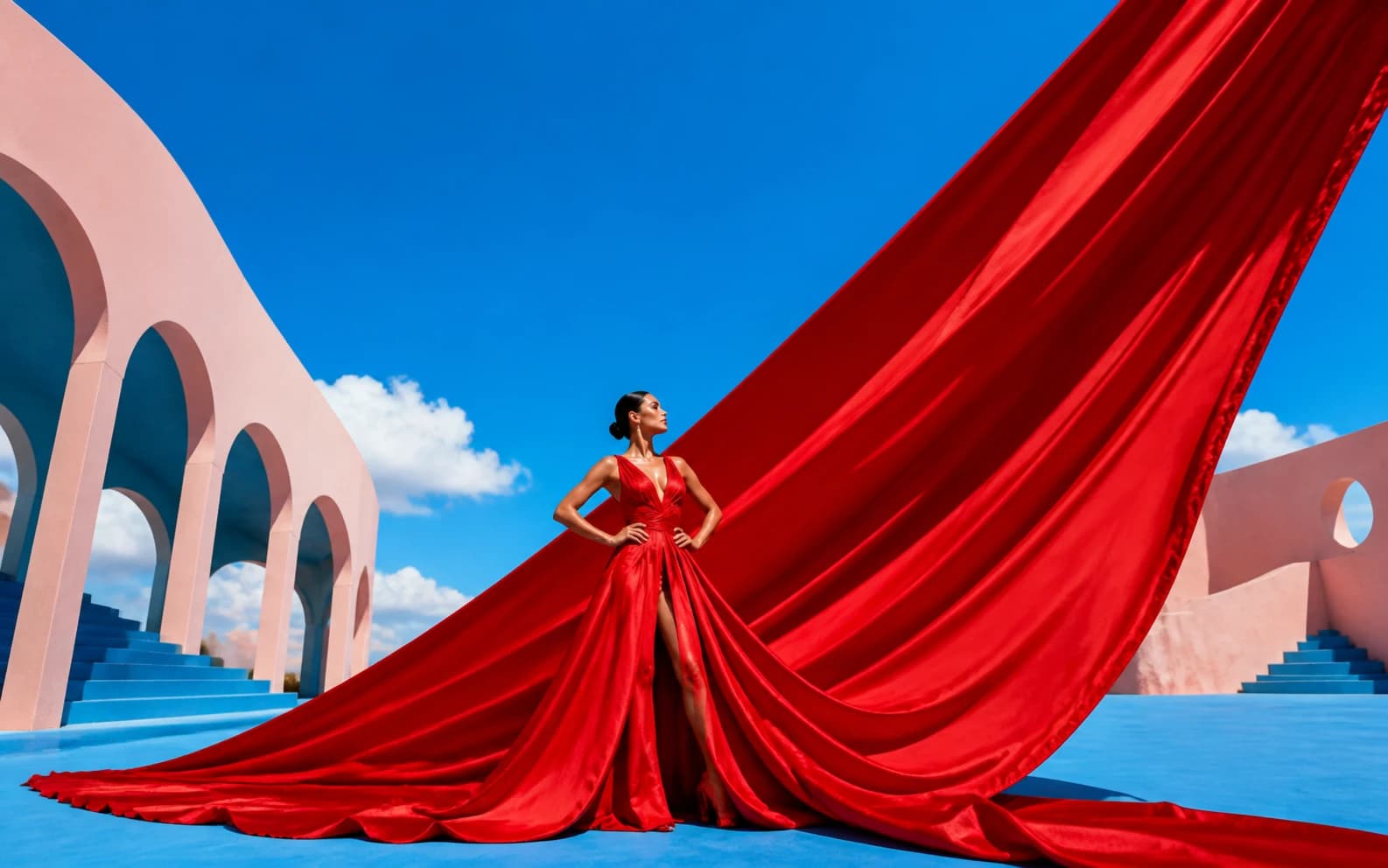
Most AI fashion prompts produce the same problem: garments that look like plastic wrapping on a mannequin. The silk has no sheen, the leather has no grain, and the denim looks painted on. Across Nano Banana, Nano Banana 2, and Nano Banana Pro on Morphed, one technique fixes this consistently: describe fabric before style. "Woman in a nice dress" gives the model nothing to render. "Woman in a flowing silk charmeuse gown in deep emerald green, fabric catching light with subtle sheen" gives it a specific material with specific light behavior. That single change is the difference between convincing fashion photography and obvious AI.
Quick reference: which fashion category do you need?
| Category | Best For | Key Prompt Elements | Prompts |
|---|---|---|---|
| High Fashion Editorial | Magazine content, portfolio, creative direction | Camera references, publication style, dramatic lighting | 4 prompts |
| Streetwear and Casual | Lookbooks, brand content, social media | Specific garments, urban settings, lifestyle energy | 5 prompts |
| Traditional and Cultural | Wedding, festival, cultural representation | Fabric type, embroidery technique, cultural setting | 4 prompts |
| Outfit Change and Dress Swap | Before/after comparisons, lookbook variations | Consistency anchors, same model/background | 3 prompts |
| Hairstyle Variations | Style exploration, beauty-fashion crossover | Specific hairstyle names, complementary lighting | 3 prompts |
| Fashion Flat Lays | Instagram, ecommerce, social content | Overhead arrangement, surface material, soft shadows | 3 prompts |
| Luxury and High-End | Brand campaigns, aspirational content | Premium materials, architectural settings, cinematic grading | 3 prompts |
| Sustainable and Minimalist | Ethical fashion, capsule wardrobe content | Natural fabrics, earth tones, clean compositions | 3 prompts |
Both Nano Banana and Nano Banana 2 are available on Morphed. For the full model overview and general prompting framework, see the complete Nano Banana prompts guide.
Why Nano Banana Renders Fashion Better Than Midjourney or DALL-E
Fashion photography exposes AI weaknesses that other genres hide. Fabric behavior, garment construction details, and the way light interacts differently with silk versus denim versus leather requires the model to handle material physics, not just shapes and colors. Comparing Nano Banana, Nano Banana 2, Midjourney v6, and DALL-E 3 on fabric texture accuracy (does silk look like silk, not plastic), garment fit realism (does the clothing drape and fold correctly on the body), and lighting fidelity (does the model follow the specified lighting setup) surfaces a consistent pattern.
| Feature | Nano Banana | Midjourney v6 | DALL-E / GPT Image | Flux |
|---|---|---|---|---|
| Fabric texture accuracy | Renders distinct silk, leather, denim, linen textures | Strong on flowing fabric, over-stylizes texture detail | Medium accuracy, misses fine weave and grain | Good with detailed fabric prompts |
| Garment drape and fit | Natural folds, wrinkles, and hang on body | Polished but often too perfect, loses natural imperfection | Clean but stiff, garments look ironed onto body | Comparable to Nano Banana |
| Lighting instruction fidelity | Follows direction and quality literally | Adds artistic reinterpretation, alters mood | Medium fidelity, softens harsh light requests | High fidelity |
| Traditional wear rendering | Strong cultural detail, accurate embroidery and draping | Variable, sometimes Westernizes styling | Inconsistent on embroidery and ornamentation | Good with detailed prompts |
| Accessory and jewelry detail | Good (v2 significantly better on fine detail) | Variable, tends to merge small items | Good on large accessories, weak on fine detail | Good |
| Setup required | None on Morphed | Discord or web app | ChatGPT Plus or API | Local install or hosted |
The biggest gap was in traditional and cultural wear. Midjourney frequently added Western fashion cues to saree prompts, while Nano Banana preserved the cultural styling specified in the prompt. For editorial photography, both produced strong results, but Nano Banana's literal prompt interpretation meant fewer surprises when specific lighting and composition were critical.
The Fabric-First Prompting Technique
Most fashion prompts describe the outfit conceptually. "Stylish outfit," "cute clothes," "fashionable look" are empty instructions because the model has no specific material to render. Every fabric has distinct visual properties that determine how light, shadow, fold, and drape behave. Naming the fabric is the single highest-impact change you can make to any fashion prompt.
Weak: "Woman in a nice dress"
Strong: "Woman in a flowing silk charmeuse gown in deep emerald green, fabric catching light with subtle sheen, drape visible at the waist"
Here is how each common fabric renders and what prompt cues produce the best results:
| Fabric | Key Visual Properties | Prompt Cues That Work | Common AI Failure Without Cues |
|---|---|---|---|
| Silk | Sheen, flow, light-catching, liquid drape | "Silk charmeuse with subtle sheen, liquid drape" | Looks like matte polyester |
| Leather | Structure, texture, matte or glossy surface | "Soft lambskin leather with subtle grain texture" | Looks like plastic or vinyl |
| Denim | Texture, wash, weight, fading patterns | "Distressed light-wash denim with fraying at hems" | Looks like painted-on blue fabric |
| Linen | Natural wrinkle, breathable texture, casual drape | "Relaxed linen with natural wrinkle texture, soft fold" | Looks stiff and wrinkle-free |
| Wool | Warmth, knit pattern, tactile texture | "Chunky cable-knit wool with visible stitch pattern" | Looks like smooth cotton |
| Velvet | Depth, light absorption, color shift at folds | "Crushed velvet with light playing on surface, color depth" | Looks like flat matte fabric |
| Cotton | Clean, crisp or soft depending on weave | "Crisp cotton poplin" or "soft washed cotton jersey" | Looks generic and undefined |
| Chiffon | Transparency, layering, delicate flow | "Layered chiffon with visible transparency and movement" | Looks like opaque solid fabric |
| Tweed | Woven texture, flecked color, structure | "Herringbone tweed with visible woven texture and fleck" | Looks like smooth wool |
The fabric name does not just describe appearance. It carries rendering instructions for the model: how light bounces, how gravity pulls, how movement affects the silhouette. Without it, the model defaults to a generic smooth textile that looks like nothing in particular.
High Fashion Editorial Prompts
Editorial fashion demands strong composition, dramatic lighting, and a clear visual point of view. These prompts work for magazine-style content, creative portfolios, and high-end brand campaigns. The key difference from other categories: editorial photography has specific conventions around lighting ratio, composition rules, and garment presentation that the model recognizes when you reference them.
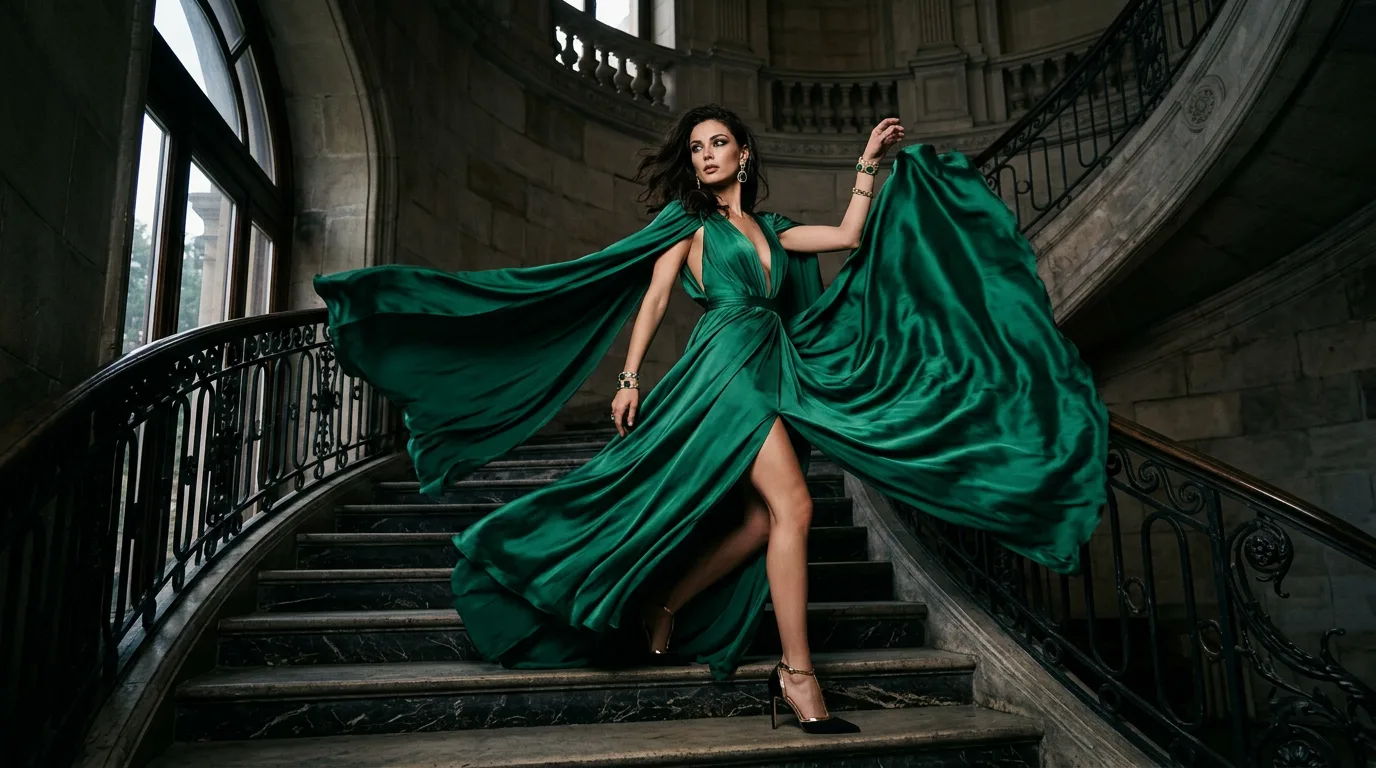
Prompt: "High fashion editorial photo of a model wearing an oversized beige cashmere trench coat on a rainy Paris street, wet cobblestones reflecting city lights, coat fabric showing weight and drape, moody cinematic color grading, shot on Hasselblad medium format"
The Hasselblad reference guides toward distinctive medium-format depth transitions and color rendering. "Fabric showing weight and drape" ensures the coat looks like it has mass rather than floating weightlessly. "Wet cobblestones reflecting city lights" adds environmental depth that editorial photography requires.
Prompt: "Editorial fashion shot of a model in a structured black wool blazer and wide-leg crepe trousers, standing against a stark white cyclorama, harsh directional light from the left creating deep shadows, Vogue editorial style"
Cyclorama backgrounds and harsh directional light are hallmarks of studio editorial. The white cyclorama eliminates distraction and puts all visual weight on the garment construction. "Crepe trousers" is a specific enough fabric reference that the model renders the characteristic subtle texture and drape of crepe rather than defaulting to smooth cotton.
Prompt: "Fashion editorial of a model in a flowing red silk gown, wind catching the fabric creating motion, dramatic sunset silhouette on a cliff edge, cinematic and romantic, Harper's Bazaar aesthetic"
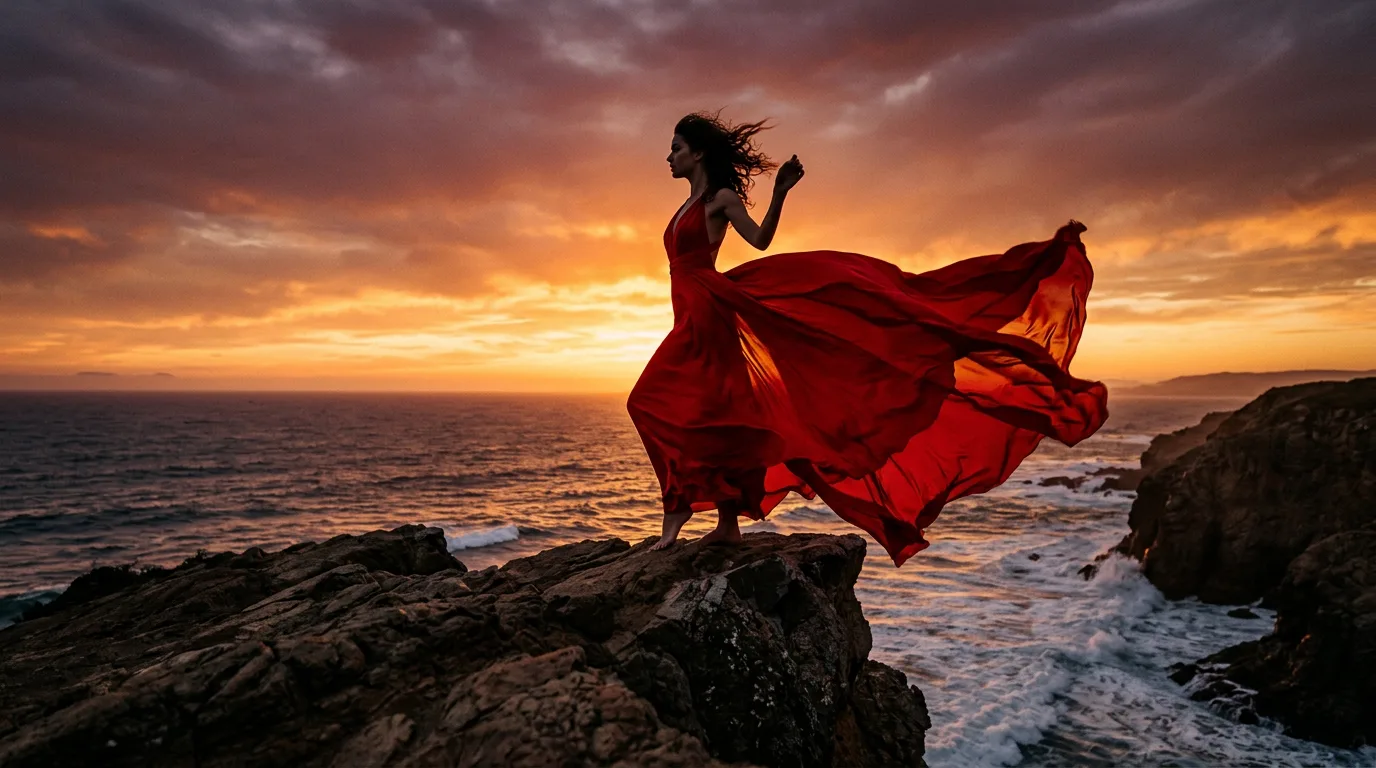
"Wind catching the fabric creating motion" is critical for silk and chiffon because the model needs a physical reason for the fabric to move. Without it, flowing garments look frozen. The "Harper's Bazaar aesthetic" reference carries decades of visual conventions: romantic, bold, and slightly theatrical.
Prompt: "High fashion portrait of a model in avant-garde geometric headpiece and monochrome tailored suit, studio lighting with Rembrandt shadow pattern, editorial beauty and fashion crossover, Karl Lagerfeld inspired minimalism"
Rembrandt lighting creates the distinctive triangle of light on the cheek that editorial portrait photography uses for dimension. "Beauty and fashion crossover" tells the model to balance face detail with garment detail rather than prioritizing one over the other.
Streetwear and Casual Prompts
Streetwear prompts work for lookbooks, brand content, and social media. The challenge with streetwear is that "streetwear" alone is too broad. Skate, hypebeast, minimalist casual, and vintage Americana are all "streetwear" but carry completely different visual languages. Naming specific garments, decade references, and urban settings produces cohesive looks rather than generic city outfits.
Prompt: "Streetwear lookbook shot of a young man in a vintage band tee with cracked print, baggy cargo pants in olive, and chunky platform sneakers, leaning against a graffiti-covered wall, urban photography, late afternoon directional light"
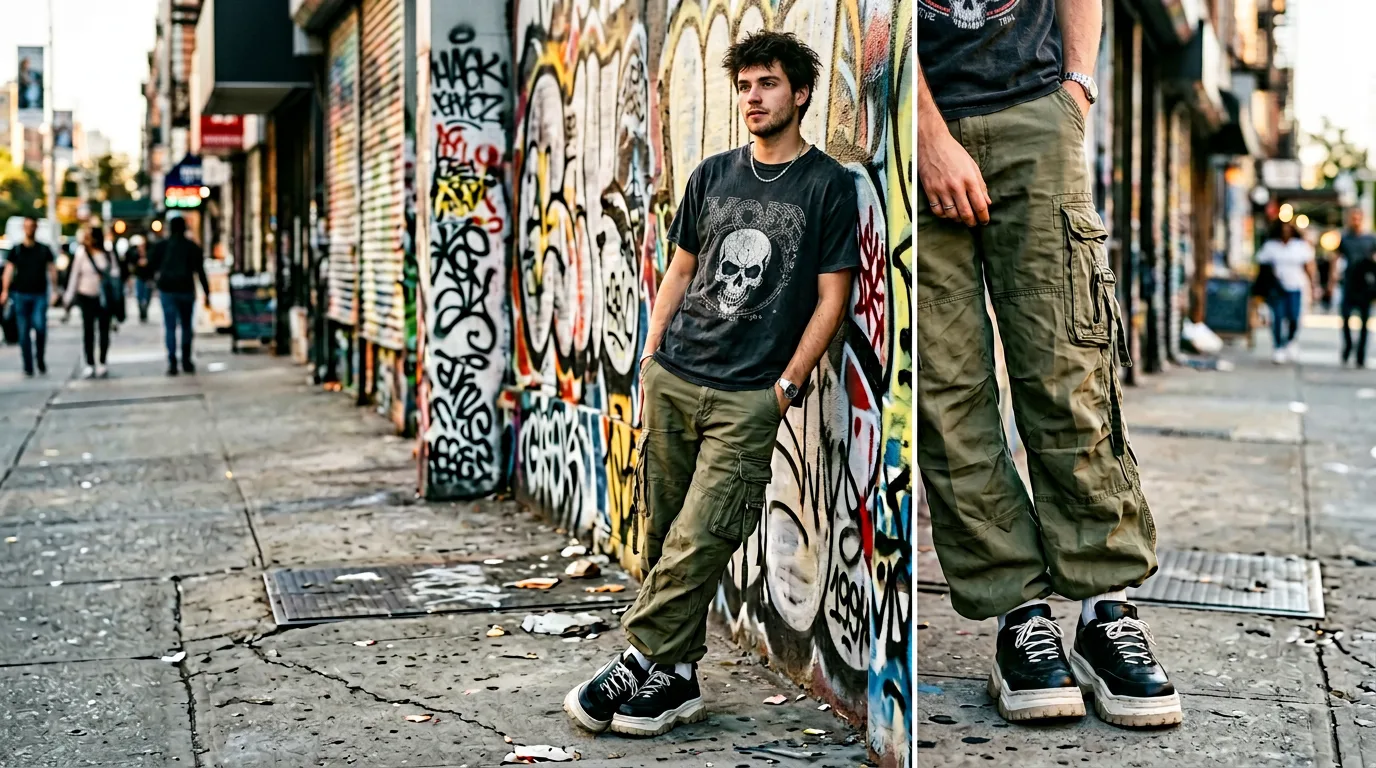
Specific garment details (cracked print, olive cargo, platform sneakers) create a cohesive look rather than generic "streetwear." The cracked print on the band tee is a texture detail that signals vintage, not new.
Prompt: "Casual outfit of oversized cream cable-knit sweater and light wash straight-leg jeans, model sitting on concrete steps with coffee cup, soft overcast daylight, lifestyle fashion photography, relaxed and effortless"
The coffee cup gives the model a clear hand position, which solves the common AI hand problem in fashion shots. "Overcast daylight" produces the soft, even lighting that lifestyle fashion photography uses to keep focus on the garments.
Prompt: "Street style shot of a woman in a black leather biker jacket and high-waisted tailored trousers, walking through a neon-lit Tokyo alley at night, cinematic color grading with teal highlights, fashion street photography"
The Tokyo neon setting adds color contrast that plays against the black leather jacket. "Cinematic color grading with teal highlights" specifies the exact grading look rather than leaving it to the model's default.
Prompt: "Minimalist casual look: white linen button-down shirt with sleeves rolled, tailored beige chinos, model in a sunlit cafe interior, soft natural light, clean and understated, shot on Canon 85mm f/1.4"
The 85mm f/1.4 reference produces the shallow depth of field and background compression that separates lifestyle fashion photography from snapshots. "Sleeves rolled" adds a human, lived-in detail that prevents the outfit from looking like it came straight off a mannequin.
Prompt: "Y2K-inspired streetwear: cropped puffer jacket in metallic silver, low-rise baggy jeans with chain detail, chunky platform boots, model posed in front of a vintage car wash with fluorescent lighting, nostalgic retro futurism, shot on 35mm film with visible grain"
Decade-specific references (Y2K, chain detail, metallic silver) produce more cohesive styling than mixing era cues. "Vintage car wash with fluorescent lighting" is a specific-enough setting that it creates the retro-futuristic mood without needing additional descriptors.
Traditional and Cultural Clothing Prompts
Traditional clothing requires attention to fabric, embellishment technique, and cultural context. The most common failure in AI traditional wear is generating a generically "ethnic" garment because the prompt did not specify the exact fabric, weaving technique, or jewelry style. Naming the specific craft tradition produces dramatically more accurate results.
Prompt: "Traditional Indian bridal portrait in a deep red and gold silk lehenga with zardozi embroidery, intricate mehndi visible on hands, soft studio backlight creating a golden halo, ornate kundan jewelry in sharp focus, warm celebratory mood"
"Zardozi embroidery" specifies the particular metallic threadwork technique, which the model renders as raised, textured gold embroidery rather than flat printed patterns. "Kundan jewelry" is more precise than "Indian jewelry" because kundan has a distinctive style with uncut gemstone settings that the model recognizes and renders accurately.
Prompt: "Japanese kimono in indigo and white shibori-dyed pattern, model in a traditional tea room with tatami mats, soft diffused light through shoji screens, serene and elegant, fabric folds visible at obi, cherry blossom arrangement in background"
"Shibori-dyed" describes a specific resist-dyeing technique that produces the irregular indigo patterns characteristic of Japanese textiles. "Fabric folds visible at obi" directs the model to render the kimono's wrap and belt construction correctly, which is where most AI kimono generations fail by making the garment look like a bathrobe.
Prompt: "West African ankara print dress in bold geometric patterns of orange and indigo, model in front of colorful market stalls, golden hour sunlight, vibrant and celebratory fashion photography, headwrap in complementary print"
Ankara (wax print) has distinctive bold geometric patterns that the model handles well when named specifically. Adding "headwrap in complementary print" creates a complete, culturally cohesive look rather than a dress in isolation.
Prompt: "Scottish tartan kilt in hunting Stewart pattern with chunky cable-knit wool sweater, model in misty highland landscape, moody overcast light, heritage outdoor fashion, weathered leather sporran visible"
Naming the specific tartan pattern (hunting Stewart) and the sporran accessory produces a recognizable, culturally accurate ensemble rather than a generic plaid skirt. The misty highland setting reinforces the heritage aesthetic.
Outfit Change and Dress Swap Prompts
Outfit change prompts let you visualize the same person in different garments. The challenge is maintaining consistency across generations. Nano Banana does not have perfect identity persistence, but three anchoring techniques improve consistency significantly: keeping the same background, specifying identical lighting, and using "same model" as an explicit instruction.
Prompt: "Same woman, two shots side by side: first in casual jeans and white cotton tee, second in elegant black silk cocktail dress, same studio background and lighting, outfit change comparison, fashion before and after"
"Same woman" and "same studio background" are consistency anchors. For the strongest results, generate each outfit as a separate prompt with identical background and lighting descriptions, then compare. This produces better consistency than asking for both outfits in one generation.
Prompt: "Model in blue denim jacket and canvas sneakers, then same pose in tailored navy wool blazer and leather loafers, neutral gray backdrop, professional outfit swap for lookbook, commercial fashion photography"
The denim-to-wool transition shows the model handling two completely different fabric types in comparison. "Same pose" helps maintain body position consistency. The neutral gray backdrop keeps the focus entirely on the garment change.
Prompt: "Dress change prompt: woman in summer floral cotton maxi dress on a beach, then same location in structured white linen blazer and wide-leg trousers, golden hour, lifestyle fashion with outfit variation, natural relaxed energy"
Location-based outfit swaps require the setting to remain identical. Specifying "same location" and "golden hour" in both versions anchors the environment while letting the garments change. This works well for travel and lifestyle lookbook content.
Hairstyle Variation Prompts
Different hairstyles change the entire energy of a fashion image. Hair interacts with lighting in ways that affect the overall composition, so the lighting should complement the hairstyle rather than fight it.
Prompt: "Portrait of a woman with sleek low bun, wearing a black cashmere turtleneck, minimal makeup, soft studio lighting from upper left, clean and sophisticated, hairstyle as focal element, beauty photography"
The sleek low bun pairs with the minimal turtleneck to create a clean, editorial look. "Hairstyle as focal element" tells the model to prioritize hair detail in the rendering hierarchy.
Prompt: "Model with loose waves and beachy texture, wearing a flowy white cotton dress, golden hour backlight creating a halo through the hair, romantic and effortless, lifestyle fashion photography"
Golden hour backlight is the most flattering lighting for wavy and textured hair because it creates a luminous halo effect through individual strands. This lighting choice is not just aesthetic; it produces the hair detail that makes the image feel like a real photograph.
Prompt: "Editorial shot of a model with bold pixie cut, wearing structured tweed blazer, strong side lighting emphasizing bone structure and hair texture, fashion and beauty crossover, confident and sharp mood"
"Strong side lighting emphasizing bone structure" works specifically with short hair because there is no hair to cast shadows on the face. The pixie-plus-blazer combination is a classic editorial pairing that the model renders reliably.
Fashion Flat Lay Prompts
Flat lays arrange clothing and accessories from above for lookbooks, ecommerce, and social media. The challenge: flat lays require the model to understand overhead perspective, fabric folding when laid flat, and spatial arrangement. These are compositional rather than portrait prompts, so the rules change.
Prompt: "Fashion flat lay of complete outfit: cream linen blazer, white cotton tee, light wash jeans, brown leather belt, and white canvas sneakers arranged on light wood surface, soft overhead lighting, minimal shadows, clean Instagram fashion content"
The key to flat lay prompts is specifying the surface material (light wood, marble, concrete) and the lighting angle (overhead). "Minimal shadows" prevents the model from adding dramatic side-lighting that does not match an overhead camera position.
Prompt: "Accessories flat lay: gold hoop earrings, delicate chain necklace, leather-strap watch, and silk scarf on marble surface, luxury fashion flat lay, soft diffused light from above, organized but slightly asymmetric arrangement"
"Organized but slightly asymmetric" produces the curated-but-not-robotic layout that performs well on Instagram. Perfectly symmetrical flat lays look staged; slight asymmetry feels intentional and editorial.
Prompt: "Streetwear flat lay: vintage graphic tee, distressed denim jacket, chunky sneakers, and corduroy cap on raw concrete surface, urban fashion aesthetic, cool gray tones, overhead shot with soft directional light from upper left"
The raw concrete surface anchors the streetwear aesthetic. Each garment has a distinct texture (graphic print, distressed denim, corduroy) that creates visual variety in the flat lay composition.
Luxury and High-End Fashion Prompts
Luxury fashion prompts require premium materials, architectural settings, and cinematic production values. The difference between "nice outfit" and "luxury fashion" is specificity in material quality, setting sophistication, and post-production grading.
Prompt: "Luxury fashion editorial of a model in a tailored double-breasted camel coat in Italian cashmere, standing in the lobby of an Art Deco hotel with marble floors and brass fixtures, warm ambient light, rich cinematic color grading, shot on Hasselblad X2D 100C"
"Italian cashmere" carries more premium material weight than just "cashmere." The Art Deco hotel lobby provides architectural context that reinforces the luxury positioning. "Hasselblad X2D 100C" is a specific camera body that signals ultra-high-end production.
Prompt: "High-end fashion portrait of a woman in a midnight blue silk velvet evening gown, seated on a velvet chaise lounge in a candlelit room with oil paintings on walls, Vermeer-inspired lighting with single warm source, old money aesthetic, editorial fashion"
The "Vermeer-inspired lighting" reference is a specific art direction cue that produces the warm, directional, painterly quality associated with Dutch Golden Age paintings. "Old money aesthetic" is a recognized style keyword that directs composition and color palette.
Prompt: "Luxury menswear editorial of a man in a hand-tailored charcoal flannel suit with visible pick stitching, standing on a rain-wet London street at dusk, warm streetlamp light reflecting off wet pavement, Savile Row craftsmanship, Esquire magazine aesthetic"
"Visible pick stitching" is a construction detail that communicates bespoke tailoring. "Savile Row craftsmanship" as a reference carries a specific visual vocabulary of British tailoring that the model recognizes.
Sustainable and Minimalist Fashion Prompts
Sustainable and minimalist fashion prompts emphasize natural materials, earth-toned palettes, and clean compositions. These work for ethical fashion brands, capsule wardrobe content, and the quiet luxury aesthetic.
Prompt: "Sustainable fashion lookbook shot of a model in an undyed organic cotton tunic and natural linen wide-leg trousers, standing in a sun-filled minimalist studio with white walls and concrete floor, soft natural window light, clean and intentional, capsule wardrobe aesthetic"
"Undyed organic cotton" and "natural linen" communicate both the material and the ethical positioning. "Clean and intentional" as mood keywords produce the pared-back aesthetic that sustainable fashion brands use.
Prompt: "Minimalist fashion portrait of a woman in a camel merino wool oversized sweater and straight-leg selvedge denim, seated on a wooden bench in a Japanese-inspired interior with plants, soft diffused daylight, quiet luxury, documentary fashion photography"
"Selvedge denim" is a specific denim type with a characteristic self-finished edge that signals quality. "Japanese-inspired interior" with plants produces the clean, natural setting that complements minimalist fashion.
Prompt: "Earth-toned outfit flat lay: hemp canvas tote bag, raw silk scarf in ochre, recycled cashmere beanie in oatmeal, and vegetable-tanned leather wallet arranged on natural linen surface, warm soft overhead light, sustainable fashion content, muted warm palette"
Naming specific sustainable materials (hemp canvas, raw silk, recycled cashmere, vegetable-tanned leather) communicates the ethical positioning while giving the model distinct textures to render.
What Actually Improves Fashion Prompts Across Both Models
Comparing fashion prompts across all eight categories on both Nano Banana and Nano Banana 2 on Morphed for fabric texture accuracy, garment fit realism, and compositional quality surfaces a few consistent patterns.
Fabric specification is the highest-impact single variable. Prompts that named a specific fabric type (silk charmeuse, lambskin leather, distressed denim) produced noticeably more convincing garment rendering than prompts that used generic clothing terms (nice dress, stylish outfit, cool jacket). This was the largest quality gap across all prompt variables.
Nano Banana 2 outperforms on texture and detail. The clearest model difference appeared in fine garment details. Nano Banana 2 rendered visible fabric weave patterns, embroidery textures, and jewelry details at significantly higher fidelity. Silk sheen, leather grain, and knit stitch patterns were consistently sharper on v2. For editorial shots where fabric quality is the focal point, Nano Banana 2 markedly cuts the "plastic-looking garment" rate compared to the original.
Lighting specificity matters more than lighting quantity. "Harsh directional light from the left" outperformed "good lighting, soft, warm, professional, flattering" in every test. One precise lighting instruction with direction and quality produces better results than stacking five vague descriptors. The model assigns visual weight based on word order, so front-loading the most important lighting detail matters.
Camera and publication references improve consistency. Adding "Hasselblad medium format" to editorial prompts and "Vogue editorial style" as a reference produced more consistent editorial-quality output than leaving these out. The model recognizes publication names as style anchors and renders accordingly: Vogue produces clean and bold, Harper's Bazaar produces romantic and theatrical, GQ produces confident and structured.
Traditional wear benefits most from cultural specificity. "Deep red silk lehenga with zardozi embroidery" produced noticeably more culturally accurate results than "Traditional Indian dress," which often defaulted to a generic red gown or mixed cultural elements. The pattern held across all cultural categories: the more specific the craft tradition named, the better the output.
| Prompt Element | Impact on Fashion Quality | Best Practice |
|---|---|---|
| Fabric specification (type and properties) | Very high | "Silk charmeuse with subtle sheen" not "nice fabric" |
| Lighting direction and type | High | One specific descriptor: "harsh directional from left" |
| Camera/publication reference | High | "Hasselblad medium format, Vogue editorial" |
| Garment fit description | High | "Flowing drape at waist" or "oversized relaxed fit" |
| Cultural specificity (traditional wear) | High | "Zardozi embroidery" not "Indian embroidery" |
| Environment and setting | Medium-high | "Rainy Paris street" not "outside" |
| Photography style keyword | Medium | "Editorial," "lookbook," "street style" carry distinct conventions |
| Mood and energy | Medium | "Confident and sharp" or "relaxed and effortless" |
| Prompt length | Medium | 30-45 words is the sweet spot for fashion |
6 Mistakes That Ruin AI Fashion Photography
1. No Fabric Specification
"Nice dress" or "stylish outfit" gives the model nothing to render. Fabric type determines how light interacts with clothing, how gravity pulls on the garment, and how movement affects the silhouette. Always name the material: silk, leather, denim, linen, wool, velvet, cotton, chiffon, tweed. Without a fabric name, every garment renders as the same generic smooth textile.
2. Ignoring Drape and Fit
"Woman wearing a dress" does not tell the model how the garment fits the body. "Flowing silk gown with drape visible at waist" or "oversized relaxed-fit linen shirt hanging off one shoulder" communicate how the fabric hangs, folds, and moves. Fit description is the second most important variable after fabric type.
3. Contradictory Style Cues
"Casual streetwear editorial haute couture" is four styles at once. Each carries different lighting conventions, composition rules, and attitude. Streetwear uses urban ambient light. Editorial uses dramatic studio light. Haute couture uses sharp architectural settings. Casual uses soft natural light. Pick one style and commit.
4. Missing Environment Context
Fashion photography is defined by its setting as much as the clothing. "Model in outfit" with no setting produces a generic, contextless image. "Rainy Paris street," "neon-lit Tokyo alley," "sunlit Amalfi Coast terrace" shape the story. The setting should complement the garment's mood: leather jacket in a rain-slicked alley, linen dress in a sun-drenched garden, tailored suit in a marble lobby.
5. Generic Lighting Descriptions
"Good lighting" is not a direction. "Professional lighting" is not specific. Fashion editorial uses harsh directional light to create shadow and drama. Lifestyle uses soft natural window light to create warmth. Street style uses urban ambient light with neon or golden hour for mood. Each lighting setup showcases fabric differently. Name the light source, its direction, and its quality.
6. Over-Accessorizing
"Model wearing earrings, necklace, rings, bracelets, belt, and scarf" overwhelms the model. Real fashion photography uses one or two accessories for impact. "Single statement gold hoop earring" renders with more detail than a list of six accessories because the model can allocate full rendering attention to one item. This is especially critical for traditional wear where one well-specified piece of jewelry (kundan necklace, jade bangle) produces better results than a list.
When AI Fashion Photography Is the Wrong Choice
AI-generated fashion images work well in many contexts, but there are specific scenarios where they are the wrong tool.
Production-ready ecommerce where garment accuracy is critical. If you are selling a specific physical garment and the customer needs to see exactly what they will receive, AI-generated images will not match the real product. Fabric color, stitch detail, and fit vary between AI output and physical reality. Use AI for mood boards, lookbook concepts, and marketing inspiration, but not as a substitute for product photos of specific SKUs. For product photography techniques, see our Nano Banana prompts for product photography guide.
Complex multi-person fashion shots. Nano Banana handles single-subject fashion photography reliably. Adding a second or third model increases artifact risk, especially where garments overlap or touch. For multi-person compositions, see our Nano Banana prompts for couples and Nano Banana prompts for friends guides.
Garments with text, logos, or specific brand markings. AI models still struggle with legible text on clothing. Band names on tees, brand logos on sneakers, and text on accessories often render as garbled or invented words. If readable text is critical, Nano Banana 2 handles it better than the original, but results are inconsistent.
Cultural garments requiring precise regional accuracy. While Nano Banana handles traditional wear well with specific prompts, niche regional garment variations (specific Rajasthani vs. Gujarati embroidery styles, particular African wax print origins) may not render with the regional precision a cultural expert would expect. Use AI for broad cultural categories and supplement with reference photos for regional specificity.
Tips for Stronger Fashion Prompts
-
Describe fabric before style. "Silk charmeuse," "soft lambskin leather," "distressed light-wash denim" carry specific rendering instructions. The fabric name is the single most impactful word in any fashion prompt.
-
Name the photography style. "Editorial," "lookbook," "street style," "flat lay" each carry distinct conventions for lighting, composition, and mood. These single keywords do more work than paragraphs of description.
-
Control lighting with one precise instruction. "Golden hour backlight," "harsh directional studio light from the left," "soft overcast daylight" each shape the mood and showcase fabric differently. One specific lighting descriptor outperforms five vague ones.
-
Describe garment fit, not just garment type. "Oversized relaxed-fit," "tailored and structured," "flowing with drape at waist" tell the model how the fabric interacts with the body.
-
For outfit changes, reinforce consistency. "Same model," "same background," "same lighting setup" as anchors across multiple generations.
-
Reference fashion publications for style direction. "Vogue editorial," "Harper's Bazaar," "GQ lookbook," "Dazed and Confused" each carry specific visual languages the model recognizes and replicates.
-
Include camera references for compositional control. "Hasselblad medium format" for editorial depth and color. "Canon 85mm f/1.4" for creamy bokeh portraits. "35mm" for environmental context. "iPhone street photography" for raw, candid energy.
-
Add one imperfection detail for realism. "Natural fabric wrinkles," "slightly wind-blown," or "visible stitching detail" prevent the over-perfect AI look. Fashion photography that looks too clean reads as CGI.
Frequently Asked Questions
What are the best Nano Banana prompts for fashion photography?
The best prompts depend on your category. For editorial, combine dramatic lighting with camera references like "Hasselblad medium format" and magazine style keywords like "Vogue editorial style." For streetwear, pair specific garments (vintage band tee, cargo pants) with urban settings and moody lighting. For traditional wear, name exact fabric types and embroidery techniques (zardozi, zari border). The single most important technique across all categories is describing fabric before style. See the eight categories above for 30+ copy-paste ready prompts.
How do I make AI fashion photos look realistic?
Three techniques produce the most realistic results. First, name the fabric type in every prompt because silk, leather, denim, and linen all render differently. Second, describe how the garment fits the body using terms like "flowing drape at waist" or "oversized relaxed fit." Third, specify one precise lighting direction instead of stacking vague lighting words. Fabric-first prompts produce noticeably more convincing results than prompts without fabric specification.
Can Nano Banana generate outfit changes on the same model?
Yes. Use "same model," "same background," and "same lighting" as consistency anchors, then swap only the outfit description. For the strongest results, generate each outfit as a separate prompt with identical environmental descriptions. Nano Banana 2 maintains stronger face consistency across separate generations than the original.
What is the difference between Nano Banana and Nano Banana 2 for fashion?
Nano Banana 2 produces sharper fabric textures, more accurate embroidery and jewelry detail, and better garment drape physics. Nano Banana 2 renders convincing fabric textures noticeably more reliably than the original. The biggest gap appeared in traditional wear where embroidery and jewelry details were significantly more accurate. Both models are available on Morphed.
Do these prompts work on other AI models?
The prompt techniques in this guide (fabric-first description, specific lighting, publication references, camera gear references) transfer to Midjourney, DALL-E, and Flux. However, Nano Banana follows fabric and lighting instructions more literally than Midjourney, which adds artistic reinterpretation. For fashion photography where accuracy to the prompt matters, Nano Banana produces more predictable results.
How do I prompt for traditional clothing like saree or kimono?
Specify the exact fabric type, embroidery or dyeing technique, and cultural setting. "Deep red silk saree with gold zari border and zardozi embroidery" is far more effective than "Indian traditional dress." Adding cultural environment details like "palace courtyard" or "tea room with tatami mats" grounds the garment in the correct context. Always name specific jewelry styles (kundan, jade, coral) rather than generic "ornate jewelry."
What prompt length works best for fashion photography?
Prompts between 30 and 45 words produce the strongest fashion results. Below 25 words, the model lacks enough fabric and lighting context to render convincing garments. Above 55 words, later instructions get deprioritized. Structure as three sentences: garment and fabric, setting and lighting, photography style and camera reference.
Try These Fashion Prompts on Morphed
Copy any prompt from this guide into Morphed and generate your first fashion image in under a minute. Experiment with different fabric descriptions, lighting setups, and style references. Try the same prompt on both Nano Banana and Nano Banana 2 to see how they handle fabric rendering differently.
More Nano Banana prompt guides:
- 80+ Nano Banana Prompts (main guide)
- Nano Banana 2 Prompts
- Girls Prompts
- Boys Prompts
- Selfie Prompts
- Professional Headshot Prompts
- Product Photography Prompts
- Social Media Prompts
- Anime Prompts
- Aesthetic Picture Prompts
- Couples Prompts
- Wedding Photography Prompts
Start creating fashion imagery with Nano Banana on Morphed →