

![Nano Banana Prompts for Dogs and Pet Photography [2026]](/_next/image?url=%2Fblog%2Fcovers%2Fnano-banana-prompts-for-dogs.webp&w=3840&q=75&dpl=dpl_6hMqNaM2pbCMtXxQSmXZKhxE6G3a)
Dogs are among the subjects AI handles best. Unlike human portraits where the uncanny valley is obvious, dog portraits are more forgiving because viewers are not as attuned to subtle wrongness in animal faces. The real challenge is personality: a generic "golden retriever in a field" looks like stock photography. A golden retriever "mid-zoom with ears flapping, dirt flying from paws, wild joy in the eyes" has character.
This guide gives you 20+ copy-paste prompts across outdoor, studio, action, puppy, owner, and artistic categories. Every prompt is built around capturing personality, not just breed accuracy, and each one works with Nano Banana 2 on Morphed with zero setup.
Quick Reference: Dog Photography Prompt Techniques
| Technique | What It Does | Example |
|---|---|---|
| Breed + fur detail | Anchors the model to correct texture | "wiry-coated terrier" not just "terrier" |
| Activity-based posing | Captures energy and personality | "mid-pounce on a tennis ball" not "sitting" |
| Lighting direction | Sets mood before anything else | "golden hour backlight creating rim light on fur" |
| Imperfections | Prevents stock-photo look | "slightly muddy paws, windswept fur" |
| Photography style reference | Guides overall aesthetic | "lifestyle pet photography" or "fine art portrait" |
| Scale context | Fixes AI proportion errors | "small Chihuahua on a large armchair" |
For a broader overview of prompt structure, see our complete Nano Banana prompts guide. For people-and-pet moments, explore Nano Banana prompts for family photos.
How Nano Banana Renders Breed-Specific Detail
Dog photos depend on fur texture, eye reflections, and expressive faces. Most AI models flatten these into a generic "animal shape" where a poodle's coat looks the same as a husky's. Nano Banana renders breed-specific features: the wiry coat of a terrier looks different from the smooth coat of a whippet, and a golden retriever's eyes actually reflect light with natural catchlights. It also handles the energy of animals in motion, keeping a mid-leap catch or a wet-nose close-up sharp and photographic.
Nano Banana 2 sharpens fine fur detail, individual whiskers, and eye reflections further. Both are available on Morphed. See our Nano Banana 2 prompts guide for model-specific tips.
Comparing dog photography prompts across Nano Banana and Nano Banana 2 across breed specificity, fur texture detail, activity type, and lighting complexity surfaces a few consistent patterns. Prompts that included breed-specific fur descriptions ("long flowing golden coat" vs. just "golden retriever") produce noticeably more usable first-generation results. Activity-based prompts (running, shaking, catching) outperform static poses for perceived naturalness. Adding a single lighting direction cue noticeably improves output consistency compared to prompts with no lighting specification.
Outdoor and Nature Pet Portraits
Outdoor settings capture dogs in their element. Natural light and environmental context make these images feel authentic and story-driven. The key is pairing the right breed energy with the right landscape.
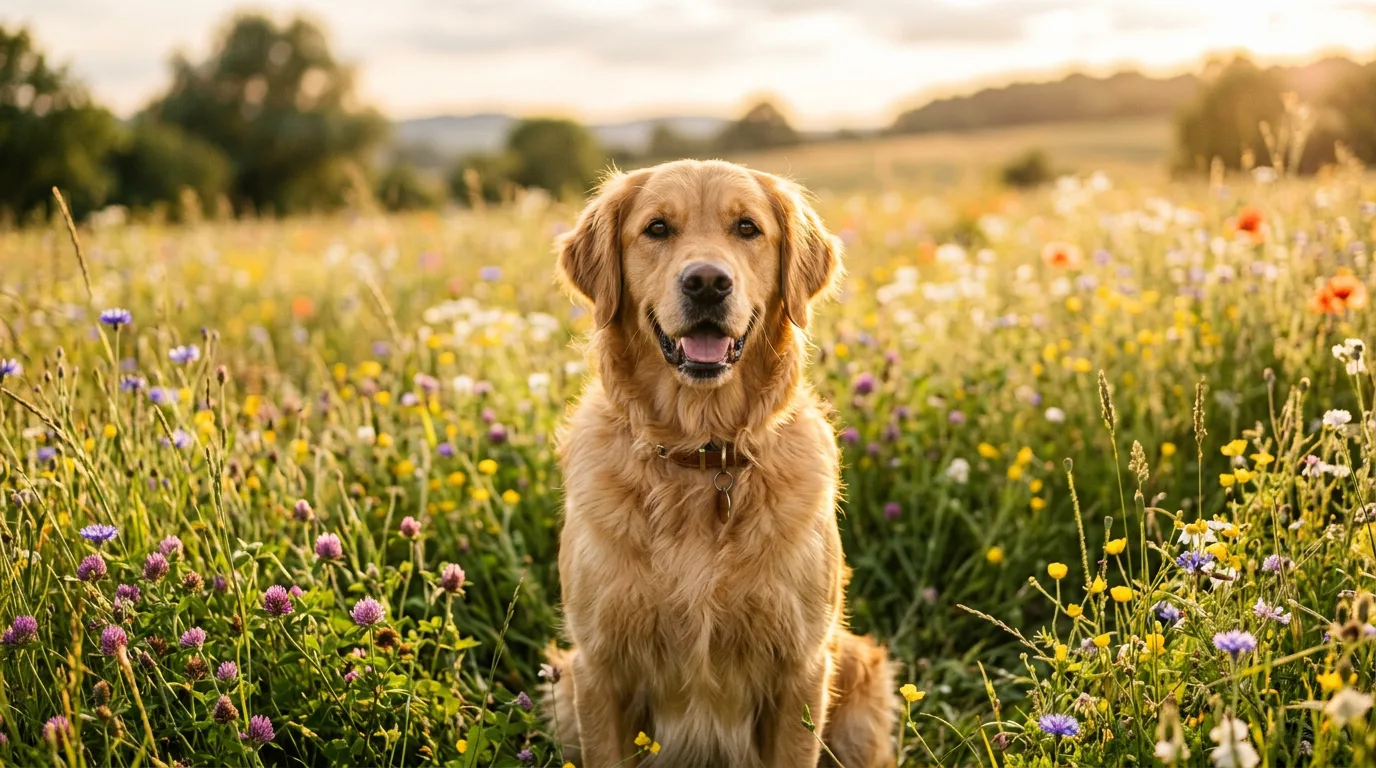
Prompt: "Golden retriever running through a sunlit meadow, long flowing golden coat catching the light, wildflowers and tall grass, golden hour backlight creating rim light on fur, mid-stride with ears bouncing, shallow depth of field, natural pet photography style"
The meadow setting and golden hour backlight create warmth and separation from the background. "Mid-stride with ears bouncing" captures motion with personality. Shallow depth of field keeps focus on the dog while the wildflowers provide color context.
Prompt: "Husky sitting on a snowy mountain ridge, thick double coat with visible guard hairs, blue hour lighting, snow-capped peaks in background, alert expression with ears forward, breath visible in cold air, dramatic landscape pet portrait"
Snow and mountain settings add scale and drama. Blue hour lighting creates a cool, cinematic mood that contrasts with the dog's warm fur. Specifying "thick double coat with visible guard hairs" gives the model a clear texture target rather than generic fur.
Prompt: "Labrador retriever on a sandy beach at sunset, wet fur glistening with water droplets, tongue out and panting happily, paw prints in wet sand behind, warm golden light from the left, wide angle showing ocean waves, lifestyle pet photography"
Beach settings are universally appealing for pet photos. "Wet fur glistening with water droplets" adds realism and visual interest. The paw prints create narrative, and the tongue-out detail makes the image feel candid rather than posed.
Studio Lighting Setups for Professional Pet Portraits
Studio pet photography offers controlled lighting, clean backgrounds, and a professional look. These prompts produce images suitable for pet brands, adoption profiles, or framed wall art.
Prompt: "Professional studio portrait of a border collie, sharp heterochromia eyes in focus, soft diffused lighting from a large softbox on the left, neutral gray seamless backdrop, every strand of the black and white coat visible, commercial pet photography style"
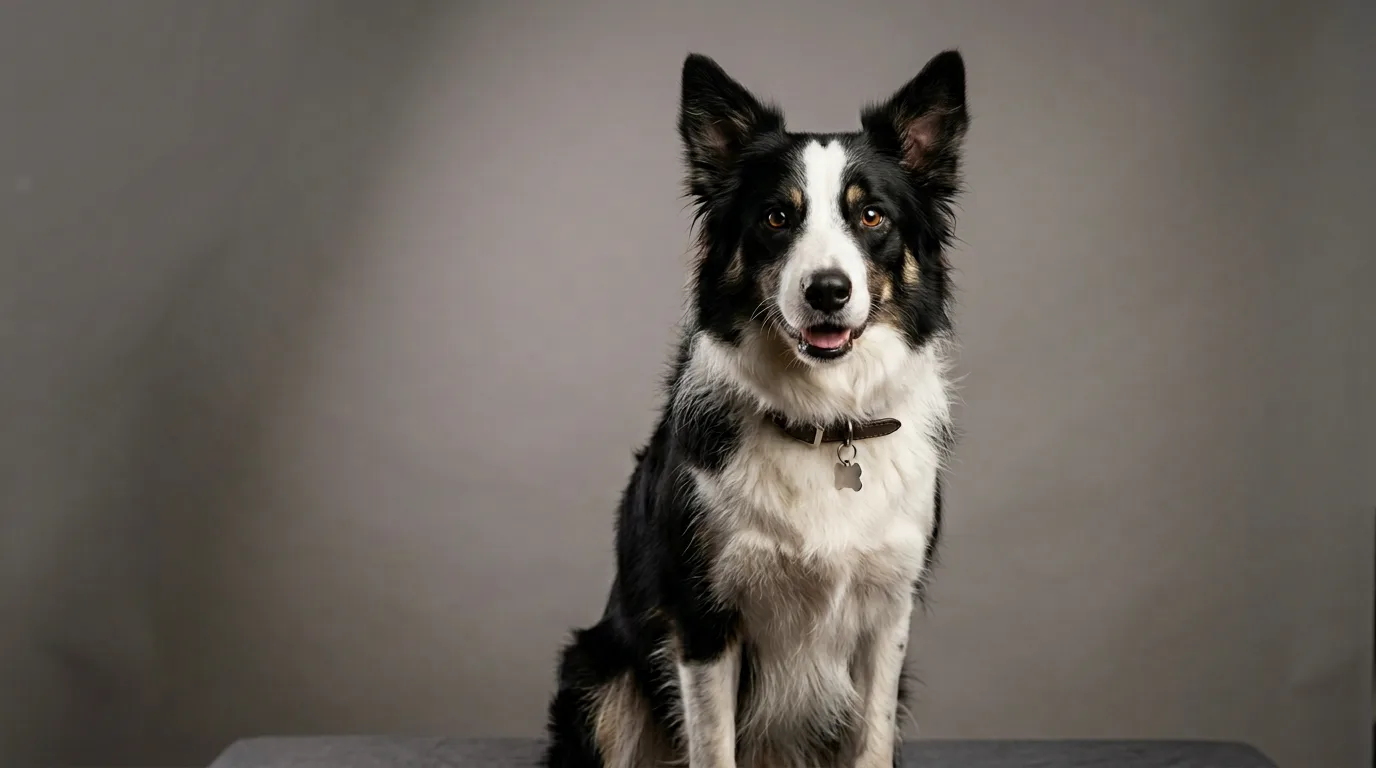
Studio lighting and neutral backdrops let the dog's features take center stage. "Sharp heterochromia eyes in focus" gives the model a specific detail to render rather than generic "sharp eyes." Commercial style produces clean, portfolio-quality results.
Prompt: "Corgi sitting on a white seamless backdrop, soft key light from above-left, subtle catchlights in dark eyes, minimal shadows, tongue slightly out, high-key pet portrait, bright and approachable"
High-key lighting with minimal shadows creates a bright, social-media-ready look. The white backdrop keeps the composition simple and versatile for overlays or branding. Adding "tongue slightly out" prevents a stiff expression.
Prompt: "German shepherd in a studio setup, dramatic Rembrandt lighting with triangle shadow on far cheek, dark moody background, noble and alert pose with one ear slightly tilted, fine art pet portrait, rich blacks and warm highlights, visible fur texture in the light falloff"
Rembrandt lighting adds depth and drama through the characteristic triangle of light on the shadowed side. The dark background and noble pose create a fine-art feel. Specifying "visible fur texture in the light falloff" ensures detail in the transition from light to shadow.
Action Shots That Capture Energy and Personality
Action and playful shots produce the most dynamic, engaging pet images. The key is "frozen motion" language that tells the model to keep the subject sharp while conveying speed.
Prompt: "Australian shepherd catching a frisbee mid-air, jaws open, all four paws off the ground, grass field background, frozen motion with sharp focus on the dog, blue merle coat pattern visible, action pet photography, vibrant afternoon light"
Mid-air action shots require "frozen motion" to avoid blur. The frisbee gives a clear narrative and focal point. Specifying the breed's coat pattern ("blue merle") makes the result breed-accurate rather than generic.
Prompt: "Puppy playing with a tennis ball in a backyard, mid-pounce with front paws extended, clumps of dirt and torn grass visible, soft afternoon side light, candid and joyful, shallow depth of field, lifestyle pet photography"
The pounce moment captures peak playfulness. "Clumps of dirt and torn grass" adds believable imperfections. The backyard setting feels accessible and real.
Prompt: "Dog shaking water off after a swim, thousands of droplets frozen in mid-air forming a halo, lake with trees in background, wet matted fur, dynamic composition, outdoor pet photography, late afternoon light catching each droplet"
The shake moment is visually striking and immediately recognizable. "Thousands of droplets frozen in mid-air forming a halo" creates a specific visual composition the model can target. "Late afternoon light catching each droplet" adds sparkle without looking artificial.
Puppy Portraits and Small Dog Photography
Puppy photography leans into cuteness through sleeping, yawning, curious expressions, and small-scale settings. The challenge is maintaining realistic proportions at small size.
Prompt: "Tiny golden retriever puppy sleeping in a woven basket with a soft cream blanket, soft window light from the left casting gentle shadows, one paw draped over the basket edge, cozy and peaceful, shallow depth of field, newborn pet photography style"
Sleeping puppies are universally appealing. The basket and blanket add texture and scale reference. "One paw draped over the basket edge" adds a specific pose detail that prevents generic results.
Prompt: "Puppy with head tilted 30 degrees, curious wide eyes, sitting on a weathered wooden porch, dappled sunlight through leaves creating pattern on fur, warm earth tones, slightly oversized paws visible, lifestyle pet portrait"
The head tilt is a classic cute pose that suggests curiosity. "Slightly oversized paws" is a breed-accurate puppy detail that most AI misses. Dappled light adds warmth and organic texture.
Prompt: "Small puppy sitting among fallen autumn leaves, one leaf resting on its head, golden hour side lighting, red and orange foliage surrounding, shallow depth of field with bokeh, seasonal pet photography"
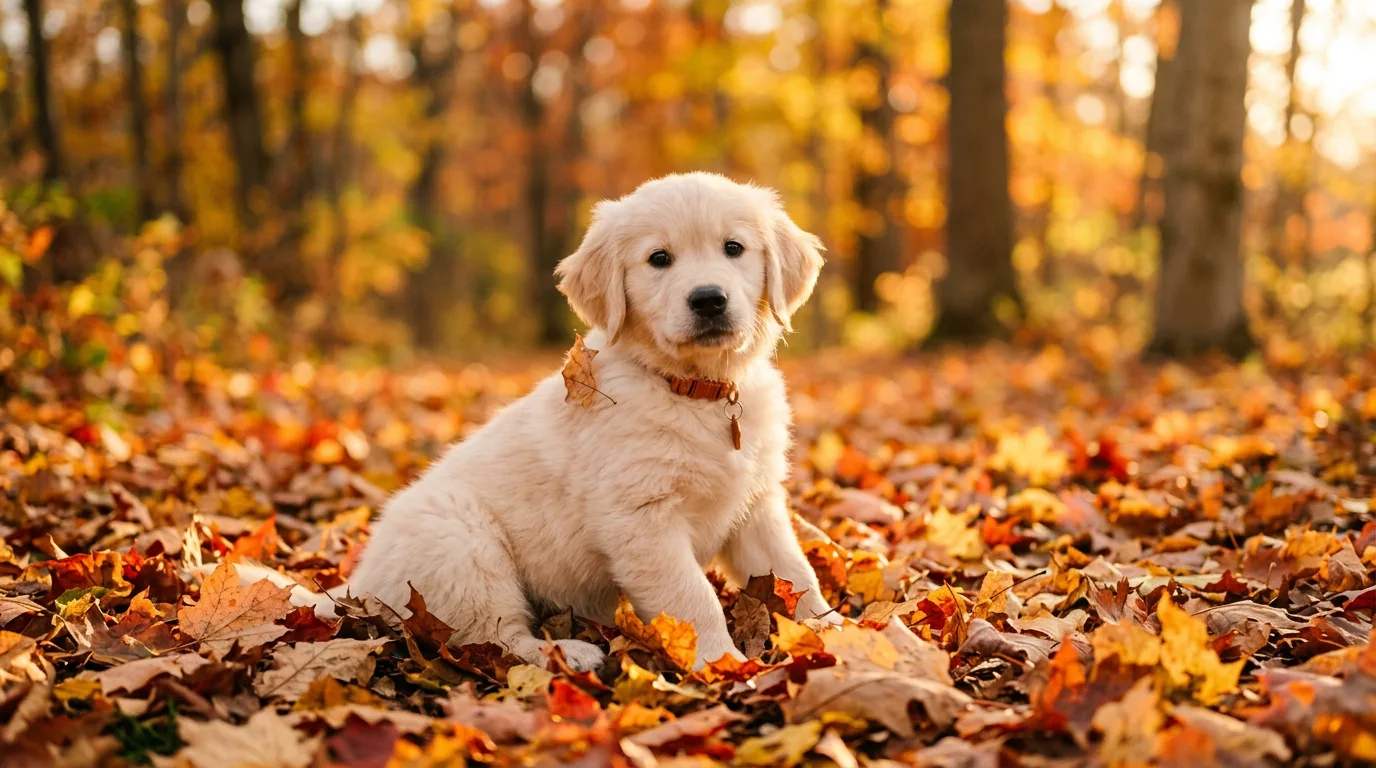
Seasonal context adds color and narrative. "One leaf resting on its head" is a specific, charming detail. The small scale of the puppy against the leaves creates visual interest and a sense of discovery.
Dogs with Their Owners
Dogs-and-owners images capture the bond between human and pet. The technique is the same one that works for family photos: shared activities and role assignment make the subjects look connected.
Prompt: "Woman and her dog walking together on a forest trail, both looking at something ahead off-camera, autumn foliage overhead, golden hour light filtering through canopy, dog slightly ahead pulling gently on leash, candid documentary style, warm color palette"
The shared gaze creates narrative and connection. Forest trail and autumn foliage add environmental richness. "Dog slightly ahead pulling gently on leash" is a detail that reads as genuine rather than posed.
Prompt: "Man sitting on a worn leather couch with his dog resting its head on his lap, cozy living room with warm lamp light, man's hand gently on dog's ear, intimate and tender moment, soft ambient lighting, natural pet and owner portrait"
Indoor, cozy moments emphasize the bond. "Man's hand gently on dog's ear" gives a specific interaction point. Warm lamp light suits the intimate mood without requiring complex lighting descriptions.
Prompt: "Child and large dog running together in a backyard, child mid-laugh with arms wide, dog bounding alongside at same pace, sunny afternoon with long shadows, candid family pet photography, warm and joyful, slight motion blur in grass"
Child-and-dog interactions are relatable and emotionally resonant. "Bounding alongside at same pace" describes a specific shared movement. The long shadows and slight motion blur add a sense of real-world timing. For more child-focused compositions, see our family photo prompts guide.
Artistic and Stylized Pet Art
Artistic pet art pushes beyond realism into painterly textures, dramatic lighting, or conceptual compositions. These prompts produce gallery-worthy or creative pet imagery for wall art and social media.
Prompt: "Portrait of a distinguished greyhound in the style of a Flemish Renaissance oil painting, elaborate ruff collar and velvet doublet, dramatic chiaroscuro lighting, rich umber and gold palette, craquelure texture on the paint surface, museum-quality frame visible at edges, fine art pet portrait"
Renaissance references give the model a clear artistic direction. "Craquelure texture on the paint surface" adds aging detail that makes the painting feel authentic rather than a simple filter over a photo.
Prompt: "Dog silhouette against a vibrant sunset sky, orange to deep purple gradient, clean outline showing pointed ears and tail position, minimal detail in the silhouette, single bird in the distant sky, graphic and striking, artistic pet photography"
Silhouettes work well for artistic pet images because they emphasize shape and breed identity over fine detail. The sunset gradient adds drama and the single bird creates visual balance.
Prompt: "Black and white close-up portrait of an old dog with grey muzzle, high contrast dramatic side lighting, film grain texture, deep expressive eyes, visible whiskers and individual fur strands, photojournalistic style, Tri-X film aesthetic"
Black and white removes color distraction and focuses on form and expression. "Grey muzzle" and "deep expressive eyes" convey age and character. The Tri-X film reference gives the model a specific tonal quality to target.
When AI Dog Photography Does Not Work Well
AI pet photography is not the right tool for every situation:
- Specific likeness of your actual dog. These prompts generate breed-accurate dogs, not your specific pet. If you need your exact dog in a scene, use Nano Banana's photo editing mode with a reference image uploaded to Morphed, not text-to-image generation.
- Multiple dogs interacting. Two dogs playing, wrestling, or cuddling pushes current models into anatomical confusion (merged limbs, extra tails). Stick to single-dog compositions for reliable results.
- Rare or mixed breeds. AI models are trained on common breeds. A "Catahoula Leopard Dog" or a "Basset Hound-Poodle mix" may produce unpredictable results. For uncommon breeds, add extra visual detail: "medium-sized dog with merle coat pattern, floppy ears, and muscular build" rather than relying on the breed name alone.
- Precise text or products on the dog. Dog tags with readable text, branded collars, or specific accessories are unreliable. Nano Banana 2 handles text better than the original, but pet accessories remain inconsistent.
5 Mistakes That Flatten AI Pet Photos Into Stock Images
1. No Personality or Activity Cue
"Golden retriever sitting" is a breed photo, not a portrait. "Golden retriever with head tilted sideways, ears perked, one paw lifted in curiosity" has personality. Always describe what the dog is doing or feeling.
2. Perfect Grooming on an Everyday Dog
Real dogs are messy. "Perfectly groomed show dog" looks artificial for everyday content. Add imperfections: "slightly muddy paws," "windswept fur," "tongue hanging sideways," or "damp patch on chest from drinking water."
3. Generic Backgrounds Without Story
"Dog in a park" is stock photography territory. "Dog on a weathered dock at a lake with morning mist rising" is a specific scene. The background should tell a story about the dog's life or create a mood.
4. Missing Scale Context
AI sometimes renders dogs at wrong proportions. A Chihuahua the size of a Labrador, or vice versa. Include size references: "small Chihuahua on a large armchair, paws barely reaching the seat edge" or "large Great Dane filling a narrow doorway, head ducking under the frame."
5. No Lighting Direction
Prompts without lighting default to flat, even illumination that looks like a phone camera flash. Adding a single cue ("golden hour backlight," "soft window light from the left," "dramatic side lighting from above") transforms the result from snapshot to photograph.
Tips for Stronger Pet Photo Prompts
-
Specify fur texture and breed together. "Golden retriever with long flowing fur" or "short-haired dachshund with smooth glossy coat" gives the model clear visual anchors. Breed-specific details improve consistency dramatically.
-
Include lighting direction in every prompt. "Golden hour backlight," "soft window light from the left," or "dramatic Rembrandt lighting" each produce distinct results. Lighting sets the mood before the viewer registers the subject.
-
Describe expression and activity, not just pose. "Tongue out and panting happily," "alert expression with ears forward," "curious head tilt," or "sleeping with twitching paw" steer the model toward specific emotion and energy.
-
Add environmental context that tells a story. "Meadow with wildflowers after rain," "sandy beach with paw prints," or "cozy living room with chewed toy on the rug" create settings that feel lived-in.
-
Reference specific photography styles. "Lifestyle pet photography," "commercial pet portrait," "action pet photography," "documentary style," and "fine art pet portrait" each carry distinct visual conventions the model understands.
-
Use camera and lens language. "Shot with 85mm lens, shallow depth of field, f/1.8 bokeh" gives the model rendering-level detail about how the image should look. See our main prompts guide for more on camera language.
Frequently Asked Questions
What makes Nano Banana good for dog and pet photography?
Nano Banana renders breed-specific fur textures (wiry terrier coat vs. smooth whippet coat vs. flowing golden retriever fur), natural eye reflections with catchlights, and believable expressions. It handles dogs in motion without flattening detail, producing images with photographic consistency across outdoor, studio, and action scenes. Nano Banana 2 adds sharper whisker and fine-fur rendering. Both are available on Morphed.
Can I use these dog prompts for cats or other animals?
Yes. The same prompt structure works for any pet: specify the animal and breed, describe the setting and lighting, add an expression or activity cue, and reference a photography style. Swap "golden retriever" for "tabby cat" or "grey parrot" and adjust the pose and environment. Nano Banana handles various animals well with clear, descriptive prompts.
How do I make AI pet photos look realistic instead of stock-like?
Three techniques: First, add imperfections like slightly muddy paws, windswept fur, or tongue hanging sideways. Second, use activity-based prompts (running, shaking water, mid-pounce) instead of static poses. Third, specify exact lighting direction and a photography style reference. These details steer the model away from generic breed photos toward images with personality.
What is the difference between Nano Banana and Nano Banana 2 for pet photos?
Nano Banana 2 offers improved fine detail rendering, especially whiskers, individual fur strands, and eye reflections. For pets alongside owners, Nano Banana 2 also handles multi-subject compositions more reliably. For pure single-pet portraits, both produce excellent results. Both are available on Morphed.
What prompt length works best for dog photography?
20 to 50 words covering five elements: breed and fur detail, action or pose, setting, lighting direction, and photography style. A focused 30-word prompt outperforms a 100-word prompt with conflicting instructions. Lead with the most important visual element since Nano Banana assigns weight based on word order.
More Nano Banana Prompt Guides
- 80+ Nano Banana Prompts (Complete Guide)
- Nano Banana 2 Prompts
- Nano Banana Prompts for Family Photos
- Nano Banana Prompts for Selfies
- Nano Banana Prompts for Product Photography
- Nano Banana Prompts for Landscape Photography
Try These Pet Photo Prompts on Morphed
Every prompt above works on Morphed with Nano Banana and Nano Banana 2. Swap in your favorite breed, change the setting, adjust the lighting mood, or upload a reference photo of your own dog for AI editing. Generate pet portraits for wall art, social media, greeting cards, or just because your dog deserves it.