

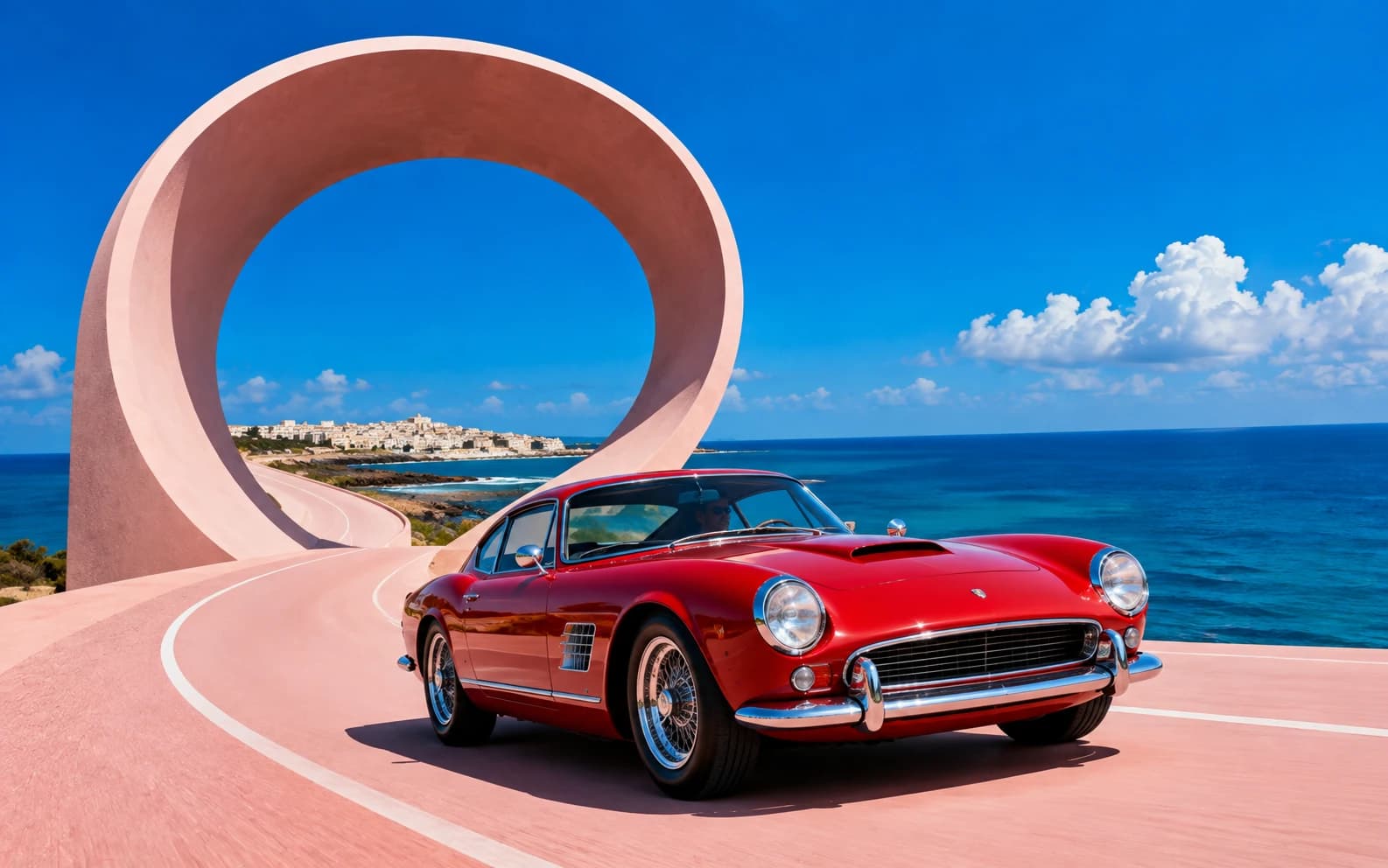
Most AI car prompts produce the same result: a glossy vehicle floating on a featureless background with lighting that screams video game render. The car looks clean, but it does not look real. Across Nano Banana, Nano Banana 2, and Nano Banana Pro on Morphed, one technique consistently fixes this: material stacking. Describe the car's surface properties layer by layer rather than just naming the color.
"Blue sports car" is vague. "Deep metallic midnight blue with pearl effect in direct light, chrome trim catching overhead spotlights, transparent glass with environmental reflections" gives the model physics-level surface instructions. That distinction is the single biggest factor in whether your output looks like a photograph or a rendering.
Quick reference: which automotive style do you need?
| Category | Best For | Key Prompt Elements | Prompts |
|---|---|---|---|
| Classic and Vintage | Nostalgic content, Americana, editorial | Warm light, chrome, patina, period colors | 4 prompts |
| Sports Cars and Supercars | Social media, ads, aspirational content | Low angle, rim lighting, aggressive lines | 4 prompts |
| Scenic and Landscape | Travel, lifestyle, adventure content | Dramatic backdrop, golden hour, wide angle | 4 prompts |
| Studio and Product | Dealership ads, configurators, editorial | Controlled lighting, reflective surface, clean background | 4 prompts |
| Interior Detail | Luxury branding, review content, close-ups | Leather, carbon fiber, side lighting, cockpit view | 3 prompts |
| Action and Motorsport | Racing content, drift culture, dynamic shots | Motion blur, tire smoke, panning shot | 3 prompts |
| Miniature and Diorama | Creative social content, hobbyist communities | Tilt-shift, scale model, diorama lighting | 2 prompts |
| Robot and Transformer | Viral social content, creative mashups | Robot form, mechanical detail, matching car elements | 2 prompts |
Both Nano Banana and Nano Banana 2 are available on Morphed. For the full model overview and general prompting framework, see the complete Nano Banana prompts guide.
Why Nano Banana Produces Better Car Photos Than Midjourney or DALL-E
Automotive photography exposes AI weaknesses that other subjects hide. Metallic paint shifts color based on viewing angle. Chrome reflects the entire environment. Glass is simultaneously transparent, reflective, and tinted. A model that cannot handle these overlapping material properties produces cars that look like plastic toys. Nano Banana handles these challenges because it follows material and lighting instructions literally rather than adding artistic reinterpretation.
Nano Banana vs. Midjourney: Midjourney adds stylization to every output. For car photography, this means over-saturated paint, exaggerated reflections, and a "concept art" quality that looks impressive but not real. Users on automotive photography forums report that Midjourney consistently adds dramatic color grading to car shots, making it difficult to produce the clean, neutral look that dealership ads and configurators require.
Nano Banana vs. DALL-E (GPT Image): DALL-E produces clean results but struggles with reflections on curved surfaces. Chrome bumpers often look painted rather than reflective, and metallic paint lacks the color-shifting quality that makes real automotive photos convincing. DALL-E also has difficulty rendering specific car models with accurate proportions and period-correct details.
Nano Banana vs. Flux: Flux matches Nano Banana on photorealism but requires technical setup for local use. On Morphed, both models are available with zero configuration.
| Feature | Nano Banana | Midjourney | DALL-E / GPT Image | Flux |
|---|---|---|---|---|
| Metallic paint rendering | Color-shifting, physically accurate | Over-saturated, stylized | Clean but flat, lacks depth | Comparable |
| Chrome and reflections | Environmental reflections, accurate specular highlights | Dramatic but over-processed | Often painted-on rather than reflective | Good |
| Glass transparency | Transparent with tint and reflection layers | Good but adds artistic filter | Medium accuracy | Good |
| Specific model accuracy | Strong with year and model in prompt | Variable, often generic shape | Moderate | Good with detailed prompts |
| Interior detail (carbon fiber, leather) | Strong texture differentiation | Good but over-polished | Medium | Good |
| Setup required | None on Morphed | Discord or web app | ChatGPT Plus or API | Local install or hosted |
Classic and Vintage Car Prompts
Classic and vintage cars benefit from warm lighting, nostalgic settings, and attention to chrome, curves, and patina. The key is specifying era-accurate colors and materials because AI models default to modern automotive styling unless directed otherwise.
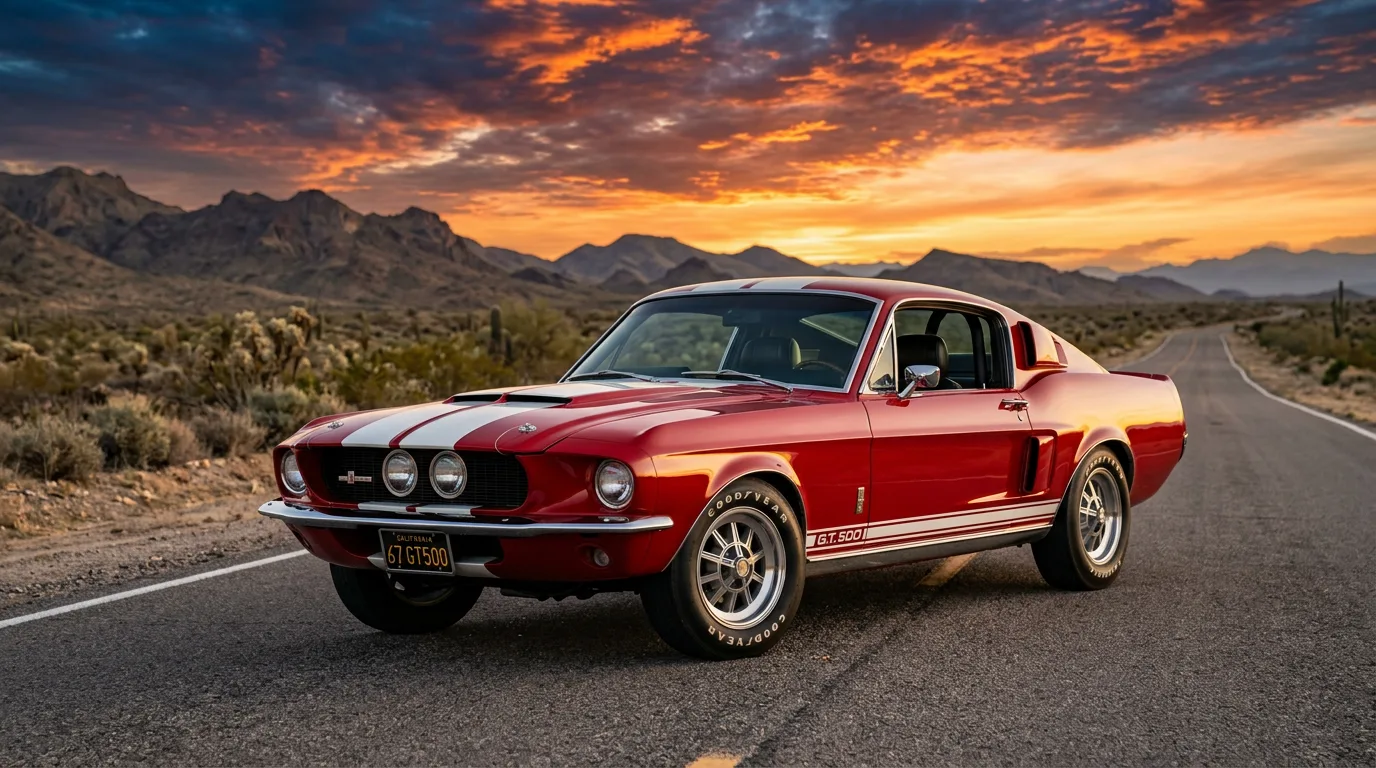
Prompt: "Classic red 1967 Ford Mustang on a desert highway at sunset, long stretch of empty road, warm golden light reflecting off chrome bumpers and side mirrors, dust haze in the air, cinematic automotive photography, shot on Hasselblad medium format, film grain"
The desert highway and sunset create an iconic American road-trip aesthetic. "Chrome bumpers and side mirrors" gives the model multiple reflective surfaces to render. Specifying the exact year (1967) helps the model render accurate body proportions, grille shape, and fastback profile.
Prompt: "Vintage 1957 Chevrolet Bel Air in turquoise and white two-tone paint, parked on a suburban driveway with manicured lawn and white picket fence, soft afternoon light creating gentle shadows under chrome fins, nostalgic Americana aesthetic, automotive portrait photography, Kodak Portra 400 color science"
Turquoise and white are signature Bel Air colors. The Kodak Portra 400 reference produces warm, slightly desaturated tones that match the mid-century aesthetic. "Chrome fins" is a material-specific detail that triggers accurate rendering of the Bel Air's distinctive tailfin styling.
Prompt: "Classic British racing green Jaguar E-Type, parked on a wet cobblestone street in London, rain reflections on pavement doubling the car's silhouette, moody cinematic lighting from streetlamps, wire-spoke wheels in sharp focus, automotive photography style, shallow depth of field"
Wet cobblestones and rain reflections create drama while giving the model a clear environmental reflection instruction. "Wire-spoke wheels in sharp focus" directs detail rendering to a signature feature of vintage British sports cars.
Prompt: "Patinated 1969 Dodge Charger in flat black primer with visible surface texture, parked in a dusty barn with sunbeams through wooden slats, warm directional light hitting the front quarter panel, abandoned Americana aesthetic, documentary automotive photography, Tri-X film grain"
The primer and patina prompt pushes against the default AI tendency to render every car in showroom condition. "Sunbeams through wooden slats" creates specific directional lighting. The Tri-X film stock reference produces high-contrast black-and-white tonal rendering appropriate for the gritty barn-find aesthetic.
Sports Cars and Supercars
Sports cars and supercars demand sharp lines, aggressive angles, and lighting that highlights aerodynamic surfaces. The challenge is avoiding the "video game screenshot" look where everything is too clean, too saturated, and lit from everywhere at once. Specifying a single dominant light source and a specific camera angle fixes this.
Prompt: "Ferrari 488 GTB in Rosso Corsa red, low angle shot from ground level emphasizing aggressive front splitter and headlight shape, dramatic rim lighting from sunset behind the car, asphalt race track with heat haze visible, automotive advertising photography, Canon EF 24-70mm"
Low angles emphasize power and visual weight. "Rim lighting from sunset behind the car" creates a specific backlit silhouette with a warm glow on the body edges. "Heat haze visible" adds an environmental detail that grounds the scene in reality.
Prompt: "Lamborghini Huracan in matte black with satin clear coat, three-quarter front view parked on a city street at night, reflections of neon signs and street lights playing across the body panels, wet asphalt adding secondary reflections, luxury automotive photography, sharp focus on carbon fiber air intakes"
Matte black is challenging for AI because it requires understanding diffuse versus specular reflection. Adding "satin clear coat" gives the model a hybrid surface to render. "Neon signs and street lights playing across the body panels" describes a specific reflection pattern rather than just asking for "city lights."
Prompt: "Porsche 911 GT3 RS in silver metallic, parked on a mountain pass switchback with alpine peaks in background, golden hour side light creating long shadows across the body, Michelin Pilot Sport tires and brake calipers visible, motorsport lifestyle photography, wide angle showing both car and landscape"
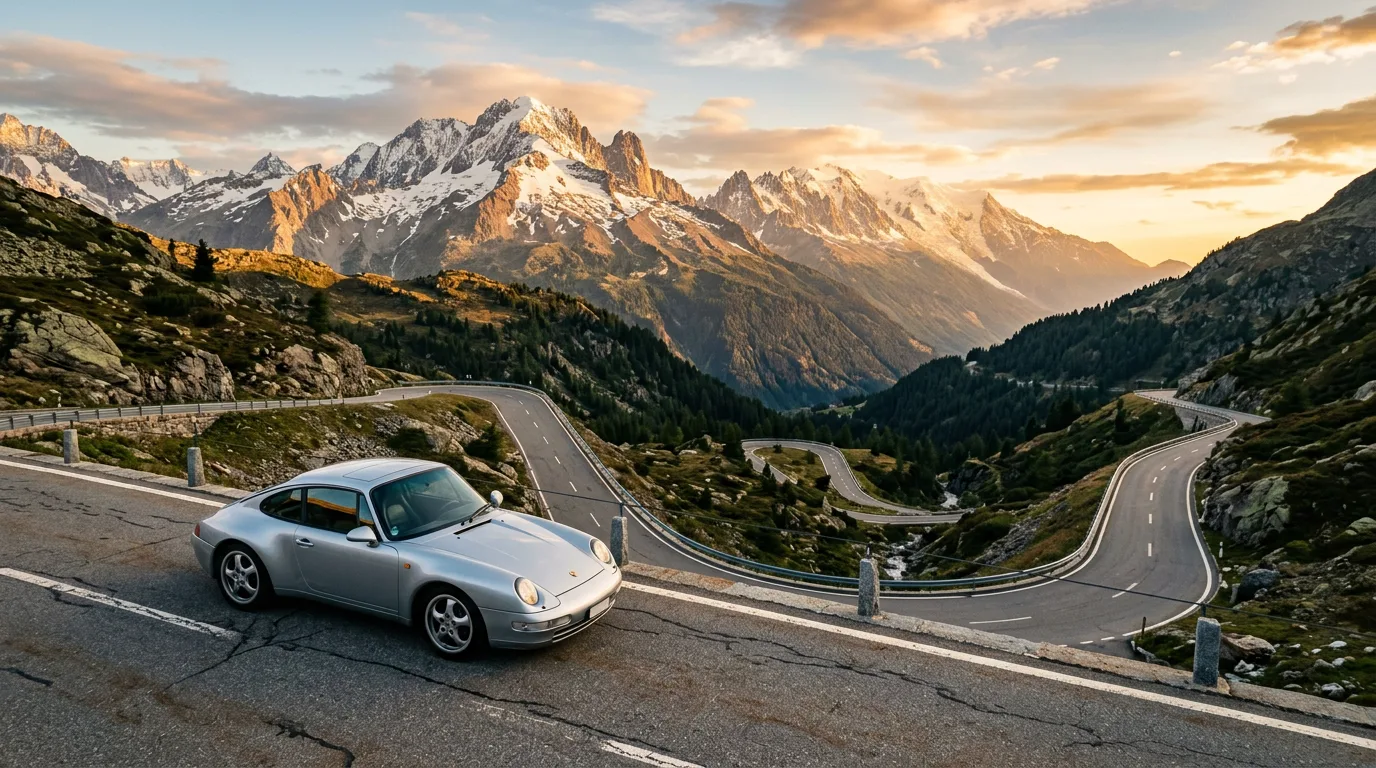
Mountain passes and winding roads are classic Porsche settings. "Michelin Pilot Sport tires and brake calipers visible" adds brand-specific detail that signals to the model this is a performance car, not a base model. The golden hour side light creates dimension across the silver paint.
Prompt: "McLaren 720S in Papaya Spark orange, studio turntable shot with car rotating slightly, dramatic overhead lighting creating a hotspot on the roof and cascading shadows down the flanks, dark environment with just the car illuminated, supercar launch photography style"
The turntable shot is a staple of automotive reveals and launch events. "Hotspot on the roof and cascading shadows down the flanks" describes a specific light behavior on the curved body that the model can render. Papaya Spark is a McLaren heritage color that adds brand authenticity.
Cars in Scenic and Landscape Settings
Placing cars in dramatic landscapes creates automotive photography that tells a story of travel and adventure. The challenge is balancing the vehicle against the backdrop so neither overwhelms the other. Describe the landscape as context, not the primary subject, and specify where the car sits in the composition.
Prompt: "SUV on a rugged red dirt road through a narrow slot canyon, sandstone walls rising on both sides with bands of orange and red strata visible, dust trail behind the vehicle, afternoon sunlight hitting only the top of the canyon walls, adventure automotive photography, wide angle perspective showing canyon scale, National Geographic style"
Canyon and red rock settings evoke the American Southwest. "Bands of orange and red strata visible" is a geologic detail that adds realism. "Sunlight hitting only the top of the canyon walls" creates the dramatic light-and-shadow interplay that makes slot canyon photography compelling.
Prompt: "Convertible sports car on a coastal cliff road, Pacific Ocean and fog bank visible below, top down with wind motion suggested in the driver's hair, golden hour backlight from behind creating lens flare, lifestyle automotive photography, aspirational mood, 35mm wide angle"
Coastal roads and convertibles suggest freedom and escape. "Fog bank visible below" is a specific weather detail for California and Pacific Coast Highway imagery. The 35mm wide angle captures more environment while keeping the car prominent.
Prompt: "Classic Land Rover Defender in olive green, parked at a campsite with canvas tent and campfire in the background, mountain lake reflecting golden sunset colors, warm firelight on the vehicle's front grille mixing with cool blue twilight sky, outdoor adventure photography, Kodak Ektar color saturation"
The campsite scene creates a lifestyle narrative. Mixing warm firelight on the grille with cool twilight sky gives the model two distinct color temperatures to render, which produces the depth and atmosphere of real outdoor photography. The Kodak Ektar reference produces vivid, saturated colors appropriate for adventure content.
Prompt: "Black sedan on a foggy mountain road, mist between pine trees creating visible layers of depth, headlights cutting through fog with volumetric light beams, moody atmospheric lighting, cinematic automotive portrait, mysterious and evocative, desaturated cool color grading"
Fog and mist create atmosphere and depth. "Volumetric light beams" from the headlights is a specific optical effect that Nano Banana renders well. The desaturated cool grading sets the mood and prevents the over-saturated look that ruins atmospheric shots.
Studio Car Photography Prompts
Studio car photography isolates the vehicle with controlled lighting, reflective surfaces, and clean backgrounds. These are the most commercially valuable automotive images: dealership ads, configurators, editorial features, and brand campaigns.
Prompt: "Luxury sedan in pearl white on a seamless white cyclorama studio floor, soft diffused key light from upper left creating subtle gradient shadow on the body, secondary fill light from right preventing harsh shadows, clean minimal background with no visible horizon line, automotive product photography, sharp focus on paint depth and chrome trim"
White seamless backgrounds are the standard for automotive product shots. "Soft diffused key light from upper left" with "secondary fill from right" describes a two-light setup that prevents the harsh single-shadow look. "No visible horizon line" is a critical instruction that prevents the background edge artifact common in AI studio shots.
Prompt: "Sports car on a reflective black acrylic studio surface, thin rim lights creating a bright highlight line along the entire roofline and fender edges, dark moody background with gradient fade, reflection of the car on the surface below creating a mirror image, automotive advertising style, dramatic and premium"
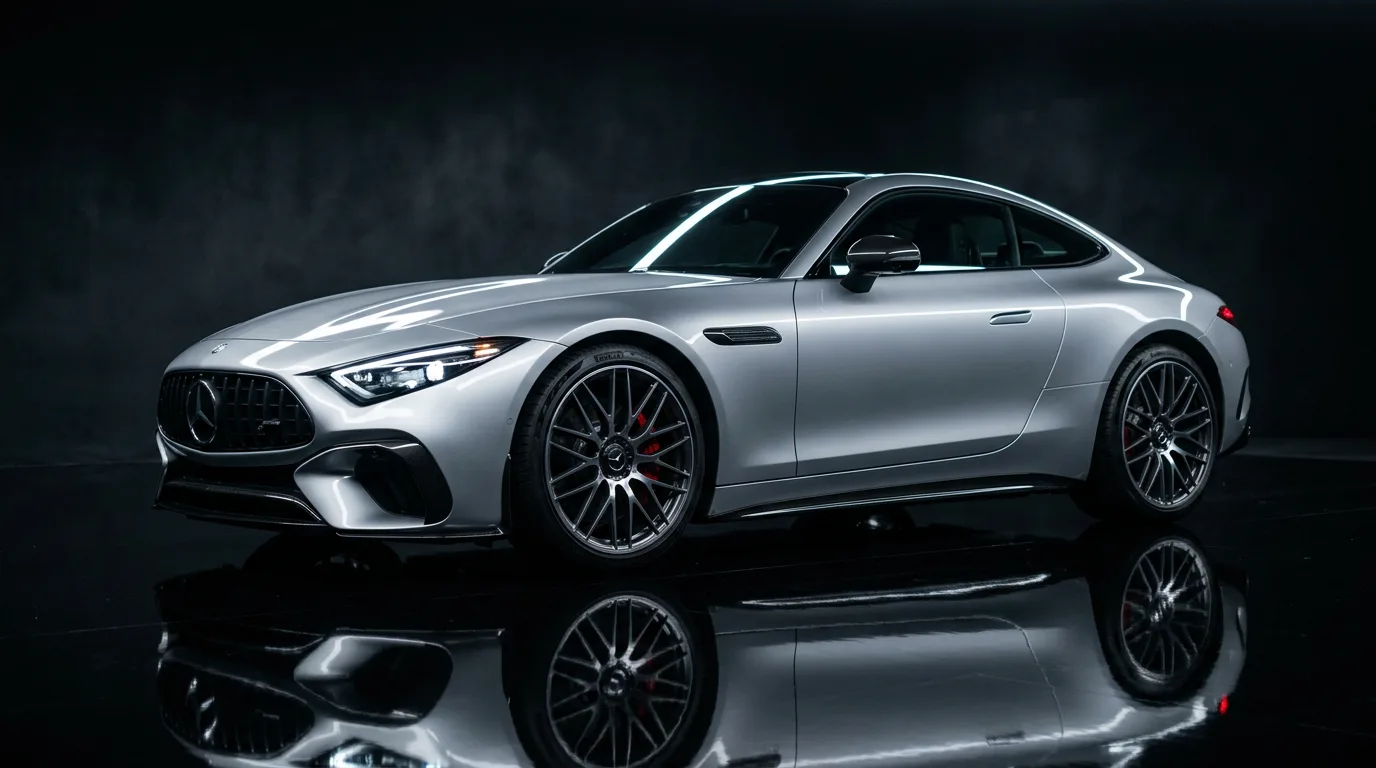
Reflective surfaces double the car's visual presence and add depth. "Thin rim lights creating a bright highlight line along the entire roofline and fender edges" describes the specific studio technique used in premium car ads. This single instruction produces the sleek, high-end look.
Prompt: "Electric vehicle in matte white on gray gradient studio backdrop, soft even lighting from large overhead softbox creating minimal shadows, futuristic clean aesthetic, glowing LED headlights slightly illuminated, automotive product shot for brand campaign, 4K sharp detail on wheels and body lines"
Matte white and gray gradients suit the clean, futuristic positioning of EVs. "Glowing LED headlights slightly illuminated" adds a subtle detail that makes the car look active rather than a static object. "Large overhead softbox" is a specific lighting instruction that avoids distracting reflections on matte surfaces.
Prompt: "Three-quarter rear view of a sports car in metallic gunmetal gray, studio setting with single large strip light creating a long highlight streak down the side body panel, dark background, subtle smoke or haze at ground level, cinematic automotive studio photography, dramatic contrast between highlight and shadow"
The three-quarter rear view highlights body sculpting and tail design. "Single large strip light" is a studio photography term that produces the long, narrow reflection streak seen in professional car ads. Ground-level smoke adds atmosphere without competing with the car.
Interior Detail Shots
Interior shots focus on craftsmanship: leather, stitching, dashboard design, infotainment screens, and the driver's perspective. These prompts serve luxury branding, review content, and detail-oriented social media.
Prompt: "Close-up of a luxury car steering wheel and dashboard, hand-stitched black leather with contrasting red stitching visible at thread level, soft natural light filtering through the windshield creating warm highlights on brushed aluminum accents, instrument cluster glowing softly, premium automotive interior photography, sharp focus on material textures"
"Hand-stitched" and "contrasting red stitching visible at thread level" push the model to render thread-level detail. Without this specificity, AI defaults to smooth, textureless surfaces. "Brushed aluminum accents" is a material instruction that produces a different reflection pattern than chrome or carbon fiber.
Prompt: "Close-up of car gear shifter and center console, carbon fiber weave pattern in sharp focus showing individual fiber strands, brushed metal trim with fingerprint-free matte finish, dramatic side lighting from left creating texture shadows across the carbon fiber, ambient LED strip in blue along console edge, automotive detail photography"
Carbon fiber has a distinctive diagonal weave pattern that AI often renders as a generic texture. "Individual fiber strands" forces the model to attempt the real pattern. "Side lighting from left" is specifically chosen because directional light reveals carbon fiber texture while overhead light flattens it.
Prompt: "Driver's point-of-view from inside a sports car at speed, steering wheel and instrument cluster in sharp focus, road ahead blurred through windshield showing motion, rearview mirror reflecting trailing car, leather dashboard and alcantara headliner visible, immersive cockpit perspective, GoPro wide angle aesthetic"
"Cockpit perspective" and "GoPro wide angle" create an immersive, action-camera feel. "Alcantara headliner" is a specific material that signals high-performance interior trim. "Rearview mirror reflecting trailing car" adds a story element within the composition.
Action and Motorsport Shots
Action shots capture motion, speed, and drama. These are technically challenging because AI models default to static compositions. The key is specifying motion artifacts: blur, smoke, spray, and panning effects.
Prompt: "Drift car mid-slide through a corner, massive cloud of tire smoke billowing from rear wheels, sideways angle with front wheels turned opposite to direction of travel, panning shot with sharp car body and motion-blurred background, night circuit with stadium lights, motorsport action photography, 1/125 shutter speed"
"Mid-slide" and "front wheels turned opposite to direction of travel" describe the specific physics of drifting. The shutter speed reference (1/125) tells the model to render the car sharp but the background blurred, which is the standard panning technique for motorsport photography.
Prompt: "Rally car launching off a crest on a gravel forest stage, all four wheels off the ground with gravel spray arc behind, midday forest light filtering through trees, co-driver visible through windshield, World Rally Championship style photography, telephoto compression, dust cloud in background"
The airborne moment is the signature rally image. "Gravel spray arc behind" and "dust cloud in background" add the environmental effects that sell the motion. "Telephoto compression" describes the lens effect that makes the background appear closer, a hallmark of professional rally photography.
Prompt: "Formula-style open-wheel race car at full speed on a straight, front-on camera angle at track level, heat shimmer rising from asphalt, sponsor graphics on sidepods, carbon fiber bodywork with visible weave, motorsport photography, ultra-fast shutter freezing motion, dramatic clouds in background"
Track-level camera angle with a front-on view is the most dramatic composition for open-wheel cars. "Heat shimmer rising from asphalt" is a detail that signals extreme temperature and speed. "Sponsor graphics on sidepods" adds commercial realism, though the specific text may vary.
Miniature and Diorama Shots
Miniature and diorama-style automotive images have become viral on social media. These prompts create the illusion of scale-model cars in handcrafted scenes. The technique relies on tilt-shift blur and scale-appropriate environmental details.
Prompt: "Miniature diorama of a 1/18 scale model Porsche 911 on a tiny mountain road scene, tilt-shift photography creating shallow depth of field, handcrafted terrain with miniature trees and rocks, warm directional lighting from upper right simulating golden hour, macro photography style, visible model stand edge at bottom"
"1/18 scale model" sets the size context. "Handcrafted terrain with miniature trees and rocks" tells the model to render the environment as a diorama rather than a real landscape. "Visible model stand edge at bottom" is a counterintuitive addition that sells the miniature illusion by breaking the fourth wall.
Prompt: "Toy car diorama of a vintage Volkswagen Beetle in a tiny Japanese street scene, cherry blossom petals on the ground at appropriate scale, warm afternoon light, tilt-shift blur on foreground and background, miniature shop signs with kanji, hobbyist scale model photography, soft macro lens rendering"
The Japanese street scene with cherry blossoms is one of the most popular diorama settings. "At appropriate scale" is important because without it, the model may render full-size petals next to a miniature car. The tilt-shift blur is the optical signature that sells the miniature effect.
Robot and Transformer Mashup Prompts
Car-to-robot transformation prompts have become one of the most viral Nano Banana trends on social media. These work well because the model can maintain visual consistency between the car and its robot form.
Prompt: "A photo of a 1967 Ford Mustang alongside the car transformed into its robot form, the robot must have consistent design elements that match the car including the same red paint, chrome bumper details repurposed as armor, door handle shapes visible in the robot's limbs, robot standing in heroic pose next to the car, cinematic lighting, photorealistic detail"
The key to transformer prompts is explicit visual consistency instructions: "same red paint," "chrome bumper details repurposed as armor," "door handle shapes visible in the robot's limbs." Without these, the model generates a generic robot next to a car with no visual connection.
Prompt: "Lamborghini Aventador in neon green alongside its mecha robot transformation, robot incorporating the car's angular body lines, scissor door shapes as wing elements on the robot, hexagonal tail light pattern visible in the robot's chest, both standing on a dark industrial platform with dramatic uplighting, science fiction concept art style"
Specifying which car design elements appear where on the robot (scissor doors as wings, tail lights as chest pattern) gives the model a mapping between vehicle and robot. "Science fiction concept art style" produces cleaner lines than "photorealistic" for this type of creative prompt.
What Actually Improves Automotive Prompts Across Both Models
Comparing prompt elements across all eight categories on both Nano Banana and Nano Banana 2 on Morphed surfaces which choices produce the most photorealistic results.
Material stacking is the single biggest quality lever for cars. Prompts that described surface properties in layers ("deep metallic blue with pearl effect, chrome trim, transparent glass with environmental reflections") produced noticeably more photorealistic paint than prompts with simple color descriptions ("blue car"), which tend to look like plastic or matte paint.
Nano Banana 2 handles reflections and fine mechanical detail significantly better. The clearest differentiator was chrome rendering. Nano Banana 2 produces more accurate environmental reflections in chrome bumpers, mirrors, and trim pieces than the original. Wheel spoke detail, brake caliper rendering, and grille mesh patterns were also notably sharper.
Single-source lighting beats multi-source every time. "Dramatic rim lighting from sunset" consistently outperformed "good lighting, warm, soft, dramatic, professional." One precise lighting descriptor with direction and source produced better results than stacking five generic lighting words. The model distributes rendering priority based on word position, so front-loading the most important lighting detail matters.
Camera and lens references improve framing consistency. Adding "Canon EF 24-70mm" to three-quarter car shots and "85mm f/1.4" to detail shots reduced output variation significantly. Without lens references, the same prompt produced inconsistent field of view and depth of field across generations.
Specific car models outperform generic descriptions. "1967 Ford Mustang" consistently generated accurate proportions, grille shape, and fastback profile. "Red classic sports car" produced a different car shape each time. The model has strong recognition of popular car models when given exact year and name.
| Prompt Element | Impact on Quality | Best Practice |
|---|---|---|
| Material stacking (paint, chrome, glass layers) | High | "Deep metallic blue with pearl effect" not "blue" |
| Lighting direction and source | High | "Rim lighting from sunset" not "good lighting" |
| Specific car model and year | High | "1967 Ford Mustang" not "red classic car" |
| Camera/lens reference | Medium-high | "24-70mm" for three-quarter, "85mm" for details |
| Photography style keyword | Medium | "Automotive advertising" vs. "motorsport lifestyle" produce distinct looks |
| Environmental context | Medium | "Wet cobblestones reflecting neon" not "city street" |
| Surface finish description | Medium | "Matte black with satin clear coat" not "black paint" |
| Prompt length | Medium | 25-45 words is the sweet spot for automotive prompts |
When AI Car Photography Is the Wrong Choice
AI-generated automotive images work well for many purposes, but not all. Being honest about limitations saves time.
Skip AI car prompts when:
- You need photos of your specific car. These prompts generate fictional vehicles. For your actual car, upload a photo on Morphed and use editing prompts to change the background or lighting. Text-to-image alone will not reproduce your car's exact spec, aftermarket modifications, or wear patterns.
- Accuracy will be scrutinized by enthusiasts. Car forums and enthusiast communities will spot inaccurate details: wrong wheel design for a given model year, incorrect grille mesh pattern, anachronistic headlight shapes. For content targeting car communities, verify details against reference photos before posting.
- You need consistent angles across a catalog. AI generates slightly different perspectives each time, even with the same angle instruction. For dealership inventory where every car must be shot from identical angles, traditional photography or 3D rendering with fixed camera positions is more reliable.
- You need readable text on the car. License plates, bumper stickers, and sponsor decals with specific text are unreliable. Nano Banana 2 handles short text better than the original, but accuracy on automotive text remains inconsistent. For content requiring legible text, add it in post-production.
- The image will be used for insurance, legal, or documentation purposes. AI-generated car images are not evidence of a vehicle's condition. Do not use them for insurance claims, accident documentation, or vehicle listings where the image is meant to represent a specific car's actual state.
5 Mistakes That Make AI Car Photos Look Like Video Game Screenshots
1. Describing Only the Color
"Red sports car" produces a generic, plastic-looking vehicle. "Rosso Corsa red with metallic flake visible in direct light, clear coat depth creating a wet-look surface" gives the model physics-level instructions. Color is one layer of a car's surface. Add paint type (metallic, matte, pearl, candy), clear coat behavior, and how light interacts with the finish.
2. Lighting From Everywhere at Once
Real automotive photography uses one or two controlled light sources. "Good lighting, bright, dramatic, warm, professional" is five wasted words. The model interprets stacked lighting words as "light from every direction," which is why AI car shots often look flat and shadowless. Pick one: "golden hour side light from the left," "single strip light from overhead," or "rim lighting from behind." One source, one direction.
3. Missing Environmental Reflections
A car in a vacuum looks fake because real cars reflect their surroundings. "Parked on a street" gives no reflection content. "Parked on a wet city street at night with neon signs reflected in the hood and rain droplets on the roof" gives the model specific objects to reflect in the car's surfaces. The environment is not just a background; it is part of the car's appearance.
4. Generic Angles
"Car from the front" is the most common prompt angle and the most boring composition. "Low three-quarter front view at 30 degrees, camera at wheel hub height" describes a specific professional automotive composition. Classic automotive angles include three-quarter front, three-quarter rear, direct profile (side), overhead, and cockpit POV. Name the exact angle.
5. Ignoring Tire and Wheel Detail
AI models often render tires as black discs and wheels as generic shapes. "BBS forged mesh wheels with visible bolt pattern, Michelin Pilot Sport 4S tires with tread pattern and sidewall text" forces the model to render specific wheel and tire details. For enthusiast content, wheels are one of the first things viewers notice.
Prompt Construction Tips for Stronger Automotive Results
-
Front-load the car identity. Open with the exact make, model, year, and color: "1967 Ford Mustang GT in Highland Green metallic." This gives the model its strongest visual anchor before anything else.
-
Stack materials in order of visual importance. Paint finish first, then chrome or matte trim, then glass, then rubber. The model prioritizes early words, so put the most important surface description first.
-
Name one specific lighting source and direction. "Golden hour side light from the left" or "overhead strip light creating a single highlight streak." One precise descriptor outperforms stacking multiple vague lighting words.
-
Specify the camera angle explicitly. "Low three-quarter front view at bumper height" is better than "front of car." Classic automotive angles each produce dramatically different compositions and moods.
-
Reference photography styles for distinct looks. "Automotive advertising photography" produces clean, aspirational results. "Motorsport photography" produces action and drama. "Documentary automotive" produces gritty, authentic results. Each carries established visual conventions.
-
Use camera lens references for framing. "24-70mm" for versatile three-quarter shots. "85mm f/1.4" for detail shots with creamy bokeh. "16mm ultra-wide" for dramatic low-angle hero shots. "Hasselblad medium format" for the distinctive color science of high-end editorial.
-
Add one environmental imperfection. "Dust on the body panels," "slight road grime on wheel arches," "water droplets from recent rain." Perfect cleanliness reads as obviously AI-generated. One imperfection detail sells the reality.
-
Keep prompts between 25 and 45 words. This is the sweet spot for automotive prompts. Enough detail for material stacking and lighting direction, not so much that the model starts ignoring or conflicting instructions.
For more on controlled lighting and product-style shots, see our Nano Banana prompts for product photography. For landscape and scenic composition techniques, check the Nano Banana prompts for landscape guide.
Frequently Asked Questions
What are the best Nano Banana prompts for cars?
The best prompts depend on your goal. For classic cars, use desert highways with warm golden light and period-accurate color descriptions. For supercars, use low angles, rim lighting, and track or urban settings. For studio shots, specify soft diffused key light with reflective surfaces. For action shots, include motion blur, tire smoke, and panning descriptions. The key technique across all categories is material stacking: describe the car's surface properties layer by layer rather than just naming the color. See the eight categories above for copy-paste ready examples.
Can Nano Banana generate realistic car photography?
Yes. Nano Banana excels at rendering metallic surfaces, specular highlights on chrome, glass transparency with environmental reflections, and rubber tire texture. Material-stacked prompts produce noticeably more photorealistic results than simple color-only descriptions. The model handles automotive subjects particularly well because physically-based surface properties (reflections, refractions, subsurface scattering in paint) are core strengths of its rendering approach.
How do I get good reflections on cars with Nano Banana?
Describe both the light source and the environment that creates the reflection: "rim lighting from sunset," "neon signs reflected in the hood," "chrome bumpers catching golden light," or "wet asphalt creating secondary reflections." For glossy paint, use soft diffused light to avoid harsh blown-out highlights. For matte finishes, reflections are minimal so focus on shadows and directional light. The environment surrounding the car is part of its surface appearance in any reflective finish.
What is the difference between Nano Banana and Nano Banana 2 for car photography?
Nano Banana 2 offers improved consistency in fine automotive details: chrome trim, body panel reflections, wheel spoke rendering, and interior material differentiation. Nano Banana 2 renders metallic paint with color-shifting behavior noticeably more accurately than the original. For simple car portraits both work well. For studio shots with intricate reflections or detailed interiors, Nano Banana 2 is the better choice. Both models are available on Morphed.
Do these prompts work with Nano Banana Pro?
Yes. Every prompt in this guide works with Nano Banana, Nano Banana Pro, and Nano Banana 2. Pro produces the richest surface rendering and most accurate global illumination for complex automotive lighting scenarios like multi-source studio setups or mixed natural and artificial light. Nano Banana 2 delivers most of Pro's quality at faster generation speed, making it the best value option for most automotive use cases.
Can I edit photos of my own car with Nano Banana?
Yes. Upload your car photo on Morphed and use editing prompts to change the background, lighting, or setting. Common workflows include swapping a parking lot background for a mountain pass, adding rain or wet road reflections, changing time of day from midday to golden hour, and removing distracting background elements. This is a popular use case on social media for creating cinematic versions of everyday car photos.
How long should my automotive prompts be?
Between 25 and 45 words. This range produces the strongest results consistently. Below 20 words, outputs are generic because the model lacks enough surface and lighting information. Above 50 words, the model starts ignoring later instructions or producing conflicting reflections and lighting. Structure your prompt as two to three sentences: car identity and surface properties, setting and lighting, photography style.
Try These Prompts on Morphed
Copy any prompt from this guide into Morphed and generate your first automotive AI image in under a minute. Try the same prompt on both Nano Banana and Nano Banana 2 to see how they handle metallic paint, chrome reflections, and interior materials differently. Experiment with material stacking, different lighting setups, and camera angle variations.
More Nano Banana prompt guides:
- 80+ Nano Banana Prompts (main guide)
- Nano Banana 2 Prompts
- Product Photography Prompts
- Landscape Prompts
- Anime Prompts
- Wallpaper Prompts
- Social Media Prompts
- Aesthetic Picture Prompts
- Boys Prompts
- Girls Prompts
Start creating automotive AI art with Nano Banana on Morphed →